|
CATEGORY: ENVIRONMENT, COLLAPSE — 21.FEB.2015
 C-Realm Podcast
Yay or Nay? — Intentional Collapse as a Response to Environmental Catastrophe —
 An extreme position in the environmental movement is that activists should be engaged in deliberately trying to hasten the collapse of the global economic system. Nothing short of complete collapse, they argue, can save the rest of life on earth from human rapaciousness and stupidity. In a debate recorded at the 16th annual Sustainable Living Festival in Melbourne, Australia, six thought leaders weighed in on whether there is any sensible reason to advocate the collapse of the global economy. No one said "yes," and one person answered with a clear "no," but the rest gave nuanced answers that cannot be contained within a simple "yay" or "nay."
Go to page |
Download/listen
58:16
Original Show Pub Date: 18.Feb.2015
CATEGORY: SUSTAINABILITY, COLLAPSE — 18.FEB.2015
 Nature Bats Last
The Sixth Stage of Grief—Gallows Humor —
Once people go through the other five stages of grief—denial, anger, bargaining, depression, and acceptance—they may reach the sixth stage, gallows humor. Or so think Guy McPherson and Mike Sliwa, who play a number of clips from well known comedians in that vein, including George Carlin, Louis C.K., Bill Hicks, and Hari Kondabolu. After each clip, McPherson and Sliwa provide commentary about the clip and link the humor to contemporary events.
Go to page |
Download/listen
58:51
Original Show Pub Date: 15.Feb.2015
CATEGORY: COLLAPSE — 10.FEB.2015
C-Realm Podcast
Twilight's Reach —
 KMO and John Michael Greer talk about the two novels Greer published last year. The first is Twilight's Last Gleaming, a geo-political thriller where a declining United States and a resurgent China come to the brink of all-out nuclear war. The other novel is Star's Reach: A Novel of the Deindustrial Future, which is set in a world shaped by the exhaustion of fossil fuels, where new social forms have replaced our familiar institutions and where new ways of inhabiting the North American continent have been necessitated by centuries of climate change.
Go to page |
Download/listen
59:24
Original Show Pub Date: 04.Feb.2015
CATEGORY: ENERGY, PEAK OIL — 05.FEB.2015
 Sea Change Radio
The Latest Oil Glut—Once Bitten, Twice Shy —
 It comes as little surprise that the author of a book entitled Snake Oil: How Fracking's False Promise of Plenty Imperils Our Future is a critic of the natural gas industry and a proponent of peak oil theory. Host Alex Wise reviews the issues with Richard Heinberg of the Post Carbon Institute and gets his perspective on how plunging oil prices will affect the energy and transportation industries; the status of the North American natural gas boom; how the turbulence may alter consumer behavior in the near term; and the need for sound policy to guide us through the long-term challenge of living in a post-carbon world.
Go to page |
Download/listen
30:00
Original Show Pub Date: 27.Jan.2015
CATEGORY: ENERGY, FINANCIAL, COLLAPSE — 30.JAN.2015
Peak Prosperity
Gail Tverberg: Beginning of the End For Oil Production —
 Gail "the Actuary" Tverberg discusses the recent sharp down-trend in the price of oil, the unfolding collapse in the shale-oil industry, and why this is ushering in a permanent turndown in oil production. Sees the global economy caught between the Scylla and Charybdis of too-low or too-high oil prices, with central banking games and Wall Street derivatives the highly combustible factors that will light a brush fire that will burn through the companies in the oil industry and eventually blow up the rest of the financial world too.
Go to page |
Download/listen
44:20
Original Show Pub Date: 17.Jan.2015 ~~ Original story title: Gail Tverberg: This Is The Beginning Of The End For Oil Production --- Why the shale collapse is ushering in a permanent turndown
CATEGORY: ENERGY — 21.JAN.2015
Radio EcoShock / Legalise Freedom
A "Renewable World" Built on Fossil Fuels is Not a Renewable World —
 The message for green-energy lovers and haters alike is simple: We can't keep this crazy civilization running just on the sun and wind, let alone on high doses of fossil fuels. When we stop being able to milk the billion year-pile of concentrated solar energy in the form of oil, gas, and coal, something WILL change. Energy expert David Fridley of the Lawrence Berkeley National Lab and the Post Carbon Institute talks about the energy dilemma, diving deep into the specifics. Topics/points include ... Our energy matrix cannot be renewable until the renewable-energy technologies and sources can replicate themselves. Wind turbines, solar panels, and electric cars are all hobbled by the limitations of fossil fuel inputs for their creation and maintenance as well as by the specialized minerals needed for their creation. He acknowledges the psychology of the American energy consumer as a key problem, referencing former Energy Department Secretary James Schlesinger's axiom
that the American people only have two modes: complacency or panic.
The message for green-energy lovers and haters alike is simple: We can't keep this crazy civilization running just on the sun and wind, let alone on high doses of fossil fuels. When we stop being able to milk the billion year-pile of concentrated solar energy in the form of oil, gas, and coal, something WILL change. Energy expert David Fridley of the Lawrence Berkeley National Lab and the Post Carbon Institute talks about the energy dilemma, diving deep into the specifics. Topics/points include ... Our energy matrix cannot be renewable until the renewable-energy technologies and sources can replicate themselves. Wind turbines, solar panels, and electric cars are all hobbled by the limitations of fossil fuel inputs for their creation and maintenance as well as by the specialized minerals needed for their creation. He acknowledges the psychology of the American energy consumer as a key problem, referencing former Energy Department Secretary James Schlesinger's axiom
that the American people only have two modes: complacency or panic.
Go to page |
Download/listen
1:00:00
Original Show Pub Date: 14.Jan.2015 ~~ Original story title: Green Dreams - Future or Fantasy?
CATEGORY: COLLAPSE, EMPIRE — 15.JAN.2015
The Lifeboat Hour
Dmitry Orlov on Collapse, US-Russia, Oil, and What We Can Expect in 2015 —
WRT the various stages of collapse, Dmitry Orlov vets the US: (1) financial collapse is "baked in"; (2) commercial collapse is slowly unfolding, with a high real-unemployment rate; (3) political collapse is already happening, at least in terms of loss of democracy; (4) unfolding cultural collapse is reflected in the general lack of community in the US and the smoldering dysfunction between race-based groups. He sees an emerging Asian bloc centered on Russia and China cooperation. Orlov also talks about the large jump in numbers of people paying attention to the truth of what's going on via his blog and other alternatives to mainstream media. Other topics include the energy-money game going on between the US, Europe, and Russia; why Grand Chessboard master Zbigniew Brzezinski is punking US interests for his own agenda; and the (non) likelihood of a major conflict between the US and Russia.
Download/listen
53:28
Original Show Pub Date: 11.Jan.2015
CATEGORY: FINANCIAL, SUSTAINABILITY — 15.JAN.2015
Post Carbon Institute
Economics of the Anthropocene —
Joshua Farley discusses how the human dominated epoch—the anthropocene—has evolved an economic model that is unsustainable—it's hitting resource and environmental limits—and he outlines the need to shift the basis of the economy from competitiveness to cooperation.
Watch |
Download/listen
20:49
Original Show Pub Date: 09.Jan.2015
CATEGORY: ENERGY, ENVIRONMENT — 12.JAN.2015
Radio EcoShock
The Future of Energy—Green Tech or Green Illusions? —
Is the whole "green energy" game just an extension of the fossil fuel industry, dressed up in green clothing? In part 1, Ozzie Zehner makes the case that high-tech greening of our civilization is a pipedream. In particular, he targets solar PV as a technology that causes many more problems that it's worth, and is often use as a "green badge of honor" when other, less sexy approaches do far more to reduce energy use and pollution. ~~ In part 2, clean-tech venture capitalist Dan Miller gives his views on alternative energy and provides a counterweight to Ozzie Zehner's dim view of a green-tech future.
Go to page A |
Download/listen A
1:00:00
Go to page B |
Download/listen B
1:00:00
Original Show Pub Date: 31.Dec.2014 + 07.Jan.2015 ~~ Original story titles: (1) Green Illusions - Ozzie Zehner (2) Green Reality vs. Ozzie Zehner
CATEGORY: ENERGY — 03.JAN.2015
Peak Prosperity
The Shocking Data That Proves Shale Oil Is Massively Over-Hyped —
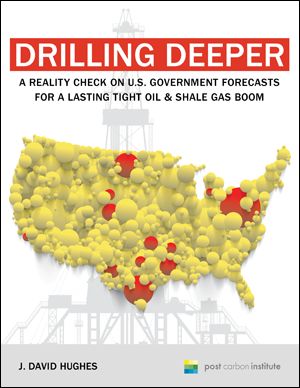 Energy analyst David Hughes discusses his field-by-field study of US shale oil/gas plays. The study finds that tight-oil production from major plays will peak before 2020. Tight oil production from the two top plays, the Bakken and Eagle Ford, will underperform the EIA’s reference case oil recovery by 28% from 2013 to 2040, and more of this production will be front-loaded than the EIA estimates. By 2040, production rates from the Bakken and Eagle Ford will likely be less than a tenth of that projected by the EIA. The overall tight-oil production forecasts by the EIA from plays other than the Bakken and Eagle Ford are in most cases highly optimistic and unlikely to be realized. Hughes observes that on the oil fields, in the battle between technology and geology, geology always wins in the end.
Go to page |
Download/listen
47:23
Original Show Pub Date: 13.Dec.2014
CATEGORY: RESILIENCE, NUCLEAR — 03.JAN.2015
Fairewinds Energy Education
Solar EMP—Beautiful Skies with Devastating Repercussions —
Sometimes the most beautiful natural phenomena can have devastating consequences. When the sun ejects hot charged particles into space, the Northern Lights are created here on Earth. Occasionally, the sun erupts with such huge quantities of particles—a coronoal mass ejection—that electronics and electrical grids can be damaged. Mat Stein and Arnie Gundersen discuss the dangers to our electrical systems and nuclear power plants worldwide from a large coronal mass ejection.
Watch |
Download/listen
30:50
Original Show Pub Date: 11.Sep.2014
CATEGORY: COLLAPSE, RESILIENCE — 31.DEC.2014
Radio EcoShock
The Pitfalls of Getting Resilient —
 This report features Jan Steinman, who cashed out from his IT gig to start a resilient eco-village as a response to a post-peak oil future and civilizational breakdown. Steinman appears to have pursued the project with a great deal of intelligence and personal energy, yet he's had a hard time finding people with a similar level of commitment. He observes, "Things just aren't bad enough yet." ~~ Also featured is "The Rap Guide to Wilderness" by Baba Brinkman.
Go to page |
Download/listen
1:00:00
Original Show Pub Date: 24.Dec.2014 ~~ Original story title: We Can't All Go Back to the Land (Or We'll Kill What's Left)
CATEGORY: FINANCIAL, EMPIRE, SUSTAINABILITY — 27.DEC.2014
KunstlerCast
John Michael Greer's 2014 Review —
John Michael Greer comments on how interlocking systems make specific technological tools far more useful—and in some cases, useable at all. He examines the fracking boom as a financial scheme (that will likely blow up big in 2015) and talks about how society is now experiencing the slow breakdown of infrastructure (such as roads) as governments experience chronic cash-flow problems. Greer predicts a continuing slow move towards a highly unequal, totalitarian society that comes to see science as part of the problem because it enables TPTB to control the impoverished populace.
Go to page |
Download/listen
44:32
Original Show Pub Date: 23.Dec.2014
CATEGORY: SUSTAINABILITY, EMPIRE — 23.DEC.2014
C-Realm Podcast
Pocket Utopias —
KMO and author J.P. Harpignies kick the tires on the value of utopian thought and ambition as well as the dangers. KMO and JP agree that the idea of Earth as just the cradle of humanity, a place from which we are meant to leave to establish an interstellar civilization, is a dangerous conceit. Topics include ... the implausibility of deep-space travel by humans; artificial intelligence and cybernetics to extend human lifespans as rather childish goals; eco-villages and "tweaked-up suburbia" as solutions to sustainability; finding the sweet spot between reclusive/epicurean hopelessness and productive activities in the face of overwhelming odds.
Go to page |
Download/listen
59:54
Original Show Pub Date: 17.Dec.2014
CATEGORY: FINANCIAL, ENERGY — 18.DEC.2014
KunstlerCast
Chris Martenson on Wall Street Games and Fracking Bombs —
 Chris Martenson guides us through the swamps of financial lingo so we might all develop a clearer notion of the jargon used in financial sectors of the chatter-sphere. Topics include credit default swaps, derivatives, margin calls, shorting and going long. Martenson also talks about the disinformation that comes out of the Fed; and he explains how the financialization of the fracking-based oil/gas industry could eventually cause a spark that lights off a financial wildfire.
Go to page |
Download/listen
46:33
Original Show Pub Date: 04.Dec.2014
CATEGORY: COLLAPSE, HEALTH — 05.DEC.2014
Off-the-Grid News
Could You Survive Without Modern Medicine? —
 If there were a natural disaster or a grid-down scenario in your area and a family member needed medical attention, would you know what to do? Dr. Joe Alton and his wife Amy Alton—better known as Dr. Bones and Nurse Amy—talk about which techniques we need to know and which supplies we need to keep in stock to stay healthy when help is not on the way. They are the authors of the Doom and Bloom Survival Medicine Handbook. Topics include how to get started in putting together a medical kit; whether you should concentrate on natural medicine, traditional medicine, or both; and why you can't trust what the government says when a pandemic hits.
Go to page |
Download/listen
29:56
Original Show Pub Date: 06.Nov.2014
CATEGORY: ENERGY — 04.DEC.2014
Uprising
Michael Klare on Cheap Oil and Geopolitics —
 With the price of a barrel of crude oil having fallen almost 40 percent compared to its peak in June, filling your gas tank has gotten cheaper. Analyst Michael Klare talks about the impact lower oil prices are having. Topics include the reasons for falling oil prices; the effect on oil producers like Iran, Venezuela, and Russia; the psychology of car buying; boosts to American, Japanese and European economies; Keystone XL; wither peak oil?
Go to page |
Download/listen
13:18
Original Show Pub Date: 03.Dec.2014 ~~ Original story title: What Are Cheaper Oil Prices Really Costing Us?
CATEGORY: COLLAPSE — 15.NOV.2014
On The Media
Steeling Ourselves Against the End of the World —
 In 1859, a solar storm threw an electromagnetic pulse at Earth so strong, it fried the telegraph system. A whole lot more is on the line now. Rocky Rawlins of the Survivor Library talks about his efforts to make sure we are prepared for getting zapped back to a time before computers and an electric grid. ~~ There are many civilization killing events that can happen other than an EMP. A killer asteroid, for instance. The Last Policeman trilogy imagines what we would all do if we knew the world would end in six months. Author Ben Winters explains.
Go to page A |
Download/listen A
7:32
Go to page B |
Download/listen B
11:49
Original Show Pub Date: 14.Nov.2014 ~~ Original Story Titles: Survivor Library, A Trilogy About the End of the World
CATEGORY: ENERGY, PEAK OIL — 14.NOV.2014
C-Realm Podcast
Economists on Oil—Hubris and Substitution —
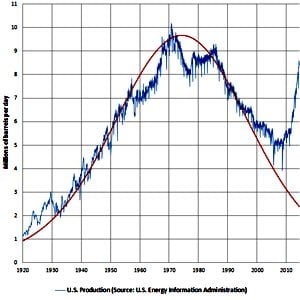 Richard Heinberg offers a good refresher on the basics of peak oil in light of recent trends in petroleum production, particularly the boom in the US. He also discusses the delusions that economists engage in when it comes to matters that are more governed by physics than finance, such as energy and the climate. In particular, he responds to Paul Krugman's recent piece on "climate despair," which claimed that anti-environmentalist right-wingers and anti-capitalist environmentalists are both wrong to think that the world can't have economic growth without increasing greenhouse gas emissions. Heinberg says Krugman either misunderstands or misrepresents the very reports that he cited to support his argument.
Go to page |
Download/listen
1:00:00
Original Show Pub Date: 22.Oct.2014
CATEGORY: ENERGY, ENVIRONMENT — 11.NOV.2014
Radio Ecoshock
A Path to Sustainable Energy by 2030 —
 Super-scientist Mark Jacobson from Stanford explains the warming/cooling nuances of soot pollution in the atmosphere. Then he reviews the math on how available technologies can have the world well on the way to running on clean energy by 2030.
Go to page |
Download/listen
20:00
Original Show Pub Date: 05.Nov.2014
CATEGORY: ENERGY, RESILIENCE — 06.NOV.2014
Sierra Club Radio
Off the Grid—And Loving It —
Nick Rosen discovered the benefits of living "off the grid" almost by accident. He has since become an advocate for distributed energy and self-sufficiency—and all the other benefits (both personal and ecological) of living without central utility services.
Go to page |
Download/listen
12:10
Original Show Pub Date: 18.Oct.2014
CATEGORY: SUSTAINABILITY, EMPIRE — 06.NOV.2014
C-Realm Podcast
The Great Grab —
 KMO recently attended the "Techno-Utopianism and the Fate of the Earth" teach-in, where he met and recorded conversations with Anuradha Mittal of the Oakland Institute and Helena Norberg-Hodge of Local Futures/International Society for Ecology and Culture. Mittal explains how agricultural corporations are pulling off an enormous land-grab in Africa and Asia, with the support of the World Bank, and all the time fallaciously portraying their actions in terms sustainable practices and local wealth enhancement. Norberg-Hodge takes on the idea that humans are so selfish and short-sighted that they deserve to go extinct. This attitude plays into the hands of transnational corporations, who are more than happy to see the blame for climate change, inequality, and injustice fall on individual actors and not to the policies that create a marketplace that favors short-term profits over long-term responsibility.
Go to page |
Download/listen
59:54
Original Show Pub Date: 29.Oct.2014
CATEGORY: SUSTAINABILITY — 02.NOV.2014
ExtraEnvironmentalist
Degrowth, You, and Your Id —
The degrowth movement advocates sustainability via adoption of strategies like voluntary simplicity and convivial activities and through creation of an economic system that is compatible with the biosphere. Here, Hartmut Rosa offers his ideas for subverting the motivations in our own lives which replicate the logic of unsustainable growth.
Go to page |
Download/listen
1:09:26
Original Show Pub Date: 28.Sep.2014 ~~ Original title: Degrowth 2014 // Part A
CATEGORY: ENERGY — 25.OCT.2014
C-Realm Podcast
Energy Peak—Just a Matter of Time —
KMO and Robert J. Fairchild (a.k.a. Solar Bob) discuss the dramatic increase in oil extraction from hydraulic fracturing, its effects on the US and global economies, and what it really represents in terms of net energy. They make extensive reference to an article by Grant Smith, "US Seen as Biggest Oil Producer After Overtaking Saudi Arabia," which asserts that the United States will remain the world’s top producer of fossil fuels until 2030. That seems unlikely, given the high depletion rates of fracking wells, but time will tell. One thing is for sure: there are limits, and they will be reached.
Go to page |
Download/listen
59:54
Original Show Pub Date: 15.Oct.2014
CATEGORY: ENERGY, ENVIRONMENT (POLLUTION) — 20.OCT.2014
Living on Earth
Companies Pulling Out of Canadian Tar Sands Oil —
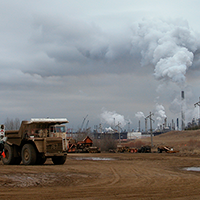 With crude prices sharply down and the future of the Keystone XL pipeline in doubt, energy companies have become dubious about investing in oil projects based in the Alberta Tar Sands. OnEarth writer Brian Palmer discusses the problems facing the industry.
Go to page |
Download/listen
8:35
Original Show Pub Date: 17.Oct.2014
CATEGORY: COLLAPSE, ENVIRONMENT (CLIMATE) — 20.OCT.2014
C-Realm Podcast
No Matter What —
KMO talks to Global Catastrophic Risk Institute researcher David Denkenberger about the technical feasibility of feeding everyone on earth in the aftermath of a calamity the wipes out conventional agriculture. The potential collapse scenarios include nuclear winter based on nuclear war or a massive volcanic eruption; a plague (natural or manmade); a catastrophic mistake in a high-impact technology; or even artificial intelligence taking over. Denkenberger is careful to distinguish technical feasibility from political or economic feasibility. Then KMO shares some thoughts on the incompatibility of capitalism and environmental stewardship from the Socialist Equality Party and with a brief clip from a conversation between Laura Flanders and Gar Alperovitz. He closes with some unconventional thoughts on technology from sci-fi author Karl Shroeder.
Go to page |
Download/listen
59:55
Original Show Pub Date: 08.Oct 2014
CATEGORY: NUCLEAR, ENERGY — 14.OCT.2014
Green Power And Wellness
Nuclear—Still Not Ready to Just Die Already —
Harvey Wasserman and guests talk about some of the latest nuclear issues, including... A study shows a 37% increase in childhood leukemia for families living near nuclear power plants. The US nuclear and fossil-fuel power industries are running a propaganda campaign to subvert progress on renewables and grab more taxpayer subsidies to help with costs on outmoded nuclear power plants. Nuclear is not a greenhouse gas solution if the fuel cycle and nuclear-plant life cycle are considered. Thorium reactors are not "inherently safe." Renewable portfolio standards are starting to have a positive impact.
Download/listen
58:17
Original Show Pub Date: 30.Sep.2014
CATEGORY: ENERGY, ENVIRONMENT (POLLUTION, CLIMATE) — 14.OCT.2014
Living on Earth
 China Still Burning Plenty of Coal as Fracking Ramps Up —
Among China’s energy efficiency initiatives is a program that replaces outdated coal-fired power plants with more modern—but larger—coal-fired plants. This has led to an overall increase in CO2 emissions as more coal is burned. ~~ Partly in response to the unprecedented air pollution crisis caused largely by burning coal, China is looking to its massive natural gas reserves for energy. But Mother Jones reporter James West says that fracking is bringing its own environmental problems to China.
China Still Burning Plenty of Coal as Fracking Ramps Up —
Among China’s energy efficiency initiatives is a program that replaces outdated coal-fired power plants with more modern—but larger—coal-fired plants. This has led to an overall increase in CO2 emissions as more coal is burned. ~~ Partly in response to the unprecedented air pollution crisis caused largely by burning coal, China is looking to its massive natural gas reserves for energy. But Mother Jones reporter James West says that fracking is bringing its own environmental problems to China.
Go to page A |
Download/listen A
5:00
Go to page B |
Download/listen B
10:30
Original Show Pub Date: 10.Oct.2014 ~~ Original story titles: China's Energy Efficiency Program Still Promotes Global Warming ~~ China's Great Frack Forward
CATEGORY: ENERGY, COLLAPSE — 13.OCT.2014
Post Carbon Inst / KCPW The Rundown
Heinberg: The Growth Model is Failing —
Richard Heinberg says that the growth model is failing because of (1) failure of energy supplies to keep up with demand; (2) inability of consumers and businesses to accept more debt; (3) worsening environmental impacts related to energy extraction and industrial activity. There won't be any momentous collapse, but the trend towards contraction, stagnation, and depression will continue until change is forced upon us. Heinberg advises adoption of the Transition Town model.
Go to page |
Download/listen
25:00
Original Show Pub Date: 26.Sep.2014
CATEGORY: PEAK OIL, COLLAPSE — 29.SEP.2014
Radio EcoShock
Taking Odds on Global Collapse —
 If you are wondering how long this high-consumption civilization can keep going, you are not alone. It's not just counter-culture types either. A small parade of billionaires have recently appeared on the financial blog Zero Hedge, predicting a shattering financial crash. But seldom do we find academics asking whether global collapse is imminent. A new research paper by Graham M. Turner takes another stab at the "Limits to Growth" angle and, as with the original paper by that name, concludes that the current civilizational trajectory will indeed fail, and that energy constraints will be the main reason.
Go to page |
Download/listen
20:00
Original Show Pub Date: 24.Sep.2014
CATEGORY: ENERGY — 23.SEP.2014
The Keiser Report
From Fracking Utopia to Cold, Hungry, and in the Dark —
 Max Keiser and Stacy Herbert discuss the increasing desperation in people's actions to acquire resources, from rich desert dwellers buying water to keep their plants green in a drought, to the natural gas industry running fracking wells at a loss. However, despite the obvious evidence of our unsustainable path, it appears very few are willing to leave behind all that they believe. ~~ In the second half, Max interviews Bill Powers, author of Cold, Hungry and in the Dark: Exploding the Natural Gas Supply Myth. Powers talks about some of the troublesome fundamentals in the natural gas industry and explains how cheap-money policies are fueling the boom, not an abundance of the resource. He says all the elements are there for a repeat of a 1970s-style energy crisis.
Watch |
Download/listen
25:45
Original Show Pub Date: 20.Sep.2014
CATEGORY: COLLAPSE — 11.SEP.2014
Agroinnovations Podcast
Living Life as Collapse Proceeds —
Host Frank Aragona and KMO of the C-Realm Podcast discuss a variety of issues, including.... collapse and one's personal posture towards it; the politics of poverty; the dominance of profit over service in corporate culture; permaculture as an outlet that deflates pushback.
Go to page |
Download/listen
50:02
Original Show Pub Date: 02.Sep.2014, Original story title: The Peter Principle
CATEGORY: FINANCIAL, COLLAPSE — 09.SEP.2014
KunstlerCast
Survive the Coming Economic Collapse —
JHK and Piero SanGiorgio, author of Survive the Coming Economic Collapse, discuss how factors like financial chicanery, peak oil, and discontented populations will lead us into an era of economic collapse. Solutions for protecting oneself are explored.
Go to page |
Download/listen
45:45
Original Show Pub Date: 03.Sep.2014
CATEGORY: EMPIRE, FINANCIAL, COLLAPSE — 05.SEP.2014
ExtraEnvironmentalist
Falling Empires —
 John Michael Greer offers a superb summary of the US as an empire, covering important topics such as .... the US as the first empire that does not call itself one; empire as a means of extracting wealth from outside the empire and transferring it inside the empire; the role of energy in the development of the US empire; the doubletalk of empire; how empires transition to oligarchies and ultimately end; why a new constitutional convention as a path to reclaiming democracy might backfire. ~~ Then Chris Martenson talks about the financial system as the most likely sector to have an empire-threatening catastrophe.
Go to page |
Download/listen
2:06:35
Original Show Pub Date: 02.Sep.2014
CATEGORY: ENERGY, ENVIRONMENT (POLLUTION) — 03.SEP.2014
Sea Change Radio
Keeping An Eye On The Natural Gas Boom —
 Even the most casual followers of energy policy have become aware of the controversy surrounding the massive expansion of fracking in this country over the past decade. Successful attempts to lift the curtain on fracking, like Josh Fox’s 2010 documentary film Gasland, have spurred a grassroots movement to push back against an industry that would have us believe that fracking is clean and safe as well as the solution to US energy woes. Journalist Neela Banerjee discusses the battle for America’s health and well-being that is being fought on the parallel fronts of policy and PR.
Go to page |
Download/listen
30:00
Original Show Pub Date: 18.Aug.2014
CATEGORY: ENERGY — 21.AUG.2014
 NPR
NPR
Oklahoma Wind Power Companies Run Into Headwinds —
 Oklahoma is the nation's fourth-largest generator of wind energy. But wind developers in the northeast corner of the state, where the Tallgrass Prairie Preserve lies, are up against stiff opposition from an unlikely pair of allies: environmentalists and oil interests.
Go to page |
Download/listen
3:54
Original Show Pub Date: 18.Aug.2014
CATEGORY: ENERGY, ENVIRONMENT, FINANCIAL — 20.AUG.2014
Post Carbon Institute
Humans—Are We the Borg? ... Or Merely Delusional? —
 In an hour and a half, ecological economist Nate Hagens offers up a grand tour of how the human-dominated planet works, or more accurately, mis-works. It all comes down to bad programming—science shows that we humans are predisposed to making bad choices; or at least making choices that bolster short-term, selfish desires at the expense of long-term, altruistic interests. Energy, or an increasing lack thereof relative to our needs, is the hammer that will force us to recognize reality and make increasingly hard choices.
Watch |
Download/listen
1:30:00
Original Show Pub Date: 29.Jul.2014
CATEGORY: ELITES, COLLAPSE — 16.AUG.2014
Against the Grain
Exit Right—Visions of Super-Soveriegn Enclaves —
There are various visions for gated communities of elites who want to escape the restrictions and taxation of the nation-state---an existance outside of the sovereign territory of any country. Historian Raymond Craib talks about visions for various libertarian enclaves, from the failed attempt to build the Republic of Minerva on a coral reef in the South Pacific, to the Seasteading Institute's plan to construct a floating city off San Francisco.
Go to page |
Download/listen
54:00
Original Show Pub Date: 13.Aug.2014 (originally aired 24.Feb.2014)
CATEGORY: ENERGY, PEAK OIL — 07.AUG.2014
Conversations with Great Minds
Richard Heinberg on Peak Oil—Past, Present, and Future —
Energy anthropologist Richard Heinberg talks about energy as the most important driver in our economy, and oil as the most important of the various energy sources. Topics include the relevance of M. King Hubbert's predictions; conventional oil and tight oil; energy density for oil vs. batteries; why the future will necessarily have less available energy.
Watch |
Download/listen
25:40
Original Show Pub Date: 01.Aug.2014
CATEGORY: COLLAPSE — 06.AUG.2014
C-Realm Podcast
James Howard Kunstler on the Third "World Made By Hand" Novel —
 James Howard Kunstler discusses his novel A History of the Future, the third book in his "World Made by Hand" series. Post-collapse topics include attitude as a survive-and-thrive strategy; the lack of mortgages in the future; the possible roles of religion, race, and mercenaries; why the insane pursuit of pointless leisure will likely continue even when it's difficult; the reemergence of social classes as the norm.
Go to page |
Download/listen
59:54
Original Show Pub Date: 30.Jul.2014
CATEGORY: ENERGY, FINANCIAL, COLLAPSE — 05.AUG.2014
KunstlerCast
The Only Growth Industry Left: The Generation of Hallucinatory Wealth —
John Michael Greer discusses a variety of topics related to energy, economy, and collapse, including slow collapse rather than "big, flashy collapse"; people who are chronically unemployed or have been otherwise economically marginalized are already in collapse; just as in the waning years of the Soviet empire, the US mainstream (state) media is full of reports that all is normal and going well; the major profit center of the shale-oil industry is not energy but rather scammy financial instruments. Greer sees the US empire as being in decline in terms of hegemony, with its global competitors getting increasingly bold at undermining the dollar as the global reserve currency. When this gets underway in full, it will result in global military conflict and, ultimately, a drastic decline in the US standard of living.
Go to page |
Download/listen
54:35
Original Show Pub Date: 31.Jul.2014
CATEGORY: ENERGY, ENVIRONMENT — 21.JUL.2014
The Keiser Report
Fracking—Economic Insolvency, Environmental Insanity —
Tina Rothery discusses the government's propagandistic stance on the 'inevitability' of fracking, the environmental damage the process causes, the poor economics for almost all fracking undertakings, how the moneychangers are propelling the technology forward despite the bad economics for most participants, and how fracking companies are now using paid squatters on fracking sites to prevent anti-fracking activists from doing the same and disrupting operations.
Watch |
Download/listen
13:23
Original Show Pub Date: 12.Jul.2014
CATEGORY: ENERGY — 15.JUL.2014
Living on Earth
Feds Dis Lake Erie Wind Project But Fund Cape Wind —
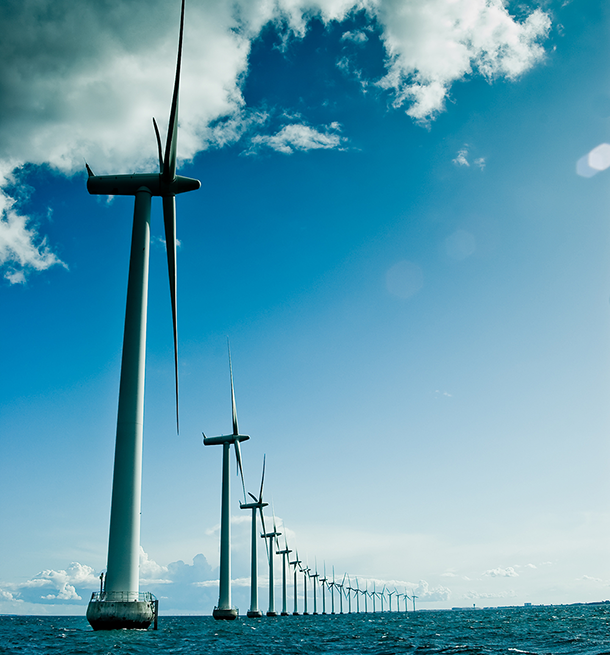 (A) Wind turbines in the Great Lakes could provide a large amount of renewable energy, but NIMBY opposition and failure to obtain federal grants have put an off-shore wind project on Lake Erie on hold. ~~ (B) The US Department of Energy has given the 130-turbine Cape Wind project a $150 million loan guarantee. Ken Kimmell of the Union of Concerned Scientists says that this vote of confidence will help make Cape Wind the first commercial offshore wind turbine farm in the United States.
Go to page A |
Download/listen A
3:53
Go to page B |
Download/listen B
6:23
Original Show Pub Date: 11.Jul.2014
CATEGORY: SUSTAINABILITY, EMPIRE — 09.JUL.2014
C-Realm Podcast
The Functional Equivalent of a Conspiracy —
KMO and Kevin Carson, author of The Desktop Regulatory State: The Countervailing Power of Networks and Super-Empowered Individuals, have a conversation about radical monopolies, car culture, retrofitting the built environment to compensate for peak oil, and how government and corporations “conspire” to criminalize low-cost living. Kevin explains the problem with literal, simplistic conspiracy narratives.
Go to page |
Download/listen
1:00:00
Original Show Pub Date: 02.Jul.2014
CATEGORY: COLLAPSE — 07.JUN.2014
C-Realm Podcast
Timelines for Collapse—Be Careful What You Wish For —
 KMO and a roundtable of guests from the Age of Limits conference discuss various aspects of collapse. Topics include ... resource and time allocation strategies for fast collapse vs. slow collapse; the difficulty of assigning a timeframe or speed to likely collapse scenarios; the importance of not seeing collapse as a panacea for societal ills but rather as a mortal danger for the fossil-fuel-based life support system that currently sustains nearly everyone in the Western world. Even low-end activities like dumpster diving and shopping at secondhand stores are dependent on the wastefulness of the current mainstream economy.
Go to page |
Download/listen
:55
Original Show Pub Date: 04.Jun.2014
CATEGORY: COLLAPSE — 03.JUN.2014
C-Realm Podcast
C-Realm Book Club—Oryx and Crake —
 KMO is joined by four C-Realm listeners to discuss Margaret Atwood’s dark work of speculative fiction, Oryx and Crake. After a brief outline of the book's plot, KMO and guests consider whether the liberal arts have been degraded and devalued by corporate culture. In the near future of Atwood’s vision, science and technology reign supreme, and it is unfashionable to ask about consequences or ethical implications. Do you think that humans are part of nature or a plague upon the planet? If the latter, would you bother trying to design a successor species to replace us, or would it be better just to wipe the slate clean and leave it blank?
Go to page |
Download/listen
1:00:00
Original Show Pub Date: 21.May.2014
CATEGORY: PEAK OIL — 28.MAY.2014
Boom Bust (RT)
 Peak Oil—Supply, Demand, Price, and Economic Impact —
Richard Heinberg and James Hamilton discuss peak oil theory and reality. Heinberg argues that we have reached peak oil supply, which will have major economic consequences for our future prospects of economic growth. Hamilton adds that the balance of supply and demand at a new, higher price will impose a new economic paradigm.
Peak Oil—Supply, Demand, Price, and Economic Impact —
Richard Heinberg and James Hamilton discuss peak oil theory and reality. Heinberg argues that we have reached peak oil supply, which will have major economic consequences for our future prospects of economic growth. Hamilton adds that the balance of supply and demand at a new, higher price will impose a new economic paradigm.
Download/listen
28:01
Original Show Pub Date: 09.May.2014
CATEGORY: ENERGY — 27.MAY.2014
Sea Change Radio
Solar Strides —
The signs of solar power becoming a truly self-sustaining industry are manifold: Solar manufacturing costs fell by 70-80 percent from 2007 to 2012. At the same time, the efficiency rates of solar panels continued to improve. But this success has also led to pushback from many of our nation's utilities. Adam Browning of Vote Solar discusses some of the policies that have helped the solar explosion, how public utilities are reacting to the success of solar in very different ways, and what steps are being taken to start getting solar to the millions of Americans who are not homeowners.
Go to page |
Download/listen
30:00
Original Show Pub Date: 06.May.2014
CATEGORY: SUSTAINABILITY, ENVIRONMENT — 22.MAY.2014
ExtraEnvironmentalist
William Rees: Why Degrowth? —
 Ecological economist William Rees, author of the "ecological footprint" concept, talks about the numerous limits humans are smacking up against and that may prove to be our undoing. He explains the concept of "degrowth"—the idea that we would intentionally choose a to shrink economic activity to reverse unsustainable trends. From the 2014 De-Growth Vancouver Event, Part 1.
Watch |
Download/listen
35:43
Original Show Pub Date: 17.Apr.2014
CATEGORY: SUSTAINABILITY, CLIMATE — 22.MAY.2014
ExtraEnvironmentalist
Jennie Moore: How Degrowth Applies to Vancouver, Canada, and the World —
 Jennie Moore is the Director of Sustainable Development and Environmental Stewardship at the British Columbia Institute of Technology. She discusses opportunities for we caring humans to do better at reducing our ecological footprint, especially carbon, but also explains why such steps will never be enough in the context of an infinite growth economy. From the 2014 De-Growth Vancouver Event, Part 2.
Watch |
Download/listen
17:33
Original Show Pub Date: 17.Apr.2014
CATEGORY: SUSTAINABILITY — 20.MAY.2014
C-Realm Podcast
Recognizing Our Dark Mirror —
 As preparatory work for the 2014 Age of Limits conference, KMO speaks with Kelly Coyne and Erik Knuteson about their experience at the 2013 Age of Limits conference. Kelly thought that the overly specific predictions of near term human extinction from climate change said more about psyche of the presenter than about the state of the climate. Erik wasn't thrilled with what he called "Kumbaya moments," which came in the form of fabricated grief rituals. ~~ Later, John Michael Greer talks about doom biases and ways to use ritual to good effect in coming to terms with the long decent of industrial civilization.
Go to page |
Download/listen
59:54
Original Show Pub Date: 14.May.2014
CATEGORY: ENERGY, GLOBALIZATION — 19.MAY.2014
CounterSpin
White House Trade Policies Undermining Clean Energy Goals —
 Ben Lilliston of the Institute for Agriculture and Trade Policy explains why White House policies promoting energy efficiency and renewables may be good rhetoric, but the broader goals for sustainable energy and a clean environment are undermined by White House trade policies.
Go to page |
Download/listen
9:30
Original Show Pub Date: 16.May.2014
CATEGORY: PEAK OIL, COLLAPSE — 15.MAY.2014
KunstlerCast
Peak Oil, Exponential Math, and Fast Crash —
Alice Friedemann worked for 25 years as a systems architect and engineer before dropping out to write full time on a wide variety of contemporary scientific issues bearing on the fate of industrial civilization. Here she discusses the reasons she thinks society is headed for a fast crash based on peaking energy supplies, particularly oil. She cites the math associated with exponential growth—which is poorly understood by the general public—as a main reason we could go quickly from the status quo to an utterly different, collapsed civilization. The problems ahead will include lawlessness, crazy dictators, decaying concrete, roads that become less and less usable, nuclear containment vessels that no longer contain, and scarce food supplies.
Go to page |
Download/listen
1:00:00
Original Show Pub Date: 13.May.2014
CATEGORY: COLLAPSE — 10.MAY.2014
Radio EcoShock
Richard Heinberg: Waiting for the Crash —
Richard Heinberg speculates on why the zombie economy is still walking about, despite its rotten parts. Topics include .... how the fracking boom in the US has delayed the arrival of economy-killing energy prices (but it can't keep that up much longer); the energy ramifications of the US-Russia wrangling over Ukraine; backyard gardening as a core part of the solution basket; the insanity of 'more road projects'.
Go to page |
Download/listen
31:00
Original Show Pub Date: 07.May.2014
CATEGORY: COLLAPSE — 28.APR.2014
KunstlerCast
KMO and JHK on Collapse—Or Not —
James Howard Kunstler and KMO of the C-Realm Podcast engage in a wide-ranging conversation, largely centering on the status of the collapse of industrial civilization—that is, that it hasn't happened yet—and how KMO, as a veteran collapsitarian, has adjusted his thinking and his life accordingly.
Go to page |
Download/listen
54:50
Original Show Pub Date: 24.Apr.2014
CATEGORY: ENERGY, NUCLEAR — 25.APR.2014
Green Power And Wellness
Energy Economics—Nuclear Failing, Solar Ascending —
 Michael Mariotte of the Nuclear Information and Resource Service explains why economics are driving the collapse of the nuclear power industry in Europe, the US, and Japan. No corporation will build a new nuke plant without subsidies. That's because they know the economics of nuclear energy are horrible. At the same time, we are witnessing an astonishing rise of solar energy due to ever-decreasing panel prices. Mariotte points out that it's now cheaper in many parts of the US to add solar to your rooftop than to connect to the grid.
Download/listen
55:33
Original Show Pub Date: 22.Apr.2014
CATEGORY: ENERGY — 23.APR.2014
Living on Earth
Hydropower Overload In China —
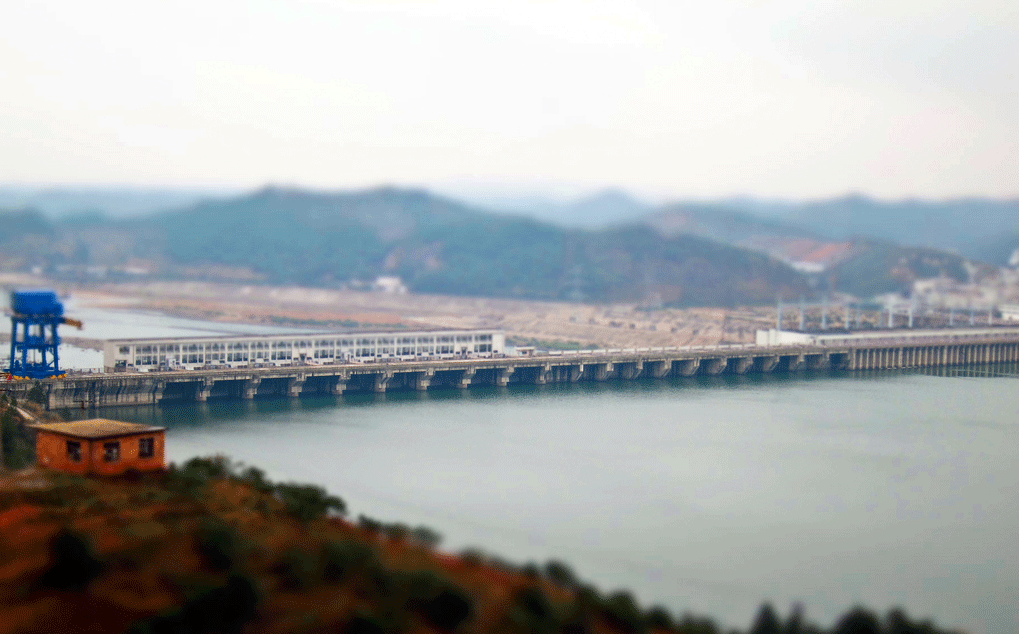 For the past 65 years, China has built nearly two dams per day, and wants to expand its hydroelectric capacity. Jennifer Turner, director of the China Environment Forum, explains how China's plan to ramp up dam installation in Yunnan Province raises the risks for this biodiversity hotspot in Southwest China, and how hydro power in China is often paired with coal power.
Go to page |
Download/listen
6:46
Original Show Pub Date: 11.Apr.2014
CATEGORY: EMPIRE, MEDIA, ENERGY — 21.APR.2014
C-Realm Podcast
Ilargi on Ukraine, Energy, China, Central Banks, and Media —
KMO welcomes Ilargi of The Automatic Earth to talk about the sorry state of watchdog journalism; the unhelpful rhetoric of American politicians and pundits around Vladimir Putin's actions with regard to Ukraine; the media's failure to examine the US role in bringing down the Yanakovish government or the role of energy politics in the region; and the fragility of the Chinese economy given its dependence on a shadow banking system which has provided it with a vital life-line of credit. Highlights include... Russians know Putin and their government are not perfect, but that doesn't mean they want the US to come in or to go back to the days of Yeltsin, who was a tool of Western predatory capitalists and Russian oligarchs. On the topic of media, they discuss the trend towards news stories being written by computer algorithms. KMO offers the insight that most mainstream media stories are written by people BEHAVING like algorithms. On the never-ending stimulus programs and central bank money printing, Ilargi says we're no longer spending our children's futures, we're spending our children's grandchildren's futures.
Go to page |
Download/listen
1:00:00
Original Show Pub Date: 16.Apr.2014
CATEGORY: ENERGY — 18.APR.2014
Living on Earth
Greening the Power of the Web —
If the internet were a country, it would be the sixth largest consumer of electricity in the world. Greenpeace analyst Gary Cook discusses his report detailing which tech companies are using renewable energy to power their servers, and which are still "dirty tech."
Go to page |
Download/listen
6:26
Original Show Pub Date: 11.Apr.2014
CATEGORY: EMPIRE, ENERGY, HISTORY — 15.APR.2014
Unwelcome Guests
The Supranational Deep State —
 Charlotte Dennett recounts how her research into the life of her deceased father, a high-level CIA agent, helped her understand how the world works. Studying information obtained using FOIA requests and interviewing people from her father's life, Dennett could see how oil fields and projected pipeline routes in the Middle East, North Africa, and Central Asia were the very locations that Western nations continually seem to find reasons to foster regime change, engage in military operations, and set up military bases. She concluded that access to energy is the dominant factor in why foreign powers incessantly exploit local religious, ethnic, and political rivalries to achieve the larger strategic goal of securing access to energy reserves.
Go to page |
Download/listen
59:36
Original Show Pub Date: 05.Apr.2014
CATEGORY: COLLAPSE, RESILIENCE — 14.APR.2014
C-Realm Podcast
The Ultimate Metric of Doom —
Sustainability prepper Orren Whiddon explains how the original Limits to Growth study put him on his life-long course of learning about energy/ecological limits and adapting his life to them—even if the modern world around him did not have much interest in joining him (at least not yet). Whiddon argues that the level of peak human population will be the ultimate metric of our civilization's undoing. In the meantime, sterile phrases like "peak population" mask the abyss of human suffering that will occur as we descend back to a sustainable level of people on the planet.
Go to page |
Download/listen
1:00:00
Original Show Pub Date: 09.Apr.2014
CATEGORY: ENERGY — 11.APR.2014
Post Carbon Institute
Drilling California —
Energy expert David Hughes and investment wonks discuss the prospects of developing California’s Monterey Shale. The potential oil reserves in the Monterey geologic region dwarf all other US shale reserves. But those who seek public support for tapping the resource are greatly overestimating the amount of oil that will be generated, exaggerating the economic benefits that will accrue to California, and downplaying the pollution associated with the oil extraction methods.
Watch |
Download/listen
50:49
Original Show Pub Date: 27.Mar.2014
CATEGORY: COLLAPSE — 09.APR.2014
Radio EcoShock
Is Our Highly Complex Society Ripe for Rapid Collapse? —
 There is a small band of pundits warning of civilizational collapse, and there are a growing number of people who suspect they are right. David Korowicz explains why certain events could cause our highly integrated, very complex modern world to become dysfunctional very quickly. He addresses examples like Ireland, which just went through an economic beating, as well as the UK fuel-depot blockade, which brought Britain to its knees in less than a week.
Go to page |
Download/listen
1:00:00
Original Show Pub Date: 02.Apr.2014
CATEGORY: ENERGY, PEAK OIL — 07.APR.2014
ExtraEnvironmentalist
Energy Slaves —
 Where past societies shackled human muscle with force and subjugation to create an energy surplus, beginning in the late 19th century we began using coal, then oil, then natural gas to create an unprecedented energy abundance. As the era of surplus energy comes to an end, how will our everyday reliance on energy slaves for mechanical and cognitive work change and adapt? Andrew Nikiforuk, author of The Energy of Slaves: Oil and the New Servitude, discusses ways of understanding our use and abuse of cheap energy. ~~ Also in this show, Chris Nelder talks about an energy-transition tipping point, clean energy in Germany, and the decline of the big oil players.
Go to page |
Download/listen
2:22:07
Original Show Pub Date: 31.Mar.2014
CATEGORY: ENERGY — 05.APR.2014
Uprising
"Big Men" Documentary Exposes the Colliding Worlds of Oil Men, Militants, and State-Owned Oil —
A new documentary chronicling the worlds of Texas oil executives, Nigerian government officials, and armed militants shows how competing interests over resources and power can warp whole nations. Rachel Boyton's documentary Big Men follows an American company called Kosmos as it wins a lucrative contract with Ghana’s government. With intimate access to the executives of Kosmos and the armed insurgents of Nigeria, Boyton exposes backroom wheeling and dealing in a way that is rarely seen on the big screen.
Go to page |
Download/listen
13:36
Original Show Pub Date: 28.Mar.2014
CATEGORY: ENERGY — 02.APR.2014
KunstlerCast
Chris Nelder on Energy —
JHK and Chris Nelder's topics include ... how tight oil and the declining global economy are affecting investment in petroleum infrastructure; the quiet movement towards more efficient use of energy; how price competitiveness and new political alliances are boosting renewables; how the political death-grip of the oil and gas industry in the United State depresses investment in alternative energy and transportation modes; how the suburbs may fare as energy prices demand demographic change.
Go to page |
Download/listen
49:04
Original Show Pub Date: 31.Mar.2014
CATEGORY: PEAK OIL — 01.APR.2014
The Lifeboat Hour
Peak Oil—Past, Present, and Future —
Richard Heinberg and Mike Ruppert, two veterans of the effort to alert the public to the problem of peak oil, review the last decade from that perspective. Were the peak oil prophets right? Will peak oil mean collapse, or burning the last, worst dirty fuels, or merely transitioning to alternative energies? Who have been the most influential players in the peak oil movement?
Download/listen
58:00
Original Show Pub Date: 30.Mar.2014
CATEGORY: COLLAPSE — 29.MAR.2014
C-Realm Podcast
Sci-Fi Dystopia and Distinguishing Collapse from Catastrophe —
 KMO welcomes Chad Hill, the author of the Hipcrime Vocab blog, to carry on the conversation about the future. It may seem a mere artistic choice that science fiction has transitioned to squallid depictions of dysfunctional futures and away from Utopian visions of people and societies liberated from drudgery and conflict by advanced technology and good governance. But many of these trends reflect the reality of our increasingly Orwellian techno-fascist society.
Go to page |
Download/listen
59:50
Original Show Pub Date: 26.Mar.2014
CATEGORY: ENERGY — 28.MAR.2014
Living on Earth
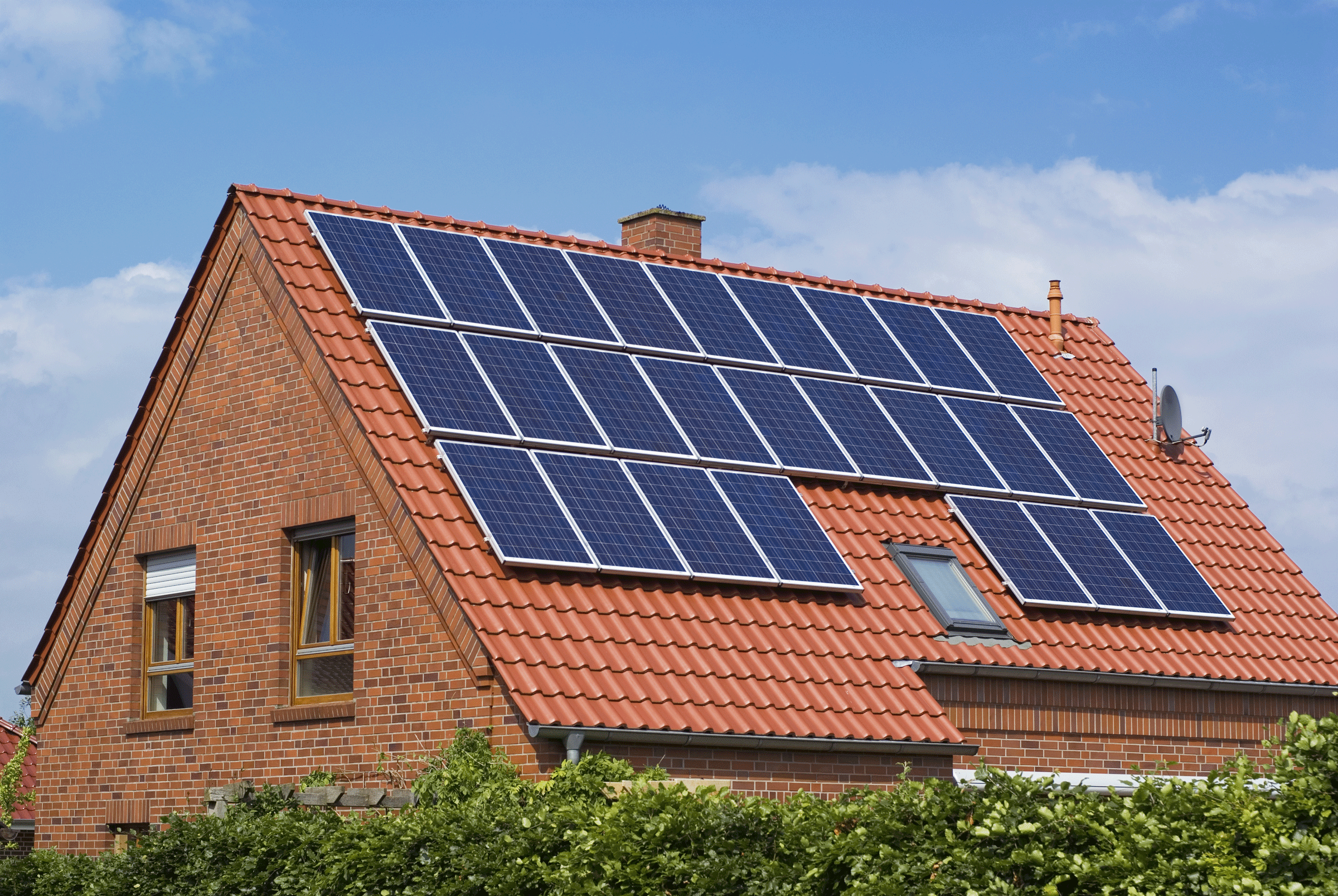 Electric Utilities Fight Home Solar and Net Metering —
Utility companies want to scale back a key incentive for homeowners to install solar panels—net metering, a policy that allows homeowners to sell or bank their excess solar power on sunny days. Bryan Miller of the Alliance for Clean Energy details utilities' attempts to reduce or do away with net metering.
Electric Utilities Fight Home Solar and Net Metering —
Utility companies want to scale back a key incentive for homeowners to install solar panels—net metering, a policy that allows homeowners to sell or bank their excess solar power on sunny days. Bryan Miller of the Alliance for Clean Energy details utilities' attempts to reduce or do away with net metering.
Go to page |
Download/listen
6:52
Original Show Pub Date: 21.Mar.2014
CATEGORY: COLLAPSE — 26.MAR.2014
C-Realm Podcast
NASA Study Explores Two Paths to Collapse —
KMO and Frank Aragona of the Agroinnovations podcast discuss a NASA-funded report that details how growing inequality and resource depletion both have the potential to bring about the fall of our globalized industrial civilization. Other topics include ... global warming trends; land grabs in Africa by powerful nations attempting to secure the ability to feed their populations; the photosynthetic ceiling; and human appropriation of net primary production.
Go to page |
Download/listen
1:00:00
Original Show Pub Date: 19.Mar.2014
CATEGORY: PEAK OIL — 17.MAR.2014
Peak Prosperity
Heinberg: The "Oil Revolution" Story Is Dead Wrong —
With the US fracking boom and media headlines touting our destiny as the new "Saudi America", many pundits have been quick to pronounce Peak Oil dead. Even Richard Heinberg began wondering whether he had gotten it wrong when he wrote The Party's Over more than a decade ago, so he went back and reexamined the data and predictions in that book. The good news—and the bad news—is that the predictions were startlingly accurate, and we are right on schedule for energy descent.
Go to page |
Download/listen
49:42
Original Show Pub Date: 08.Mar.2014
CATEGORY: RESILIENCE — 15.MAR.2014
Beyond 50
When Disaster Strikes—Extreme Cold & Solar Storms —
Mat Stein shares his tips for emergency planning. He talks about two extremes: crisis survival in extreme snow and ice conditions during the winter when technology fails and a solar storm that will take down the electrical grid. Stein says the chance of super solar storm is 100%; the only question is when. Such a disaster would also cause meltdowns in most of America's 104 nuclear reactors, since the cooling water there is kept moving by electric pumps. Stein says compared to many things society spends money on, it's not that expensive to harden the grid, and it's stupefying that we haven't done so. But given that we haven't, what should an individual do to prepare?
Go to page |
Download/listen
41:15
Original Show Pub Date: 07.Mar.2014
CATEGORY: COLLAPSE, EMPIRE — 12.MAR.2014
The Lifeboat Hour
The Horror and Beauty of Collapse —
Mike Ruppert reads part of James Howard Kunstler's worthwhile essay, Are You Crazy To Continue Believing In Collapse?, which explains the factors that have allowed the elites to keep their Ponzi scheme going a lot longer than many predicted they could. Ruppert cautions us not to get too wrapped up in the machinations of the TPTB (like Dem-GOP politics, proxy wars, etc.)—constant engagement in negativity cannot be part of a positive outcome. He also talks about some of the dire climate predictions of Paul Beckwith. Finally, he reminds us of Terrence McKenna's comment that a human birth is a beautiful thing but, in its way, also a horrific experience. Similarly, as the horror of collapse unfolds, we must remember to see the beauty in the rebirth of humanity.
Download/listen
58:00
Original Show Pub Date: 09.Mar.2014
CATEGORY: ENERGY — 11.MAR.2014
Sierra Club Radio
Mosaic—Direct Investment in Clean Energy —
 Mosaic is an investment company that links small- and medium-capital investors with solar energy projects in the US. Company founder Billy Parrish explains how it works, discusses current successes, and talks about the vision for 100% clean energy in the United States.
Go to page |
Download/listen
12:45
Original Show Pub Date: 01.Mar.2014
CATEGORY: ENERGY — 03.MAR.2014
Sea Change Radio
Renewed Energy for Renewables —
Can the winds of Wyoming power an air conditioner in Southern California? It may be happening soon! Wind energy consultant Shalini Ramanathan gives us a peek into new advances in the wind industry. Then, Michael Kyes, the mayor of Sebastopol, California, discusses his town's controversial-yet-effective solar power ordinances, which are helping get Sebastopol off of fossil fuels and making them a trailblazer in the shift to sustainability.
Go to page |
Download/listen
30:00
Original Show Pub Date: 18.Feb.2014
CATEGORY: ENERGY — 21.FEB.2014
Progressive Commentary Hour
Energy is What We Have to Spend; Money Just Represents Who Controls the Energy —
Energy mavens Kurt Cobb and Nate Hagens update us on the energy predicament. Cobb observes that the average daily price of oil has stayed near the all-time high over the last three years, and he explains the math on why the US will never be energy independent. Hagens reviews the incredible numbers on how many "slave equivalents" are found in a barrel of oil, reminding us how dependent we are on energy and how relatively cheap it actually still is. He offers a number of maxims that are critical for everyone to understand: (1) Energy is what we have to spend; money is who controls the energy. (2) The economy is a subset of the environment, not vice versa. (3) Biology determines what we need; culture determines what we have and how we get it.
Download/listen
57:08
Original Show Pub Date: 10.Feb.2014
CATEGORY: RESILIENCE, FINANCIAL — 18.FEB.2014
Peak Prosperity
FerFal: Here's What It Looks Like When Your Country's Economy Collapses —
Want to know what it's like living through a currency collapse? Argentina is providing us with a real-time window: The country has defaulted on its sovereign debt three times in the past 32 years and looks poised to do so again soon. Fernando "FerFal" Aguirre began blogging during the hyperinflationary destruction of Argentina's economy in 2001 and has since dedicated himself to educating the public on issues related to resilience. He sees many parallels between the path that led to Argentina's decline and the similar paths most countries in the West, including the US, are currently on.
Go to page |
Download/listen
36:41
Original Show Pub Date: 08.Feb.2014
CATEGORY: COLLAPSE, EMPIRE — 14.FEB.2014
Vice
Apocalypse, Man—World's End According to Michael C. Ruppert —
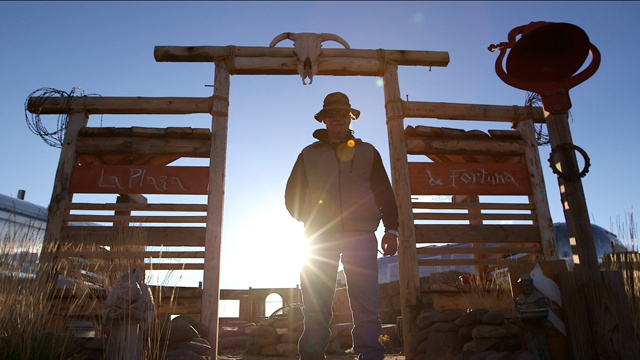 Michael Ruppert says we have a choice to make: approach living with a new state of consciousness, or descend into a dog-eat-dog scenario of endless war and grasping for depleting resources. This clip is from a new, half-completed film called Apocalypse, Man, which updates the stark assessment of the world Ruppert offered in 2009's Collapse. Topics include dirty energy technologies as exemplars of pre-collapse insanity; the militarization of local police departments as an early step on the path to centralized totalitarian control; why the public rejection of the US intention in Syria is a hopeful sign; and how Native American philosophy can inform "what we do next."
Watch |
Download/listen
32:43
Original Show Pub Date: 21.Jan.2014
CATEGORY: ENERGY — 12.FEB.2014
Sierra Club Radio
US Wind Energy Update —
Rob Gramlich of the American Wind Energy Association updates us on the latest in wind power, including increases in generation capacity, data on reliability, and the production tax credit.
Go to page |
Download/listen
14:15
Original Show Pub Date: 08.Feb.2014
CATEGORY: FINANCIAL, RESILIENCE — 11.FEB.2014
Post Carbon Institute / PBS News Hour
Why a Conservative Economist Moved to the Country —
Chris Martenson explains why he left a lucrative career (and all the perks that go with it) to move his family to the country and a simpler, more sustainable way of living. Regarding the money-system shenanigans of the Fed, he reminds us of the old maxim, anything that can't go on forever, won't. Add to that his concerns over energy and resource constraints, you have a recipe for waking up to the realization that major change is coming.
Watch |
Download/listen
8:30
Original Show Pub Date: 16.Jan.2014
CATEGORY: CLIMATE, PEAK OIL, RESILIENCE — 10.FEB.2014
Radio EcoShock
Crash on Demand —
 Do we need to break the insane, rapacious financial system to save the climate? Permaculture co-founder David Holmgren says "yes." Nicole Foss counters that the system is going to crash anyway, so why set yourself up as the fall-guy or get stuck in the quagmire of climate-denier politics? We should focus on the peak-oil/resilience message. If people get onboard with that, action on climate issue will happen as a natural side-effect.
Go to page |
Download/listen
1:00:00
Original Show Pub Date: 05.Feb.2014
CATEGORY: ENERGY — 08.FEB.2014
NPR
Much Of North Dakota's Natural Gas Is Going Up In Flames —
 Natural gas is often a useful byproduct oil wells. In North Dakota, though, the infrastructure to move the natgas to where it can be profitably used does not yet exist, so the gas is being flared (burned off). Why can't this gas be put to use, some way, somehow?
Go to page |
Download/listen
4:34
Original Show Pub Date: 30.Jan.2014
CATEGORY: ENERGY — 05.FEB.2014
Living On Earth
Not Enough Rare Earths to Ramp Up Alternative Energy? —
Renewable energy technologies like wind and solar are on the rise around the world, but they depend on a group of metals called rare earths, which are in short supply. Science writer Nicola Jones talks about the scarcity of rare earths and how it could inhibit green energy expansion.
Go to page |
Download/listen
6:40
Original Show Pub Date: 24.Jan.2014
CATEGORY: COLLAPSE, ENERGY, RESILIENCE — 04.FEB.2014
Radio EcoShock
What Kind of Doomer Are You? —
 Albert Bates discusses his chart that attempts to categorize the various responses to potential collapse. On the ultra-doomy end are the collapsniks, who see it all falling down one way or the other, due to financial fiascos or peak energy or catastrophic climate collapse, with the only realistic response at this point being to get ready for the storm. Then there are the techno-fixers who think all can be made well by adopting green tech and avoiding brown tech. A more realistic offshoot of that group are those who see that radical lifestyle change would have to accompany any technological approach to sustainability. He also bins some well known names into their place in doomerdom.
Go to page |
Download/listen
25:00
Original Show Pub Date: 29.Jan.2014
CATEGORY: ENERGY — 30.JAN.2014
Resistance Radio Hour
Charles Hall on Net Energy —
Charles Hall is a systems ecologist with strong interests in biophysical economics and the relation of energy to the structure and functioning of society. Hall explains how energy return on investment (EROI) is a key limiting factor for all living things, from bacteria up to humans. Any living being or living society can survive only so long as they get more net energy from their activities than they expend during the performance of those activities. Hall discusses natural gas reserves and fracking, Marion King Hubbard's work, and a variety of other energy issues.
Download/listen
46:58
Original Show Pub Date: 19.Jan.2014
CATEGORY: ENERGY, ENVIRONMENT — 29.JAN.2014
Living On Earth
Explosive Oil Trains —
The past year has seen a marked increase in oil train derailments and explosions, including the deadly accident in Lac-Megantic in Quebec that killed 47 people. These events have raised questions about oil transport in North America. Canadian journalist Jacquie McNish discusses.
Go to page |
Download/listen
15:06
Original Show Pub Date: 24.Jan.2014
CATEGORY: RESILIENCE — 27.JAN.2014
11:11 with Simran Singh
Common Sense in Disaster Preparedness —
Brian and Pamela Crissey discuss preparedness prioritization, water storage, food storage, medical supplies, having a safe/supplied area in your house, safe places in collapsing buildings, bug-out bags, cash on hand, prearranged rendezvous points, gas in car, carrying proof of identity, and involving your children in the process.
Go to page |
Download/listen
55:04
Original Show Pub Date: 16.Jan.2013
CATEGORY: ENERGY — 25.JAN.2014
Quirks & Quarks
Organic Flow Battery Avoids Pricey Materials —
 Flow batteries feature a design that is well suited for backing up intermittent renewable energy generators like solar and wind. They allow storage of electricity in liquids that can be stored separately from the power-conversion part of the battery, allowing larger amounts of energy to be stored than in a conventional solid battery. Flow batteries, however, have been handicapped by the fact that the energy storage system uses expensive metals. Michael Aziz explains how a new flow-battery chemistry based on inexpensive quinones shows great promise.
Go to page |
Download/listen
9:16
Original Show Pub Date: 18.Jan.2014
CATEGORY: MEDIA, FINANCIAL, ENERGY —
18.JAN.2014
Sea Change Radio
Correcting the Record on the Cleantech Crash —
If you watched the recent 60 Minutes piece on the so called "Cleantech Crash," you might have taken a moment to check the channel and make sure you weren't watching Fox News. The story focuses almost exclusively on failed companies that have received government support, giving no coverage to clean technology successes, no information on the success/failure ratio of other venture capital investments, and no mention of all the taxpayer money that goes to support traditional, polluting energy technologies. Joe Romm of Climate Progress and Katie Fehrenbacher, a senior writer at GigaOM, respond to the 60 Minutes hatchet job.
Go to page |
Download/Listen
29:45
Original Show Pub Date: 07.Jan.2014
ExtraEnvironmentalist
How Coal and Oil Shaped the 20th Century —
26 Nov 2013 —
The ideas we have about our government systems have been dramatically shaped by the energy sources that power them. Timothy Mitchell explains how coal and oil shaped 20th century politics and economics, playing key roles in war—and the reasons for war—as well as the evolution of monetary systems and the shift in power from Europe to the US. ~~ Also in this podcast, Richard Heinberg updates us on the shale oil bubble and the implications of peak oil.
Go to page |
Download/Listen
1:59:55
|
C-Realm Podcast
Carolyn Baker: Enlightenment, But First Endarkenment —
04 Dec 2013 —
Carolyn Baker returns to the C-Realm to discuss the themes of her new book, Collapsing Consciously. These include peak everything, the twin specters of climate chaos and Fukushima radiation, and the psychological dimension of collapse. Baker suggests that the demise of our consumerist, corporate culture is inevitable, and that it is crucial to prepare emotionally and spiritually for the certain changes to come.
Go to page |
Download/Listen
59:40
|
|
 ExtraEnvironmentalist
Preparing for Hard Times —
10 Dec 2013 —
Nicole Foss and Laurence Boomert discuss their tour across North America in which they engage with communities on the topic of preparing for hard times. They highlight community initiatives that can help people meet basic needs, even as monetary institutions pursue desperate measures. ~~ John Michael Greer answers a few listener questions, and he highlights the lack of whole-systems thinking in internet visionaries.
Go to page |
Download/Listen
1:47:11
Peak Prosperity
The Shale Oil Boom is More Mirage than Miracle —
07 Dec 2013 —
Gail Tverberg is a professional actuary who applies classic risk assessment procedures to global resources, studying issues such as oil and natural gas depletion, water shortages, and climate change. Some say the shale oil "revolution" in the US will usher in a new Golden Age of American oil independence. With her actuarial eyeshade firmly in place, Tverberg quickly begins discounting the underlying economics behind the shale model.
Go to page |
Download/Listen
38:07
Peak Prosperity
Water in the Era of Peak Everything —
16 Nov 2013 —
Similar to oil and other key natural resources that are mined and consumed, water is subject to the same limitations. Both surface supply and underground fossil stores of clean water are depleting at alarming rates, and the energy and economic costs of extraction are swiftly increasing. Water management expert Jack Keller comments on water in the era of Peak Everything.
Go to page |
Download/Listen
48:39
Radio EcoShock
The Economic Impacts of Peak Oil —
05 Nov 2013 —
Ecological economist Christian Kerschner discusses a recent joint American-European university study of peak oil. Topics include technology improvements vs. net energy; economic impacts; which industries are already in trouble with today's high oil prices; why specialty petroleum products have different price elasticity than energy products.
Go to page |
Download/Listen
14:11
Living On Earth
Generating Electricity with Community Solar —
08 Nov 2013 —
Not every home is suitable for solar panels, and not all homeowners can afford their own solar setup. Community solar is an approach that lets people pool resources and buy shares in a "solar farm" that is integrated with the local power grid.
Go to page |
Download/Listen
10:48
Living On Earth
Coal Plants Burning Wood —
08 Nov 2013 —
Carbon sequestration technology is still experimental, so coal burning power plants are looking for other ways to lower carbon emissions to meet proposed new EPA standards. David Nicholls of the US Forest Service explains how burning wood along with coal is a partial solution.
Go to page |
Download/Listen
5:15
|
C-Realm Podcast
With Apocalyptic Clarity —
30 Oct 2013 —
Robert Jensen explains what he means when he says that it's time to get apocalyptic. We need to engage with those who dismiss the problem of a resource-scarcity-driven apocalypse because they think a God-driven apocalypse is likely in our future. The conversation also delves into the need to sharpen our analysis in conversation with people who already share a good many of our values and goals, thus helping them sharpen their own arguments, creating a daisy chain of better rhetoric.
Go to page |
Download/Listen
59:08
|
|
The Lifeboat Hour
Orlov on the "6th Stage of Collapse" —
27 Oct 2013 —
Dmity Orlov discusses his new "6th stage of collapse"—environmental collapse. In particular, he sees catastrophic climate change and radiation from Fukushima to be the top threats—though there are plenty of others. He laments the futility of further annoying people with talk of collapse—they aren't listening, or at least not changing their behavior, so why keep annoying them? He also comments on Russia's geopolitical stance vs. the US.
Download/Listen
58:47
Post Carbon Institute
Energy Sustainability Dilemma—Powering the Future in a Finite World —
01 Nov 2013 —
David Hughes of the Post Carbon Institute presents a plethora of information on our energy predicament. Topics include easy energy; energy return on investment (EROI); tar sands and fracked shale gas; wind, solar, and other renewables; energy options as our society pushes for continued growth.
Watch |
Download/Listen
1:16:00
Living On Earth
G-20 Pledges to Eliminate Fossil Fuel Subsidies —
08 Nov 2013 —
A new report from the Overseas Development Institute finds more than $500 billion in direct subsidies go to fossil fuel industries world wide each year, despite pledges to phase them out. Public policy analyst Joe Aldy says that the amount is even higher if one counts indirect subsidies like externalized health and environmental costs.
Go to page |
Download/Listen
5:32
|
Peak Prosperity
Homesteading, Relocation, and Resilience —
28 Sep 2013 —
In the context of various possible disaster scenarios, well known prepper James Wesley Rawles discusses actions people should take to be ready for trouble. He also talks about prepping in place vs. trying to find a better location. For those thinking somewhere other than the US might be a good idea, Rawles has some cautionary words.
Go to page |
Download/Listen
37:31
|
|
Quirks & Quarks
Solar—Smaller ... and Greener? —
05 Oct 2013 —
Researchers have been exploring a new material for solar power. They've produced tiny nano-scale zinc-phosphide particles that seem to have good solar absorbing properties, but are potentially much cheaper and more energy efficient to make than traditional silicon solar cells.
Go to page |
Download/Listen
8:40
Living On Earth
Overwhelming the Grid with Renewable Energy? —
18 Oct 2013 —
In Germany, renewable energy is so popular that on one recent sunny day power generators produced more energy than the grid could handle. And instead of being paid for power, they had to pay to feed in their electricity. Harvard Professor Michael McElroy explains that similar problems are beginning to happen here in the US.
Go to page |
Download/Listen
7:26
Lifeboat Hour
Doomed by the False Promise of Alternative Energy —
13 Oct 2013 —
Thom Hartmann recently opined that we must transition to alternative energy with all effort and speed. Michael Ruppert blasts him for ignoring the two immediate threats to our future—Fukushima and tipping-point-based runaway climate change—which are only two of the reasons that Hartmann's plea is a false hope. The dangerous state of Fukushima is the world's dirtiest (non-) secret, and only the immediate cessation of industrial activity will solve the climate problem. And failing to address the infinite growth paradigm and the way money works ensures that no progress will be made on any front. Ignoring inconvenient facts and offering fanciful half measures dooms us.
Download/Listen
57:03
Radio Ecoshock
The Colorado Floods and Resilience —
25 Sep 2013 —
In the context of the unbelievable tropical-style rains that flooded Boulder, Colorado and points north, Boulder resident (and notable collapse commentator) Carolyn Baker talks about resilience lessons learned and long-term sustainability.
Go to page |
Download/Listen
1:00:00
KunstlerCast
Desperately Seeking Sustainability ... At the Farmers Market —
26 Sep 2013 —
It's harvest time. As the frost finds the pumpkins, JHK visits the farmers market in Cambridge, NY, and chats with farmers (and sundry other interesting people) about the role of local agriculture in stimulating community and the local economy.
Go to page |
Download/Listen
37:32
One Radio Network
NASA Solar Scientist on the Curious Behavior of the Sun —
13 Sep 2013 —
The sun is being very quiet—too quiet. Some think this means the sun is about to go whoop-ass on the earth, as it did in the Carrington Event of 1859. David H. Hathaway of NASA comments on this possibility and other solar issues. He also bats down a number of issues related to whether the climate is actually cooling rather than warming.
Go to page |
Download/Listen
59:12
KWMR Post Carbon
Exposing the Myths of Fracking —
11 Sep 2103 —
Richard Heinberg discusses the myth of US energy independence through fracking. He also addresses many interesting energy-related questions, including, "Which is better, coal or fracked natural gas?"
Go to page |
Download/Listen
48:37
|
C-Realm Podcast
The Brown Truck of Happiness —
18 Sep 2013—
John D. Adams talks about cultivating preparedness, both on the individual level and on the local community level. John uses the word prepper in a non-pejorative sense to refer to someone who affixes their own oxygen mask first before attempting to assist others, though ultimately he is strongly motivated towards fostering community cohesion and resilience. For now, the still-functioning (if faltering) economy continues to allow the brown trucks of happiness to deliver the bounty of industrial civilization to our doorsteps—which is a prepping opportunity.
Go to page |
Download/Listen
1:00:00
|
|
KunstlerCast
The Path to Sustainable Development vs. the Other Road to Serfdom —
12 Sep 2013 —
JHK and Eric Zency discuss the problems of an infinite growth economy, the relationship between energy and money, and the fate of the planet.
Go to page |
Download/Listen
44:54
KunstlerCast
City Planning—The Good, the Bad, and the Ugly —
15 Aug 2013 —
JHK talks with John Norquist, director of the Congress for the New Urbanism and four-term mayor of Milwaukee, Wisconsin, about the state of the American city, the future of the Great Lakes Region, and the difficulty of overcoming decades of bad choices regarding how we inhabit the landscape of our country.
Go to page |
Download/Listen
44:42
Green Front
Green Tea Coalition Makes Solar Happen in Georgia —
11 Sep 2013 —
Shane Owl-Greason, one of the founders of the Green Tea Coalition in Georgia, discusses how an unlikely alliance between Tea Party Patriots and solar-power loving environmentalists led to a major adoption of solar energy in Georgia. ~~ Also in the show, Center for Environmental Health spokesman Charles Margules dishes the dirt on the 100+ hair products that were discovered to contain carcinogens.
Download/Listen
54:58
Free Speech Radio News
DOE Approves Export Site in Maryland to Send Fracked Gas Abroad —
12 Sep 2013 —
Environmentalists and communities in Maryland are raising concerns after the US Department of Energy gave the okay for a private energy company to vastly expand a liquefied natural gas site on the Chesapeake Bay. DOE announced conditional authorization to allow the energy company Dominion to use the Cove Point Terminal to house and transport gas extracted through hydraulic fracturing to other countries.
Audio no longer available from host site (fsrn.org) 6:47
Unwelcome Guests
Community Successes—Restoring Our Connection To The Land —
24 Aug 2013—
"Community Successes" is a recent talk by Rob Hopkins, in which he recounts some of the transition movement's successes in the UK, showing how communities can organize activities that subvert the dominant power structure by avoiding it altogether, and at the same time fostering activities that are rewarding on a personal level and build local economies.
Go to page |
Download/Listen
1:00:00
C-Realm Podcast
Manifesting in Meat Space —
28 Aug 2013—
KMO offers an eloquent essay on the paradox of awareness, which is at once both empowering (because you know the truth) and disempowering (because you discover all solutions to be hopelessly inadequate). He gives a very nice overview of the metaphorical film Fight Club and then reviews the options for moving forward. He cautions against the allure of the "sexy solutions," from the unlikely possibility of a new revolution to the deus ex machina of a technology-killing solar strike. In the end, it will be straightforward, persistently applied efforts that will change things.
Go to page |
Download/Listen
55:22
C-Realm Podcast
Only Fashion Can Save Us From Collapse —
07 Aug 2013—
If a collapse is unfolding, it is certainly arriving at different rates in different places. Business is booming in NYC, with a constant influx of international cash, and another real estate bubble spinning up. But in the middle of the country, the collapse is easier to spot. KMO and Albert K. Bates discuss the merits of John Michael Greer's catabolic collapse theory and compare it to the Olduvai Gorge theory, which envisions industrial civilization as a transient pulse that will resolve itself in short order. Bates thinks resilience, ecological regeneration, and a steady-state economy will have to be seen as "cool"—that is, fashionable—before we can turn the corner towards sustainability.
Go to page |
Download/Listen
59:33
KunstlerCast
Heinberg on Energy Decline and the Great Shale Snooker —
08 Aug 2013—
Richard Heinberg reviews the energy predicament we find ourselves in and explains the evidence that says the US shale gas boom is already fizzling. More generally, James Howard Kunstler and Heinberg agree that the majority of leaders and citizens are waltzing down the road of denial, unwilling to have the adult conversation necessary to begin reforming the various aspects of civilization to ensure a workable future.
Go to page |
Download/Listen
38:01
|
C-Realm Podcast
Technology Won't Save Us, But... —
21 Aug 2013 —
Members of Transition Humboldt discuss peak oil, community resilience, and technology. They agree that the techno-triumphalism generally pervading the brains of the populace is misplaced, that does not mean technology necessarily can't be part of a the sustainability solution..
Go to page |
Download/Listen
1:06:36
|
|
KunstlerCast
David Orr on Local and Sustainable —
01 Aug 2013 —
Sustainability/localism guru talks about how to create practical projects that further local sustainability initiatives. He stresses the importance of getting all the right players bought in to your sustainability goals and projects. Tangentially, he warns against the darkening corp-gov axis that is fostering a descent into totalitarian fascism, saying the best solution is to withdraw financial support from that system by shifting your buying habits to local and non-corporate purveyors.
Go to page |
Download/Listen
38:18
NPR
Massive Solar Plant a Stepping Stone for Future Projects —
29 Jul 2013 —
The largest solar power plant of its kind is about to turn on in California's Mojave Desert and will power about 140,000 homes. The project had its challenges—including conflicts with the needs of endangered species. But California is trying to bring conservationists and energy companies together to create a smooth path for future projects.
Go to page |
Download/Listen
4:00
AD CLICKS AND AMAZON PURCHASES FROM HERE HELP SUPPORT THIS FREE SITE. THANKS!
Search Amazon.com ....
|