|
There are many issues on the minds of US voters these days, but according to national polls, the environment ranks ...um... just above hemp policy and just below humane treatment for shoe bombers and investment-banking executives.
People are, of course, justifiably concerned about top issues such as the stability of the financial system; the economy, jobs, and salary levels; health care; terrorism and military conflicts. So, why vote "green"—that is, why vote for candidates who consistently take pro-environment positions—when there are other seemingly more urgent issues to attend to? Here's why: Because the environment actually has a direct role to play in most of those areas, and "green" candidates tend to be "good" even on issues where there is no direct eco-connection. Below are some examples of how this is so.
"If you have your health, you have everything"—so goes the old cliché. We usually don't think too much about our health until we have a problem. Diseases usually creep in on us slowly. They're very patient, waiting until our defenses are down far enough for us to be susceptible.
The health of the environment—the quality of the air we breathe, the purity of the water we drink, the condition of the land on which we grow our food—are prime factors in the health of our bodies. We can protect the health of ourselves and our families by reducing pollution, by encouraging better farming practices that result in more nutritious agricultural products, and by getting the toxic chemicals out of our food and out of the household products we use every day.
|
Politicians are busy jousting about who has the better plan for improving health care, but they're mostly silent on the most basic health issue—keeping disease-causing pollutants and toxins out of the environment and out of us.
|
TAKE TWO VOTES AND
CALL ME IN THE MORNING |
|
It's also worth noting that politicians who score high on environmental issues also tend to push for better availability of health care for those of us in the lower half of the economic scale, and they oppose sweetheart deals for drug manufacturers and other giant health-care corporations.
|
|
What are the terrorist targets that have the most potential for causing problems? Here are three.
 Ports: We thoroughly inspect only a fraction of the more 6 million containers arriving in US coastal cities each year. Many security experts think it's just a matter of time before terrorists sneak a nuclear, chemical or biological device into one of them..
By supporting the concept of "buying local," our leaders could begin reducing the traffic in our ports and thus make the problem more manageable. This would also reduce the huge level of pollution associated with product transport. Instead, our leaders pursue ever-grander "free trade" schemes that only INCREASE port security problems.
|
You can indirectly promote better safety by voting for candidates that are critical of the World Trade Organization (WTO) and trade agreements like NAFTA and the Free Trade Area of the Americas (FTAA).
|
|
Chemical Plants and Other Facilities That Use Chemicals:
A terrorist strike at a facility that manufactures or uses toxic substances could release clouds of poisonous chemicals. And we're not only talking about heavy-duty chemical and industrial plants; many water-treatment facilities, for instance, still use toxic forms of chlorine for disinfection, even though safer alternatives are available.
Those who currently control our federal government have been far too passive in addressing problems with high-chemical-use industries. Find out where your candidates stand on security at chemical plants. If they offer a response like "the industry has it under control," run.
Nuclear Power Plants: Although most nuclear facilities are hardened against airplane strikes, many are vulnerable to direct terrorist takeover. Because there are only 103 nuclear power plants in the US and because they do get a fair degree of attention when it comes to security, this is probably the least likely of the three disaster scenarios presented here.
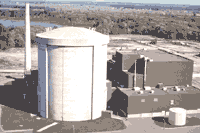
But it's still a possibility, and instead of trying to reduce the level of the vulnerability by diverting investment resources to development of wind, solar, wave, and other clean, safe forms of electricity generation, some politicians are pushing hard to build MORE nuclear power plants—and they're planning to spend billions of your tax dollars doing it. (By the way, if electricity from nuclear power plants is so cheap (as the nuclear industry repeatedly tells us), why do they need such huge subsidies?)
Finally, more nuclear power means more nuclear waste. Radioactive waste is not only an insanely unforgivable legacy we leave for thousands of years of future generations, but if terrorists get a hold of any, they can use it to make "dirty bombs." Egad.
Mature industries do not typically create large numbers of new jobs. Industries based on oil, gas, and coal—the "business-as-usual industries" in the energy sector—are certainly not going to bolster our sagging job numbers, given that they're caught between the twin hammers of dwindling fossil-fuel supplies and the need to reduce air pollution and CO2 output.
But there is a good solution. According to analyses by The Apollo Alliance, embarking on an ambitious program to develop renewable energy will allow us to create three million new, high quality jobs, free ourselves from imported oil, and clean up the environment.
 A separate report by the Center for American Progress shows that the US can create 2 million jobs in just two years by investing in a "rapid green economic recovery program." An investment of $100 billion in green technologies and industries—a fraction of the amount the Feds have already thrown at the banking mess and the
US War for Oil
would create nearly four times more jobs than spending the same amount of money within the oil industry for things like offshore drilling. A "side benefit" would be a significant reduction in pollution and greenhouse gas emissions as greener, non-fossil fuel alternatives become more widely implemented.
A separate report by the Center for American Progress shows that the US can create 2 million jobs in just two years by investing in a "rapid green economic recovery program." An investment of $100 billion in green technologies and industries—a fraction of the amount the Feds have already thrown at the banking mess and the
US War for Oil
would create nearly four times more jobs than spending the same amount of money within the oil industry for things like offshore drilling. A "side benefit" would be a significant reduction in pollution and greenhouse gas emissions as greener, non-fossil fuel alternatives become more widely implemented.
Ah, millions of new jobs and a cleaner environment. What's not to like? Plenty, if you're an elected official in the pocket of the dinosaur-energy industries that still receive massive subsidies and special treatment from the government. All them idjits have to go!
It's also worth pointing out that candidates who strongly support alternative energy technologies and would vote for tougher rules for polluters are usually opposed to the current free-trade agenda, which is much more about rigging the game for large multinational companies than it is about leveling trade rules. In the US, participation in the WTO and various trade agreements has done a lot to foster the offshoring of US jobs, so voting for a green, anti-WTO candidate would be a good thing for jobs here at home.
|
While the federal government continues its unprecedented spending spree, many states and counties are suffering serious downward pressure on their budgets. So, at the state level—where most environmental monitoring occurs—how are the budgets of our environment and natural resources agencies faring? Did they suffer cuts right along with the Program to Assist Millionaires Become Billionaires? Are important environmental projects being dropped from the budget along with luxury items like the statehouse's new Gold-Plated Enforcement Gavel?
|
|
ECO-HEROES: THE STATES |
|
It turns out that the states, not the US EPA, are carrying most of the load when it comes to environmental enforcement:
- 75% of the federal programs that can be delegated to states have been delegated;
- 90% of environmental enforcement actions are taken by the states;
- 94% of the data in EPA databases came from the states;
- Issues such as land use and recycling programs are usually decided at the county level.
Perhaps most importantly, in the last 8 years, the EPA has largely morphed from a regulation-enforcement agency to a regulation-dismantling agency. It's typical reason today for defending the environment is that it is being forced to by the courts, in response to lawsuits filed by environmental groups. The proof of this trend is in the large number of such lawsuits filed and in how regularly the EPA loses in court. With the US EPA now siding more often with industrial polluters than with we the air-breathing, water-drinking people, even more burden for environmental protection falls to the states.
|
|
Reducing resources at the state and local levels can cut the heart out of the planning, monitoring, and enforcement activities that are needed to ensure that our air, water, and land—and our bodies—are protected from environmental toxins. Even more troublesome are elected officials who have a weak commitment to the environment. The back-room deals cut in your governor's mansion, your statehouse, and your county council chambers can have a great impact on the environment.
So, how do you tell who's green and who's not in your state? Many state-level green groups create environmental scorecards or make election endorsements—check Grinning Planet's
environmental voters guide
to see what's available for your state.
There's one aspect about voting green that troubles us. In the end, it won't be enough—it can't be enough because of the subtle but powerful political corruption that dominates how our country is run.
There are a number of fundamental problems in how the US is governed that create a sort of "iron envelope" within which all problems exist and all solutions must be pursued. The envelope is no accident—it has been carefully engineered by the Democratic and Republican parties, guided by wealthy elites, special-interest groups, and powerful corporations and the large sums of campaign cash they regularly dump into party coffers. Oh sure, each side has their pet issues and there are differences in their approaches, but at their core, the actions of both parties show clear allegiance to corporations and elite interests, not to the general welfare of the US citizenry. The iron envelope allows the illusion of free speech and a free election system, but information flow is now largely controlled and spun by the corporate media, and your electoral choices are almost always limited to candidates from the two main parties, which have agreed to share power in a monopoly arrangement.
So, we can pursue green solutions and other great ideas, but we will always find ourselves limited by the bounds of the iron envelope, which will remain defined and controlled by those whose interests run contrary to our great ideas. Until we can fundamentally reform the system—and break outside of the iron envelope—progress on environmental issues will remain marginal, and we will continue winning battles but losing the war.

We at Grinning Planet believe that continuing to blindly vote within the two-party system, at least as it is, guarantees systemic failure in the long run. We have a separate article that delves deeper into this issue (Wasting Your Vote — The Voters' Choice in 2008: Darth Vader, The Emperor, or Luke Skywalker).
We admit that reclaiming our system of governance will take tremendous pushback from the grassroots (that's you and me), and that this will not happen overnight. Recognizing that we all will arrive at the conclusion "it ain't working" at different paces, we offer two thoughts about voting in the meantime:
- Voting against incumbents every time sends a message that we are fed up with party politics, the two-party monopoly, and the "Republicrat" allegiance to corporate power at our expense. There are indeed a few good elected babies who do not deserve to be thrown out with the bad election bath water—for instance, Ron Paul (formerly R) and Dennis Kucinich (barely D) have publicly and boldly opposed to the continuance of business as usual in their respective parties. But such true mavericks are very rare, and it's very unlikely that your particular congressman or senator is one of them. So, send a message, give 'em the boot—99% of them deserve it.
- If being radically anti-incumbent is just too broad an axe for you to feel good about swinging, then voting green is your next best solution. Green candidates at least will slow down our slide into the rat hole, giving us more time to figure out how to rid ourselves of the iron envelope.
- Environmental Voting Guide
A state-by-state guide to the best resources to help you vote for the greenest candidates
- Environmental Doublespeak
An article about tricky environmental language, anti-environmental propaganda, environmental ethics, and greenwashing
- Wasting Your Vote ... The Voters' Choice in 2008: Darth Vader, The Emperor, or Luke Skywalker
An article about how neither the Dems or the GOP are talking about real solutions to real problems, and whether it's a waste of your vote to give it to a third-party candidate
Know someone who might find this article interesting?
Please forward it to them.
More articles and resources on....
Get Grinning Planet free via email once a month
|