|
In our article
Peak Oil and Environment,
we outlined how non-conventional oil, biofuels, coal, and nuclear energy are peak oil solutions that have both inherent limitations and an environmental dark side. To that list, we added methane hydrates, biofuels from animal fat and offal, and hydrogen. None of these are technologies that we feel can provide a real solution to the problem of peak oil—or at least can do so in the long term without causing environmental problems that are just as bad as the peak oil problem.
|
No doubt our future will include some energy from all of those sources, and hopefully any chaos resulting from a liquid-fuels crisis will not be so bad that the public abandons its desire for clean air, pure water, and unpolluted land—i.e. that there won't be an energy disruption so bad that they tell their elected officials, "give me energy, no matter what the environmental cost."
|
|
But if the "old guard" of energy technologies—coal, oil, gas, nuclear—are unsuitable for solving the coming liquid-fuels crisis because of supply limitations or because of unacceptable environmental consequences or other risks; and if the "new dog" technologies like ethanol, biodiesel, and hydrogen fuel cells are found to be lacking for various reasons, what would real energy solutions look like? Today, we offer our ideas for peak oil solutions, with a focus on energy technologies that have a real chance of long-term sustainability.
To be effective in the long term, peak oil solutions must be sustainable. That is, they must not rely heavily on resources that will eventually become depleted. Some use of such non-renewable fuels is fine—other non-renewable fuels will always emerge to pick up the slack for the depleting fuels. But petroleum has been a unique energy source, and we are unlikely to see alternate energy sources discovered that have:
- the same high energy density;
- an equivalent ease of extraction, refinement, and distribution;
- similar usefulness for transportation applications;
- the same overall versatility; and
- the same high availability.
In short, petroleum was a one-shot deal for humanity, and a future without oil is likely to be a less energy-abundant future. But keeping in mind the phrase "doing more with less" and knowing that humans and their infinite ingenuity will doggedly work on this problem, let's look at what possible energy solutions hold the most promise for allowing our long-term energy-generation rate to keep pace with our long-term energy-consumption rate.
|
There are a number of energy-generation technologies that are appropriate for electricity generation but not for vehicles. These include the most promising sustainable energy technologies: wind, solar, and wave/tide power. From a transportation standpoint, the way to take advantage of them is by starting to move the fleet to plug-in hybrids. In this way, declining liquid fuel supplies can be augmented with electricity from more sustainable sources of energy.
In the US, our aging electricity-grid infrastructure is already in need of updating. More power demand will heighten the need for grid improvement. (However, we are very sensitive to the grid-related issues of property rights, habitat degradation, and health effects of living near high-voltage power lines. Grid expansion should not trump all other concerns.
|
|
WHAT IS A PLUG-IN HYBRID? |
|
Plug-in hybrids can be plugged into an electrical outlet at night to charge their batteries. On the road, a sophisticated electronic control system governs how much time the car spends running on battery power (via an electric motor) and how much time it spends running on gasoline or diesel (via an internal combustion engine). Compared to a conventional gasoline- or diesel-electric hybrid, more time is spent running on battery power, and the result is a vehicle that can get upwards of 100 mpg.
Plug-in hybrids are a key part of how we might reasonably come to grips with the emerging liquid-fuels crisis. They may even be the single most important item in our supply-side basket of long-term peak oil solutions. Though advances in battery technology are still required for plug-in hybrids to reach their full potential, automakers will soon have some plug-in models on showroom floors.
|
|
Additionally, if we're going to be using more electricity, where will it come from? Right now the main energy sources used to make electricity in the US are coal (49%), natural gas (21%), and nuclear (19%). That totals up to 90%, which makes these the dominant electricity-generation technologies—by far.
What does the future hold for these three electricity stalwarts?
- Natural gas supplies are already in overall decline in North America. New drilling technologies have made accessible a number of previously unrecoverable deposits in the US, but new wells are depleting very rapidly, suggesting that the recent uptick in US gas production is a minor bump on the overall downward curve.
Natural gas can also be shipped from gas-rich overseas sources via LNG tankers, but doing that is expensive, and most US coastal cities are not interested in having a potentially dangerous LNG terminal in their midst. US consumers should not look to natural gas for expansion of electric generating capacity (or the personal-vehicle fleet, as T. Boone Pickens has suggested).
- It's likely that politics and inertia will dictate expanded use of coal in the US (and in other countries that have plentiful coal reserves), regardless of the significant environmental impacts. (See sidebar, "The Inevitability of Coal.")
- Nuclear may get its revival; we can only hope not. The waste issue is a deal-breaker for all but the insane. A nuclear revival is not a peak oil solution; it's a peak oil nightmare.
|
|
THE INEVITABILITY OF COAL |
|
Given coal's current #1 position in the world's electricity-generation rankings, its high remaining levels of reserves, and the difficulties associated with developing or expanding other energy technologies, it seems unavoidable that coal will continue to be a major part of our energy mix.
Using coal in "coal gasification" plants to generate electricity or in the Fischer-Tropsch process to make synthetic liquid fuel are the two best approaches to using coal because these processes allow pollutants like mercury, sulfur, and carbon dioxide to be captured. Workable carbon sequestration schemes still need to be developed—and proven—to make these approaches to coal "carbon minimal," but these technologies are about the best we can do when it comes to coal. Non-gasification coal plants shouldn't even be under discussion. Unfortunately, non-gasification plants are almost exclusively the type of coal plants being proposed for the near-term.
A next-best solution that makes construction of non-gasification coal plants somewhat more acceptable is to approve them only if they're paired with other carbon-neutral or carbon-negative energy projects, such as building wind turbines or closing down some of the oldest, dirtiest coal-fired power plants.
In the end, no matter how clean our use of coal, it leaves unaddressed the dirty processes of coal mining and coal processing. There is no obvious, practical solution that will make coal mining "clean." For that reason, coal use should still be seen only as a transition solution, a technology that should be laid to rest as soon as possible.
|
|
The good news is that better electricity-generating solutions than these exist. Prime among them is wind power.
Wind energy has huge electricity-generating potential. It's estimated that the US northwest has enough wind energy to more than meet the entire US electricity demand. Off-shore wind power also has good potential because of strong over-the-water wind speeds.
But do the downsides of wind power keep it from being a good peak oil solution? The three main objections are:
- Visual Blight. It's fair to say that one wind turbine looks cool, and that maybe even a handful of them look pretty neat, but that hundreds or thousands of them all over the place could create "visual pollution." So, let's agree that there are going to be certain areas where we should avoid putting wind turbines—say, Yosemite or Big Sur,
or any other place that would inhibit enjoyment of a particularly beautiful view. That said, it's important to remember that this is the only form of pollution that wind turbines cause while generating electricity. There is no air and water pollution (as we get with the mining and burning of coal) and there is no toxic waste (as we get with nuclear power plants). Also remember that one of the best ways to site wind turbines is on active farms or grazing land. The turbine infrastructure only uses 5% of the farm's footprint, leaving the rest of the space for crops or cattle. Would most of us really be offended at seeing hundreds of wind turbines in a wheat field or prairie?
- Wildlife Kills. Yes, wind turbines can kill birds and bats to some extent, but so do the structures and processes associated with other forms of energy generation. So do buildings, for that matter. Improved future turbine designs will no doubt lessen the problem of wildlife kills, and we should not let the issue divert us from using more wind power.
- Inconsistency. The wind doesn't always blow, and when the wind stops blowing-or, more properly, when the wind stops blowing hard enough-wind turbines can't generate power. It's worth noting, though, that studies have shown wind energy levels hold up well when integrated over a large, geographically distributed grid. Additionally, solar energy tends to be highest when wind energy is lowest. Knitting together a mix of renewable energy technologies can indeed provide most of the base-load power required, with a relatively small amount coming from the current dominant energy technologies.
Improved large-scale electricity-storage technologies (batteries, capacitors, fuel cells, pumped-storage hydro) may also one day allow more practical storage of large amounts of electricity, which will help address inconsistencies in generation patterns from wind and other "nature-based energy technologies."
Wind energy's relative benefits far outweigh its detractions, and we should be using a lot more of it in the future. For more on wind power, see our article
Wind Energy—Advantages, Cost, Potential, Statistics, and the Future.
|
When a new hydroelectric dam is built across a river, the rising waters behind it engulf wildlife habitat, block fish-spawning runs, and inundate people's homes and even entire villages. These negative effects have caused many environmentalists to become anti-dam, but the clean energy we get from hydro power is hard to dismiss. In the US, hydro currently accounts for 6% of our electricity generation—by far the highest share for any renewable energy source. But even if we decided it was a good idea to expand hydro power in this country, we would find that most appropriate sites were dammed long ago and that trying to dam any remaining sub-prime sites would encounter fierce local property-rights resistance, not to mention a battle over water rights. There is more potential in developing countries for new major hydro projects, and it will be up to them to weigh the positives and negatives.
|
|
DAM IT ALL! OR NOT... |
|
Some anti-dam analysts assert that large-scale hydro power is actually not all that global-warming-friendly. Even though hydro generates power without producing greenhouse gases, when the dam is initially placed into service and the water rises behind the dam, land is inundated and vegetation is submerged.
As the vegetation decays, methane is produced and escapes into the atmosphere. This production of methane—a greenhouse gas that is 21 times more powerful than CO2—makes large-scale hydro unattractive from a global warming standpoint. Or so the argument goes. This is a complicated issue and we think more research is needed before large-scale hydro is kicked out of the peak oil solutions club.
|
|
One hydropower technology that can generate power and do so with minimal disruption of the river (or stream) and surrounding lands is "micro-hydro"— small installations that typically do not use dams but rather divert a small percentage of a stream's water through a pipe to generate electricity using a turbine-generator at a lower elevation. The water can then be returned to the stream.
Micro-hydro is a great example of distributed power: It's electricity output is small—designed to supply a single house or perhaps a small village—but it is not dependent on the grid. A major drawback of micro-hydro is its site specificity—if a piece of property doesn't have a stream or sufficient elevation drop, it won't work. This limits micro-hydro's scalability in developed countries, though a good case can be made for putting installations where they're appropriate. Micro-hydro is more attractive in mountainous or hilly regions of developing countries, especially in regions where bringing in the grid isn't cost-effective.
In simple terms, wave power and tidal power are the water-based equivalents of wind power. Moving water pushes against blades or other mechanical surfaces connected to energy-generating devices, and electricity is created. Because water is much denser than air, wave and tide power setups can extract more power per unit area than wind power.
Problems such as wildlife kills are thought to be lower with wave and tidal power setups than with wind power, though more studies have to be done. They also have the problems of potentially interfering with shipping lanes and needing to be sited in places that aren't very hospitable for large-scale construction. But a majority of the populations in Western countries live relatively close to coasts, and that gives wave and tidal power a logistical advantage over some other technologies (like nuclear—siting nuke plants in populous areas is a horrible idea!).
In time, the technical hurdles faced by wave power and tidal power will be overcome with design improvements and better insight into siting requirements. Wave and tidal power have good potential for the future, and we should be pushing to fast-track development of these technologies over the next decade.
The amount of power delivered by the sun to the surface of the earth is massive. The
Union of Concerned Scientists
notes that the energy stored in all of earth's reserves of coal, oil, and natural gas is matched by the energy from just 20 days of sunshine. We MUST do better at utilizing the power of the sun!
There are two main ways to use the energy of the sun directly:
- to generate electricity;
- to capture heat.
In the first category, solar panels (a.k.a. photovoltaic, or PV) are the most familiar approach. Though its per-kilowatt-hour productions costs are still not cheap enough for general application, solar PV already is growing rapidly—and needs to grow much more. Increasing R&D funding would be a good move—more research is needed to make PV technology economically viable, and more production capacity (or a better production method) is needed for refinement of silicon if we are to significantly expand the number of solar panels in the future.
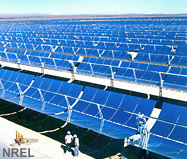 A relatively recent development in solar electric generation is Concentrating Solar Power, which concentrates the sun's rays to
heat liquid-filled pipes. That heat energy is then used to generate electricity in a steam generator. This technology does very well in areas that get lots and lots of sun (like the US southwest), and the number of installations will no doubt rise.
A relatively recent development in solar electric generation is Concentrating Solar Power, which concentrates the sun's rays to
heat liquid-filled pipes. That heat energy is then used to generate electricity in a steam generator. This technology does very well in areas that get lots and lots of sun (like the US southwest), and the number of installations will no doubt rise.
The technologies used to generate electricity from solar energy may not quite be ready for widespread implementation, but heat-capture solar technologies are. These include:
- Solar Hot Water Heaters — These units use a panel on the roof to collect solar heat and transfer it to the water in your hot water tank. Solar hot water heaters usually pay back their extra up-front cost in 5-8 years, with hot water being substantially free after that!
- Passive Solar Heating and Cooling — Architectural designs that incorporate passive solar heating and cooling concepts capture solar heat during the winter and reject solar heat during the summer. In conjunction with good insulation and proper selection of windows and roofing materials, passive solar can greatly reduce a home's heating and cooling bills.
|
Both of these heat-capture solar-energy approaches reduce energy demand for their respective "household services," with the unused energy then remaining on the grid and being more available for other uses (like powering plug-in hybrids).
Although some decent tax breaks
exist for homeowners who implement PV, solar hot water, and (some) passive solar techniques, very few new-home builders offer such options. Thus, as new subdivisions go in, more and more homes add their own unnecessarily high energy loads to the electricity and natural gas grids. It's just sad, Larry.
|
|
In initial experiments, making biodiesel from certain types of oil-rich algae is orders of magnitude more efficient than making biofuels from crops like soybeans or palm oil.
Much work remains to be done on this technology, and it's not obvious that algae farms will scale up to useful levels of production. Further, the concerns we have about how feed stocks for conventional biofuels are grown (i.e. with chemical agriculture, and by chopping down rainforests to plant crops) would apply here too. But if those problems can be overcome or sidestepped, this technology appears to have the kind of efficiency numbers that make it viable for long-term, large-scale liquid fuel production.
We must admit that we think there is a flaw in our proposed peak oil solutions. They're mostly "David solutions" in a world of "Goliath energy requirements." Wind power, as promising as it is, currently accounts for less than 1% of total US energy. Solar's share is far less than that. Only hydro (at 3.3% of total energy) has anything close to a respectable share, but hydro is maxed out in the Western world.
We have a loooong way to go before so-called "alternative energy" technologies can reach meaningful numbers at our current rate of development and expansion. What's unfortunate is that for most of the 2000's, our leaders in Washington used this fact as an excuse to shovel billions of dollars in subsidies to the established energy industries. Even now, when green energy is all the rage, the paltry share of stimulus and bailout money that was applied to sustainable energy shows that most in power still don't get it.
Collectively, we must recognize that unsustainable dinosaur technologies are doomed to eventual extinction. Pushing further in that direction can only lead to more pollution and a tougher time making the inevitable transition to non-depleting fuels. The billions in budgetary gifts that continue to go the coal, oil, and nuclear industries should instead be ALL used for more research, development, and production of sustainable alternatives.
In the end, none of the energy technologies we favor, either alone or all together or in combination with the technologies we're less enthusiastic about (coal, nuclear, etc.), are going to solve the problems peak oil is beginning to reveal. And without a dramatic change of policy, we will eventually face a liquid-fuels crisis.
Unfortunately, we at Grinning Planet think there is too much inertia in the system, too many politicians who prefer preserving their own power and padding the pockets of their corporate cronies at the expense of protecting the long-term needs of the populace. Alas, with the onset of the global financial crisis, time for successful proactive approaches has probably run out, and in this fable, David will not slay Goliath. Rapid development and deployment of new energy technologies will help, but the available money and time are simply not sufficient get us to where we need to be.
Since supply-side solutions to peak oil are now impossible, we need to look at how we use energy and figure out how we will live well in a future with less of it. Part 3 of this series, Peak Oil and Energy Demand, tackles this subject.
|
However, even the combination of demand reduction and new sources of energy will not likely allow us to sustain our current high-octane approach to living. It's VERY unlikely that business as usual will continue. A new age IS coming, an age of transformation in which our approach to living changes as much as our approach to energy.
But as with all major transitions, it won't be problem-free. How do you go about minimizing the impact of the coming transition to your family? We'll discuss that in the final installment of this series, "Transition Preparedness." Parts 3 and 4 will be published in the next couple of months.
Know someone who might find this Peak Oil Solutions article interesting? Please forward it to them.
Books:
- See books related to
Peak Oil Solutions
More articles and resources on....
|
| |
GP ARTICLES RELATED TO
Peak Oil Solutions
|
| |
|
THIS INFORMATION HAS BEEN APPROVED BY OUR BRAINY FAQ-CHECKER
Peak Oil FAQ (Frequently Asked Questions)
BIOMASS ONLY LOOKS GREAT IN A FUN-HOUSE MIRROR
Biomass and Sustainability
— Why Biofuels Can't Replace Oil
HIGH GAS PRICES? B-B-B-BABY, YOU AIN’T SEEN NOTHIN’ YET
Peak Oil Article: Are High Gas Prices the First Sign?
|
| |
|
Get Grinning Planet free via email
|