|
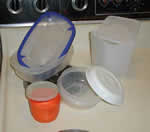
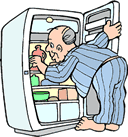 It's been a rite of passage for anyone growing up in the last three decades to learn how to burp a Tupperware storage container. Tupperware and other brands of plastic storage containers are ubiquitous these days. Sometimes you even see large plastic containers to store your smaller plastic containers in.
Is there a potential health downside to using all this plastic to store our food—i.e., do chemicals leach into our food from the plastic storage containers? We'll discuss that, and suggest a few options for non-plastic food containers, some of which will even save you money.
Several research studies have found that when plastic comes in contact with certain foods, molecules of the chemicals in the plastic can leach into the food or beverage. Certain characteristics of the food item can make it more likely to pick up plastic molecules:
- The more liquid a food is, the more it touches the plastic, so the more opportunity it has to pick up plastic molecules.
- Acid foods, such as tomato sauce, appear to be particularly interactive with plastic.
- If you heat a food item in a plastic container—even if the container is microwave-safe—the transference of plastic from the container to the food is even more likely.
When molecules of plastic—or more properly, molecules of the chemicals that get added to plastics during manufacturing—get into
 our bodies, it's not a good thing. They can cause unwanted effects in the human body; for instance, some of the chemicals mimic estrogen. Estrogen, of course, is a normal, essential human hormone; but having too much of it (or the molecules that mimic estrogen) has been associated with breast cancer and other health problems. In general, chemicals that fool the body into thinking they are estrogen or other hormones are called endocrine disruptors and are best avoided.
So, if plastic food containers are sometimes trouble, what would a better food-storage solution look like? The primary characteristic you want in a container material is inertness—that is, you want a material that holds tightly to its own molecules and does not let them go floating off into the food or drink touching the container. On this score, glass is the best choice, followed closely by porcelain, ceramic, and stainless steel.
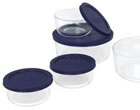
Even though plastic food containers are dominant on store shelves, some companies do make storage containers from glass and other preferred materials. Some of them are oven-safe and large enough to cook in; in those cases, you can simply store the leftovers in the same thing you cooked in. Some of the containers are smaller and more appropriately sized for small portions of leftovers and items transported to work or school for lunch.
|
Some containers have glass lids that fit loosely—fine for storing in the fridge, but not so good for putting leftovers in a lunchbox. Other containers have lids designed to be air- and liquid-tight, making them good for just about any type food storage. Having a good assortment of containers will allow you to choose the right size and style for each food-storage application.
All glass, ceramic, and porcelain containers are microwave-safe, though you should check the manufacturer's specifications before assuming they are safe for use in a regular oven. Plastic lids should be left off even when heating in a microwave. Our experience shows that the heat from the food tends to warp the lid. It's better to microwave the dish covered with a plate or microwave food cover.
|
|
WHERE CAN I BUY THIS STUFF? |
|
This article generated lots of reader emails asking us where to buy non-plastic food storage containers.
 Apparently, such containers are not as easy to find in stores as we thought!
So, now we've done some legwork for you. Online at Amazon.com, you can check out the wide variety of non-plastic food-storage options offered by
Pyrex and
CorningWare. If you take dishes to picnics, parties, and potlucks, there's also the Pyrex
Portables collection. For large-volume food storage (gallon-size and up), check out the wares from
Anchor Hocking (glass) or
StainlessLUX (stainless steel).
You may also be interested in getting rid of your plastic water bottle and trying a
steel one instead.
AMAZON PURCHASES FROM HERE HELP SUPPORT THIS FREE SITE. THANKS!
|
|
Stainless steel cookware is also a good choice. If you cook something in a small or medium pot on the stove and have leftovers, why not just put the lid on, let it cool, and then put the pot right in the fridge? It will mean one less thing to wash, too.
A reader asked whether chemicals from plastic and/or silicone lids might be able to leach into the food stored in the containers, even if the food does not touch the lids.
We don't have any data on "bad molecules" off-gassing from food-container lids and then going via the air into the food in the container. It's certainly possible—new products in general often have a plasticy odor for a while after they're unboxed. But at some point, the off-gassing stabilizes.
Just to be safe, it's probably a good idea to let plastic lids for new food-storage containers sit out for a while to off-gas (in an area with good ventilation) before you use them. How long? If they still smell strongly of plastic, then longer!
As for containers with metal tops, they would probably have less of an off-gassing issue, though metal used in food applications is sometimes coated with a thin layer of plastic.
For some types of food storage requirements, there is also a free solution. For small and medium storage needs,
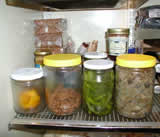 the glass food jars that you would otherwise throw out or recycle make great storage containers once they have been washed and the label has been removed. Jars with a minimal amount of constriction in the neck—like peanut butter jars or squat-style olive jars—work best.
A nice feature of these freebie containers is that you can easily see what's in them when they're in the refrigerator. No more rooting through myriad opaque containers to find what you're looking for.
It's quite reasonable to have a mix of glass and plastic in your fleet of food storage containers. Use the plastic for "non-liquidy" foods when you have them—for instance, raw veggies you've already washed and need to store—and use glass, porcelain, and ceramic containers for the rest.
As your plastic containers wear out—and they all do, eventually—you can continue the transition to "more glass, less plastic." If you do continue to use plastic storage containers, you should at least stop microwaving food in them.
|
As for using glass storage containers in the freezer, there is a risk of cracking. But we have had success using them for frozen food storage as long as they're not too full—i.e. so the food has room to expand in a manner that doesn't push out against the glass. For items that are liquidy (say, spaghetti sauce), fill the container no more than 2/3 full. Items that are less dense (say, a tuna-mac casserole), can usually be frozen in a full container without any problems.
|
|
RE-PURPOSING PLASTIC |
|
Plastic containers aren't useless, they're just not very good for food storage. Storing certain food items in plastic—veggies, nuts in shells, cookies—is still probably reasonable. But if you prefer to simply get the plastic out of the kitchen, period, why not re-purpose your plastic containers for storage of household items—sewing stuff, screws and nails, etc. You might as well get some use out of the things—your money and the earth's resources have already paid for them.
|
|
|
The threat of chemicals from plastic-ware getting into your food and then into your body may not rise to the level of threat posed by, say, eating a bicycle on a dare, but it's a good idea to slowly transition away from plastic storage. The only downside—you'll no longer be able to say, "Uh, thanks, Grandma, but I can't eat any of the leftover okra-rhubarb lasagna because you put it in a plastic container."
|
|
PAPA’S GOT A BRAND NEW BAG STRATEGY |
|
The world's consumers use a gazillion plastic food-storage bags each year. By getting into the habit of using storage containers for things that you have traditionally been putting into plastic bags, you can reduce the toxics associated with plastics manufacturing, reduce the amount of waste plastic getting into the environment, and save money on bag purchases.
Related GP article:
TRASH-TALKING IS OUR BAG
Save Money on Plastic Bags
— and Keep a Few Out of The Landfills
|
|
Know someone who might like this article about chemicals and plastic food containers? Please forward it to them.
|
Search Amazon.com for food storage containers....
Books:
Further reading at other sites:
|
| |
GP ARTICLES RELATED TO
Food Issues
|
| |
|
CLOUDS IN YOUR COFFEE? TRY LESS STYRO, MORE FOAM
Polystyrene Foam Cups and Containers — Styrene Migration, and Your Health
THIRD TIME’S THE CHARMIN
Increase Your
Food Security
— and Save Money and Improve Nutritional Intake
BAD RESIDUALS FROM DAILY RERUNS OF “EATING YOUR FOOD”
Reduce Your Exposure to
Pesticides in Food
Through Smart Food Choices
|
| |
|
More Grinning Planet articles and resources on....
Get Grinning Planet free via email
|