|
We know that one of the architectural devices perfected by the Ancient Romans was the
 arch. We're less certain about whether arches were ever the subject of a song by top Roman rap-poet Cicero Doggy Dogg.
In any event, just as the keystone is essential to the physical integrity of a stone arch, a keystone species is defined as one that has a critical role in determining and maintaining the overall relationship of plants and animals within an ecosystem. If a keystone species is removed or declines, the nature of the ecosystem will change dramatically.
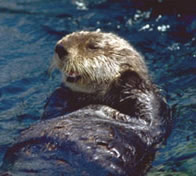
The classic tale of a keystone species is that of the sea otter, which was once found in abundance along the West Coast of North America. The story goes something like this:
- European and Russian trappers hunt sea otters to near extinction in the 18th and 19th centuries.
- The decline of the sea otters, which are essential to keeping sea urchins in check, allows sea urchin populations to explode.
- The burgeoning sea urchins feast on and decimate the kelp beds, which are critical habitat for spawning fish.
- Fish begin to decline for lack of spawning habitat; this affects fishermen's catches.
- Finally, an international treaty is enacted to protect sea otters.
- In areas where the otters recovered, urchin populations are once again kept down, the kelp beds recover, fish nurseries recover, and fish catches rise again.
The news today is not completely happy for sea otters—they are still struggling to maintain their populations where they were able to re-establish themselves, and their range along the West Coast, which once stretched from Baja to Alaska, never did recover to anywhere near what it was. But the tale does serve to perfectly illustrate the concept of how a keystone species is essential for keeping an ecosystem in balance.
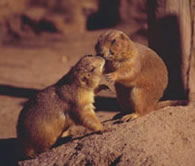 Other examples of keystone species are the prairie dog in the US Southwest, the banner-tailed kangaroo rat in the Chihuahuan Desert grassland (also in the Southwest), and the red-naped sapsucker in Colorado. But not all keystone species are cute and furry or feathered: Certain species of truffles are thought to be keystone fungal species, and oysters and other shellfish are considered keystone species in a variety of estuarine ecosystems.
It takes a great deal of study for scientists to understand the complexities and nuances of ecosystems and their keystone species, and there is still much work to be done.
|
STAY CURRENT WITH THE LATEST AUDIO DOWNLOADS |
|
CATEGORY: FOOD, ANIMAL WELFARE — 11.FEB.2015
 Diet Science
Pastured vs. Free-Range vs. Cage-Free vs. Organic Eggs—What's The Difference? —
Dee McCaffrey says the problems with conventional eggs range from low-quality feed to inhumane growing conditions. Organic eggs use better feed and have better growing conditions, but access to outdoors is sometimes more theory than practice in large organic operations. She rightly promotes eggs from backyard chickens as the best choice, with eggs from pastured chickens another good way to go.
Go to page |
Download/listen
10:53
Original Show Pub Date: 19.Jan.2015
CATEGORY: ENVIRONMENT (POLLUTION), SPECIES — 01.DEC.2014
 Quirks and Quarks
Lakes Turning to Jelly —
The problem of acid rain is often touted as one of the few success stories in controlling pollution, as the industrial emissions that cause it have been cut substantially. But the environmental damage and disruption caused by acid rain still echo in the wilderness. One example discovered is the "jellification" of temperate lakes, where acid rain has reduced calcium content, an essential element for most lake organisms. This has caused some crustaceans at the base of the aquatic food chain—the ones that make their exoskeletons from calcium—to be at a disadvantage, and they're now being displaced by species that have a jelly-like coating. These jelly organisms are inedible to many predators and thus are disruptive to the lakes' ecological balance.
Go to page |
Download/listen
10:43
Original Show Pub Date: 22.Nov.2014
CATEGORY: ENVIRONMENT, SPECIES — 10.OCT.2014
Living on Earth
Obama Creates the World's Largest Ocean Reserve —
President Obama expanded the Pacific Remote Islands National Marine Monument, protecting nearly half a million square miles of Pacific Ocean from commercial exploitation. Elliott Norse of the Marine Conservation Institute talks about the impact of the reserve on the ecosystem and the precedent it sets for global conservation.
Go to page |
Download/listen
6:40
Original Show Pub Date: 03.Oct.2014
 MORE
MORE
Get more audio clips on biodiversity, species, animal welfare, and many more topics in Grinning Planet's biweekly
downloadable audio news feed.
|
The important thing for us non-brainiacs to understand is the general concept of keystone species, the need to protect them, and the fact that there are many keystone species that have yet to be identified by scientists.
It's also worth considering the related concept of general species interaction. Even when an ecosystem does not radically change upon decline or loss of a particular species, it does change to some degree. This is often a natural process of evolution. But when the species losses are caused by external factors, the changes to the ecosystem cannot be passed off as "natural." Unnatural causes of habitat and ecosystem change include:
- overhunting, overfishing, or overharvesting;
- pollution;
- habitat encroachment from housing developments, agriculture, ranching, mining operations, or logging;
- invasion of non-native species (which are often introduced inadvertently via shipping or intentionally via illegal trade in exotic species);
- disappearance of predator species (which allows populations of prey species to explode);
- habitat change due to unnatural temperature changes in the environment (such as with global warming).
According to noted biologist E.O. Wilson, we are now seeing species extinctions at 1,000 times the normal rate, and there is no disagreement among biodiversity scientists that this is human-caused. How many of these lost species will turn out to have been keystone species? How much habitat change can our natural world withstand before a domino effect causes truly disastrous results?
Such unanswered or abstract questions may have a hard time competing with our everyday needs, but they're questions that are worth keeping in mind. And now, back to the keystone species in our house, the television.
More articles and resources on....
Get Grinning Planet free via email
|