REVIEW OF ...
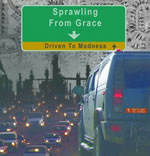
Sprawling from Grace, Driven To Madness
Movie (Documentary) Released: 2008
This 'Sprawling from Grace, Driven To Madness' review written by Mark Jeantheau, Grinning Planet.
A lot of the topics Sprawling from Grace, Driven To Madness—peak oil, sprawl, unsustainable trends—have been covered in other peak oil films, though they are nonetheless explained very well here. The film correctly identifies flow rate, not total reserves, as the critical factor to consider when looking at where we stand with oil supplies. Sprawling from Grace also makes the observation that, among Western nations, the United States has a uniquely high level of sprawl, which will mean unique energy problems and social challenges in the coming oil-constrained future.
The film features a particularly good review of why alternatives will fail to arrive in time to avert a future fossil-fuels crisis, as well as an exploration of the denial psychology that afflicts most of our politicians and most of the public. James Howard Kunstler sums it up wonderfully: "If America could harness the energy from blowing smoke up it's own ass, we could solve the energy problem."
Though Sprawling from Grace has many of the familiar faces (like Kunstler) making many familiar pronouncements, it also presents some new interviewees and gives a fresh treatment to some of the angles. ASPO-USA co-founder Randy Udall offers the trenchant insight that "energy is wealth." Wonksters like Michael Dukakis and Bill Clinton, as well as hands-on urban thinkers like the mayor of Charlotte, North Carolina, all help fill in the political angle on the sprawl problem without getting into a blame game.
Though the movie is a clear critique of sprawl, it is actually sympathetic to the story of how we got here: Living outside the city was appealing and it was affordable for a time, so the gravitation towards it was understandable. The question is, now what?
The movie speculates that "our love affair with the car is fading." That seems more like wishful thinking rather than tires-on-the-ground observation. At least here in the United States, the average driver still loves their car and the fabulous degree of personal mobility it enables. What they hate is the snarly traffic and rude drivers; the never-ending maintenance and gougey repair bills; and, of course, the high price of gas when it spikes. The bottom line is, though, most Americans cannot imagine how their lives would run without a personal automobile. And to be fair, our current spread-out living arrangement makes that hard to envision.
But Sprawling from Grace argues that it no longer matters whether our first choice is a transition back to walkable communities, expanded mass transit in cities, and rail-based transportation networks. Without cheap, abundant oil, it's our only choice.
In the end, the film is convincing in its assertion that the suburban way of life cannot and, ultimately, will not go on. Its focus on workable urban solutions saves Sprawling from Grace from being "just another peak oil movie."
INSCRUTABLE RUNES
One minor complaint is that the text giving people's positions/titles was so small that even on a 46" TV it was nearly impossible to read. Hey, I know I have 50-year-old eyes, but sheesh!
One might be tempted to question whether the economic mess and future energy constraints make it rather unrealistic to think that we can undo 50 years' worth of sprawling infrastructure and rebuild it in a manner than will work on a much more limited energy budget in the future. That proposition seems especially daunting when one realizes that few of our leaders offer more than token support for sustainability—"growth" is still the mantra found in every politician's speeches—and that the vast majority of the public still does not see how fundamentally unsustainable our current direction is.
But we should at least start with an honest discussion why it's important to try to re-envision, reengineer, and re-build. Sprawling from Grace provides a good starting point for that conversation, helping us understand the problem and the solutions, arming with insight and facts so that we can make apt changes in our own lives and push our leaders to choose a new path. The "new urbanist" lifestyle will not be for everyone, but many more people will be living that way in the future by necessity.
Check out 'Sprawling from Grace, Driven To Madness' at
Amazon.com
Liner notes for 'Sprawling from Grace, Driven To Madness': Tagline: We've become the oil tribe!
Categories: Peak Oil, Suburban Sprawl.
A film by David M. Edwards.
Runtime: 82 minutes
FREE AUDIO CLIPS
Grinning Planet also has audio . . .
RELATED AUDIO
CATEGORY: ENERGY, PEAK OIL — 05.FEB.2015
Sea Change Radio
The Latest Oil Glut—Once Bitten, Twice Shy —
It comes as little surprise that the author of a book entitled Snake Oil: How Fracking's False Promise of Plenty Imperils Our Future is a critic of the natural gas industry and a proponent of peak oil theory. Host Alex Wise reviews the issues with Richard Heinberg of the Post Carbon Institute and gets his perspective on how plunging oil prices will affect the energy and transportation industries; the status of the North American natural gas boom; how the turbulence may alter consumer behavior in the near term; and the need for sound policy to guide us through the long-term challenge of living in a post-carbon world. Go to page |
Download/listen
30:00
GP comment: Heinberg is solid as usual, though if you have heard his other interviews in the last six months, you will not find much new here.
Original Show Pub Date: 27.Jan.2015
CATEGORY: COLLAPSE — 10.FEB.2015
C-Realm Podcast
Twilight's Reach —
KMO and John Michael Greer talk about the two novels Greer published last year. The first is Twilight's Last Gleaming, a geo-political thriller where a declining United States and a resurgent China come to the brink of all-out nuclear war. The other novel is Star's Reach: A Novel of the Deindustrial Future, which is set in a world shaped by the exhaustion of fossil fuels, where new social forms have replaced our familiar institutions and where new ways of inhabiting the North American continent have been necessitated by centuries of climate change. Go to page |
Download/listen
59:24
GP comment: I haven't read the books, but it's always interesting to get glimpses of possible future scenarios.
Original Show Pub Date: 04.Feb.2015
CATEGORY: ENERGY — 21.JAN.2015
Radio EcoShock / Legalise Freedom
A "Renewable World" Built on Fossil Fuels is Not a Renewable World —
The message for green-energy lovers and haters alike is simple: We can't keep this crazy civilization running just on the sun and wind, let alone on high doses of fossil fuels. When we stop being able to milk the billion year-pile of concentrated solar energy in the form of oil, gas, and coal, something WILL change. Energy expert David Fridley of the Lawrence Berkeley National Lab and the Post Carbon Institute talks about the energy dilemma, diving deep into the specifics. Topics/points include ... Our energy matrix cannot be renewable until the renewable-energy technologies and sources can replicate themselves. Wind turbines, solar panels, and electric cars are all hobbled by the limitations of fossil fuel inputs for their creation and maintenance as well as by the specialized minerals needed for their creation. He acknowledges the psychology of the American energy consumer as a key problem, referencing former Energy Department Secretary James Schlesinger's axiom
that the American people only have two modes: complacency or panic. Go to page |
Download/listen
1:00:00
GP comment: This is one of the best reviews I've ever heard of the problems we face as demand for energy keeps rising but technology finds itself unable to compensate for the peak in global net energy. Must-listening!
Original Show Pub Date: 14.Jan.2015 ~~ Original story title: Green Dreams - Future or Fantasy?
MORE
Get more audio clips on peak oil and sprawl (and many more topics) in Grinning Planet's biweekly
downloadable audio news feed.
ADVERTISEMENT
Hey, we don't pick the Google ads! – GP
CLICKS ON OUR ADS AND PURCHASES VIA OUR AMAZON LINKS HELP SUPPORT THIS FREE SITE... THANKS!
"...More important than the deficit, more important then healthcare—more important than anything—we have got to do something about our energy strategy. Because if we permit the climate to continue to warm at an unsustainable rate, and if we keep on doing what we're doing until we're out of oil and we haven't made the transition, then it's inconceivable to me that our children and grandchildren will be able to maintain the American way of life and that the world won't be much fuller of resource-based wars of all kinds."
— former president Bill Clinton, speaking in Sprawling From Grace; Driven To Madness







 The film features a particularly good review of why alternatives will fail to arrive in time to avert a future fossil-fuels crisis, as well as an exploration of the denial psychology that afflicts most of our politicians and most of the public. James Howard Kunstler sums it up wonderfully: "If America could harness the energy from blowing smoke up it's own ass, we could solve the energy problem."

 Sea Change Radio
 C-Realm Podcast
 Radio EcoShock / Legalise Freedom
 MORE
MORE
