| |
MOVIE REVIEW OF ...
King Corn
Documentary; Released: 2007
Featuring Ian Cheney and Curt Ellis; Directed by Aaron Woolf
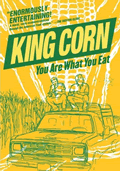 Corn on the cob, canned corn, creamed corn, pop corn, corn bread, corn dogs, corn chips, corn taco shells, candy corn.... Well, except for that last one, we humans have come up with many inventive and delicious ways to eat corn. But there are some insidious ways we consume corn, most notably via meat consumption (where corn is heavily used as a feed grain) and corn sweeteners (which today dominate the non-diet part of the sweetener market). In scientific terms, we are largely what we eat, and we in the US owe a lot of our flesh, for better or for worse, to corn.
But what does it mean that we have become a part of the "corn matrix"? In King Corn, we find out. The storyline follows two college buddies, Ian Cheney and Curt Ellis, as they trace the trail of corn kernels that runs from agricultural extension offices through corn fields to silos and feed lots and processing plants.
The scale of the corn-related food economy in the US is hard for the average person to fathom. It gets easier as King Corn shows us the endless fields of 10-foot-tall corn plants; the tractors and huge pieces of farming equipment; the mountainous piles of harvested corn; the muddy feedlots with confined cows eating from troughs full of a feed mix that is mostly corn; the huge industrial-style buildings used to refine corn into sweetener.
To bring the material to life, Ian and Curt relocate to the heart of corn country (Iowa) to get first-hand experience in a variety of activities related to corn:
- They apply for farming subsidies.
- They spend a season growing an acre of corn, including driving tractors, plowing, seeding, spraying, and harvesting. (You may feel more inclined to buy organic after you see the chemical dosing the corn field gets.)
- They even make a batch of high-fructose corn syrup. (Did you know that the process uses sulfuric acid?)
- They talk to locals about the impact that industrial corn farming has had on farm families and farm towns.
|
The film also covers the ills of some corn-related aspects of our society:
- It discusses problems with concentrated animal feeding operations and what an extended corn-based diet does to cattle—we have to have to give them drugs because the corn eventually makes the cows sick.
- The risks of consuming sweetened drinks are explored—drinking 1 soda per day doubles the risk of Type 2 diabetes.
- Corn is also noted as a poster child for the falling taste quality and nutritional values that plague today's industrialized farm products.
One amazing fact illuminated by King Corn is that in the US we're able to produce copious quantities of corn using very efficient, high-tech methods, and as consumers, we pay less money to feed ourselves as a percentage of our paycheck than any previous generation. But in this apparent land o' plenty, corn farmers cannot make a living without government subsidies. Given the general nutritional deficit of today's corn-based food system, what does all this say about how things are being run for us?
Skillfully directed by Aaron Woolf, King Corn gently explores its subject with a sense of balance. It generally comes off as agnostic about the good or bad of corn, but in the end, the film still gets to the complex truth of corn in a manner that is entertaining and educational. The style of King Corn makes it easy to watch: We get to learn alongside the two protagonists, rather than just seeing a stream of talking heads disgorging fact after fact. The film has a quirky sense of pacing, and the fun stop-motion animations and other graphical devices keep our eyelids in the fully up position. King Corn is a fine choice as a main course.
|
|
Check out King Corn at
Amazon.com
See clips or get purchase info for this movie at the
film's website
or at
Bullfrog Films

|
|
Or search
Amazon.com for more...
|
FREE AUDIO CLIPS

Grinning Planet also has audio . . .
 |
 |
|
CATEGORY: AGRICULTURE — 08.FEB.2015
 Agroinnovations Podcast
Food Hubs —
Erik Hoffner talks about the local food movement, focusing on the exciting development of "food hubs" that are springing up across the country. He describes the opportunities of scale and collaboration food hubs and related innovations are providing for local food entrepreneurs. Also discussed are energy cooperatives, fair trade, and the prospects for sustainable agriculture to replace the industrial model.
Go to page |
Download/listen
49:36
Original Show Pub Date: 19.Jan.2015
CATEGORY: AGRICULTURE, FOOD, GMOs — 09.DEC.2014
Food Sleuth Radio
The Seed Underground—A Growing Revolution to Save Food —
Janisse Ray discusses the threat to seed sovereignty posed by multinationals like Monsanto, which are endeavoring to lock up the food-related profit stream from field to fork by owning the means of production. She explains how activism and seed saving both play a role in the fight.
Go to page |
Download/listen
28:15
Original Show Pub Date: 13.Nov.2014
CATEGORY: AGRICULTURE, LABOR ISSUES — 03.DEC.2014
Democracy Now
Food Chains: New Film Tracks How Immokalee Farm Workers Won Fair Wages from Corporate Giants —
A new film, Food Chains, documents the groundbreaking partnership between farm workers, Florida tomato farmers, and some of the largest fast-food and grocery chains in the world. Twelve corporations have agreed to join the Fair Food Program, including McDonald’s, Taco Bell and WalMart. Participants agree to pay a premium for the tomatoes in order to support a "penny per pound" bonus that is then paid to the tomato pickers. Soon, the Fair Food label will appear on Florida tomatoes at participating stores. Gerardo Reyes-Chavez, a farm worker and organizer with the Coalition of Immokalee Workers, discusses the issue.
Watch |
Download/listen
9:32
Original Show Pub Date: 21.Nov.2014
 MORE
MORE
Get more audio clips on food and agriculture (and many more topics) in Grinning Planet's biweekly
downloadable audio news feed.
|
| |
 |
 |
|
ADVERTISEMENT
|
|
|
|
|
Hey, we don't pick
the Google ads! – GP
|
| |
| CLICKS ON OUR ADS AND PURCHASES VIA OUR AMAZON LINKS HELP SUPPORT THIS FREE SITE... THANKS! |
|
| |
|