| |
MOVIE REVIEW FOR ...
Forks Over Knives
Movie (Documentary); Released: 2011
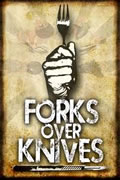 The premise of Forks Over Knives is that people can avoid or improve heart disease, obesity, Type II diabetes, and other serious health conditions simply by avoiding junk food and eating a plant-based, whole-foods diet. The film uses "plant-based diet" and similar terms, but what it really means is "plants-only diet"—vegetarianism is the explicit recommendation for optimizing health.
Throughout the film, scientists and doctors offer evidence that animal products cause disease, but the evidence feels cherry-picked and lacking in context of other disease factors. I wholeheartedly agree that diet is a central problem in Americans' bad health, but the film does not address GMOs, pollution, chemicals, lack of exercise, sleep deficiencies, chronic stress, smoking, excessive drinking, and other important disease factors as co-contributors to ill health. In Forks Over Knives, the boogieman in the pantry is wholly composed of animal products.
Americans do over-consume animal products, and that is not healthy. Americans also way under-consume vegetables, and that too is not healthy. The third section of Americans' Big TV Dinner Tray of Dietary Offenses is filled with junk food, particularly sweeteners. It is this overall dietary imbalance that is the first-order problem.
There's plenty of truth in this film—the deceitfulness of USDA nutritional guidelines, the industry-driven dietary disaster found in most school lunch programs, the influence of corporations on public science and policy, how high fructose corn syrup fools the bodily sensors that are supposed to tell us when we're full. And it correctly points out the superiority of a plant-based diet in terms of energy use, environmental impact, and morality towards animals.
But throughout, Forks Over Knives seems determined to pin all the blame for human health problems on consumption of animal products. Even within the narrow meat/vegetables question, it fails to discuss whether the positive health effects seen in people who switch to a vegetarian diet could simply be from eating many more vegetables rather than from the complete elimination of animal protein. More disturbingly, it asserts that human protein needs can easily be filled by vegetable foods but does not talk about the importance of amino acid balance, and the film does not let us know that long-term vegetarians can end up with nutritional deficiencies without a carefully designed approach.
A super-vegetable diet can indeed be a path to healing—the Gerson Institute's juicing therapies can cure cancer (though outpatients find it difficult to continue the program due to the expense and rigor). Similarly, for some health conditions, a nutrient-monitored vegetarian diet may indeed be helpful in reversing disease. But for the average person, dietary balance is the key. Forks Over Knives did not convince me that moderate amounts of animal protein can't be part of that balance.
My recommendation: Skip Forks Over Knives and spend that time working out a plan to move your consumption of animal products to lower levels and your consumption of fresh, organic vegetables to much higher levels. And then do it!
|
Check out 'Forks Over Knives' at
Amazon.com
See clips or get purchase info at the
film's website

|
Or search
Amazon.com for more...
|
Categories: Food movie, vegetarian movie, vegan movie.
Produced and directed by Brian Wendel, Lee Fulkerson, John Corry, Allison Boon.
Runtime: 61:17
FREE AUDIO CLIPS

Grinning Planet also has audio . . .
 |
 |
|
CATEGORY: FOOD, ANIMAL WELFARE — 11.FEB.2015
 Diet Science
Pastured vs. Free-Range vs. Cage-Free vs. Organic Eggs—What's The Difference? —
Dee McCaffrey says the problems with conventional eggs range from low-quality feed to inhumane growing conditions. Organic eggs use better feed and have better growing conditions, but access to outdoors is sometimes more theory than practice in large organic operations. She rightly promotes eggs from backyard chickens as the best choice, with eggs from pastured chickens another good way to go.
Go to page |
Download/listen
10:53
Original Show Pub Date: 19.Jan.2015
CATEGORY: FOOD, ORGANICS — 30.JAN.2015
 One Radio Network
Keeping Food Clean—Overseeing the Organic Food Industry —
Mark Kastel of The Cornucopia Institute talks about agribusiness' constant attempts to weaken the USDA organic standard—and what we can do about it. Topics include ... big companies trying to do organic on-the-cheap; Eden Foods and other food companies using excellent business ethics; the scorecard on the Cornucopia website that lets you research your favorite organic companies; carageenan, yes or no; why Chipotle took pork off the menu in 1/3 of its restaurants; why monocropping hurts soil; long term effects of GMO foods on human health; how buying organic protects you from the worst issues in the food industry.
Go to page |
Download/listen
59:36
Original Show Pub Date: 20.Jan.2015
CATEGORY: FOOD, GMOs — 28.JAN.2015
 Corbett Report
Food—Can DIY Conquer "OMG!"? —
The problems of the industrial food system are obvious: food safety scandals, the death of family farming, food supply insecurity, the revolving door between corporate lobbyists and government regulators, and many more. The solution should be equally obvious: rolling up our sleeves and getting in the garden. James Corbett reviews some of the evidence against the industrial food model and then explores growing your own as a simple, natural solution to one of our most fundamental problems.
Go to page |
Download/listen
55:38
Original Show Pub Date: 14.Jan.2015 ~~ Original story title: Episode 299 -- Solutions: Guerrilla Gardening
 MORE
MORE
Get more audio clips on food and nutrition (and many more topics) in Grinning Planet's biweekly
downloadable audio news feed.
|
| |
 |
 |
|
ADVERTISEMENT
|
|
|
|
|
Hey, we don't pick
the Google ads! – GP
|
| |
| CLICKS ON OUR ADS AND PURCHASES VIA OUR AMAZON LINKS HELP SUPPORT THIS FREE SITE... THANKS! |
|
|
|
|