|
We sometimes hear politicians and pundits say, "There's no water pollution problem anymore. We've done very well cleaning up our water." Now, we would never suggest that anyone take a politician at his word or believe the TV—proceed into the spin zone at your own risk. But since there are no rivers on fire now and we don't see too many stories about fish kills, they must be right, eh? On the other hand, a majority of people in the Western
 world seem to think their tap water is much less safe and drinkable than bottled water, which is a very expensive way for people to quench their thirst.
So, when it comes to water pollution facts, who's all wet and who's got it right? This article is the first of a multi-part series that will splash around in the deep end of the water pollution issue.
Before we dive into our pool of water pollution facts, it will be helpful to do a quick review of the different types of water in general:
Ocean Water: The vast majority of water on the planet is the salt water in the oceans and seas.
Fresh Surface Water: This is the fresh water in rivers, streams, lakes, ponds and similar bodies of water. (Almost all of these contain fresh water, though a few
 lakes contain salty water.) Technically, the world's ice caps and glaciers also fall into this category , and actually contain very, very large amounts of fresh water.
Groundwater: The majority of the planet's liquid freshwater is stored in underground aquifers. It's important to remember that groundwater pollution is very difficult to treat, and it doesn't just "flush out" on its own. Water that enters an aquifer remains there for an average of 1,400 years!
Hey, I think that was our first water pollution fact! Here are some more.
40% of America's rivers are too polluted for fishing, swimming, or aquatic life.
Even worse are America's lakes—46% are too polluted for fishing, swimming, or aquatic life.
Two-thirds of US estuaries and bays are either moderately or severely degraded from eutrophication (nitrogen and phosphorus pollution).
|
The Mississippi River—which drains nearly 40% of the continental United States, including its central farm lands—carries an estimated 1.5 million metric tons of nitrogen pollution into the Gulf of Mexico each year. The resulting hypoxic coastal dead zone in the Gulf each summer is about the size of Massachusetts.
|
|
Endangered Rivers |
|
The river-protection group American Rivers lists the primary water pollution threats for U.S rivers:
-- Polluted runoff from roads, parking lots, and neighborhood lawns
-- Runoff from farms (pesticides, fertilizers, and animal waste)
-- Livestock damage to riparian areas (reduces near-stream filtering abilities)
-- Logging and mining operations
Of the 1200 species listed as threatened or endangered, 50% depend on rivers and streams. At least 123 freshwater species became extinct during the 20th century.
Source: American Rivers
|
|
1.2 trillion gallons of untreated sewage, stormwater, and industrial waste are discharged into US waters annually. The US EPA has warned that sewage levels in rivers could be back to the super-polluted levels of the 1970s by the year 2016.
In any given year, about 25% of beaches in the US are under advisories or are closed at least one time because of water pollution.
|
Asian rivers are the most polluted in the world. They have three times as many bacteria from human waste as the global average and 20 times more lead than rivers in industrialized countries.
In 2004, water from half of the tested sections of China's seven major rivers was found to be undrinkable because of pollution.
|
Canada’s
Most Endangered Rivers |
|
#1 - Petitcodiac River
#2 - Eastmain River
#3 - Okanagan River
#4 - Taku River / Iskut River
#5 - Groundhog River
#6 - Milk River
#7 - Peel River
#8 - Red River
#9 - Churchill River
#10 - Bow River
SOURCE: EndangeredRivers.net
|
|
The quality of water in Europe's rivers and lakes used for swimming and water sports worsened between 2004 and 2005, with 10% of sites not meeting standards.
|
STAY CURRENT WITH THE LATEST AUDIO DOWNLOADS |
|
CATEGORY: ENVIRONMENT (POLLUTION) — 01.OCT.2014
 Living on Earth
Communities at Odds with States on Fracking Wastewater Zoning —
Fracking wastewater is trucked from Pennsylvania into Ohio, where it is processed and injected into deep wells. Many locals worry about earthquakes and water contamination, but local councils are finding that state rules override citizens' concerns about waste-water well siting.
Go to page |
Download/listen
7:09
Original Show Pub Date: 19.Sep.2014
CATEGORY: ENVIRONMENT (POLLUTION) — 08.OCT.2014
 Quirks and Quarks
"Microbead" Plastic Pollution Plagues the St. Lawrence River —
Microplastic beads, often found in industrial and household products like cosmetics and cleaners, are known to pollute ocean water. Now the beads have been found in the sediments of the St. Lawrence for the first time. Anthony Ricciardi, a biologist at McGill University, explains why it was surprising to find this type of pollution in a river, especially in the sediment, and what the impact on river life is.
Go to page |
Download/listen
8:50
Original Show Pub Date: 04.Oct.2014
CATEGORY: ENVIRONMENT (WATER), SPECIES — 28.AUG.2014
Resistance Radio
The Colorado River—Past, Present, and Future —
Gary Wockner coordinates the Save the Colorado River Campaign, whose mission is to protect and restore the Colorado River and its tributaries from the source to the sea. Topics include the history of the river; water rights and farms vs. cities; impact of dams and water rights on species; and opportunities for improving the river's future.
Download/listen
39:45
Original Show Pub Date: 24.Aug.2014
 MORE
MORE
Get more audio clips on pollution, environmental issues, and many more topics in Grinning Planet's biweekly
downloadable audio news feed.
|
Slovakia has the lowest compliance with EU guidelines for freshwater areas, with only 22.4% of bathing sites meeting the standards.
Thirty percent of Ireland's rivers are polluted with sewage or fertilizer.
The Sarno is the most polluted river in Europe, featuring a nasty mix of sewage, untreated agricultural waste, industrial waste, and chemicals.
Greece has the cleanest coastal waters, followed by Spain and Germany. Lithuania and Estonia have the dirtiest coastal waters.
The King River is Australia's most polluted river, suffering from a severe acidic condition related to mining operations.
Pollution of freshwater (drinking water) is a problem for about half of the world's population. Each year there are about 250 million cases of water-related diseases, with roughly 5 to 10 million deaths.
Diseases caused by the ingestion of water contaminated with pathogenic bacteria, viruses, or parasites include:
- cholera
- typhoid
- schistosomiasis
- dysentery and other diarrheal diseases
Bangladesh has some of the most polluted groundwater in the world. In this case, the contaminant is arsenic, which occurs naturally in the sediments. Around 85% of the total area of the country has contaminated groundwater, with at least 1.2 million Bangladeshis exposed to arsenic poisoning and with millions more at risk.
Each year, plastic waste in water and coastal areas kills up to:
- 100,000 marine mammals,
- 1 million sea birds, and
- countless fish.
The world's seas are beset by a variety of water pollution problems. See the table below for 10 of the worst areas.
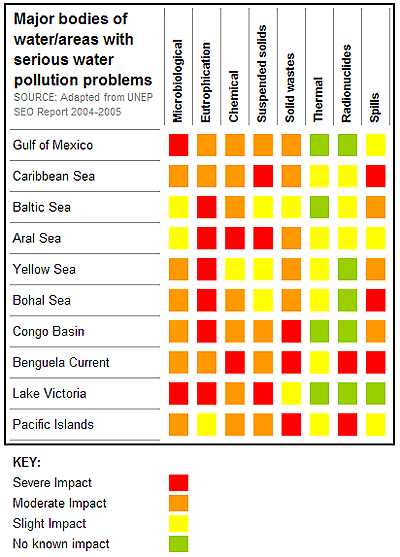
If you are using a screen reader, click here to get html version of table.
In one week, a typical cruise ship generates:
- 210,000 gallons of sewage;
- 1,000,000 gallons of "gray water" from showers, sinks, dishwashers and clothes washers;
- 37,000 gallons of oily bilge water;
- more than eight tons of solid waste; and
- toxic wastes from onboard operations like dry cleaners and photo processing laboratories.
Around 80% of the pollution in seas and oceans comes from land-based activities.
|
This has just been a small overview of the pollution insults our waterways are suffering. When we remember that water is the stuff of life, we see that this is an insult to us, too.
The next segment in this series discusses water pollution causes.
Do you know someone might appreciate this Water Pollution Facts article?
Please forward it to them.
|
|
Related articles:
THE GULF OF MEXICO’S DEAD ZONE HAS NO PSYCHIC POWERS
Coastal Dead Zones in the USA and Around the World
HOW ABOUT A NICE ASPHALT SLURPEE?
Fresh Water for Birds, Squirrels, and Other Back Yard Animals
Books, other articles, and resources:
- See Books related to this topic
- See articles and resources for Water
- See articles and resources for All Subjects
Get Grinning Planet free via email
|