|
On a fairly regular basis, Grinning Planet throws cow pies at "industrial agriculture"—those massive, corporate farming operations—while singing the praises of small farms and sustainable, non-chemical agriculture. It all sounds good: who doesn't prefer the idea of varied, natural, lush fields to endless miles of genetically
 engineered corn stalks, and who can't see that happy barnyard animals are better off than sad creatures trapped in cages, pens, and feed lots.
But deep down, we all must wonder at times whether industrial agriculture is just a natural evolution of farming, and whether without it our farmers would be unable to keep the abundant supply of food coming our way.
Not only does the following article answer those questions with a resounding "no," it's also a great success story in a corporate-dominated farming world that is increasingly short on happy endings. It comes to us from the Great Lakes Radio Consortium, which has generously granted reprint rights.
~ ~ ~
Small Dairy Farms Get Greenbacks From Grazing
by Erin Toner, Great Lakes Radio Consortium
In the retail world, big-box stores have made it tough for small companies to stay in business. That's also true for agriculture, where the big guys are massive feeding operations that house thousands of cows. Surviving as a small farmer in that world often takes a new way of doing business. Here's the story of one dairy-farming family that's found a way to stay in farming, and make a pretty good living....
DOWN ON THE DAIRY FARM
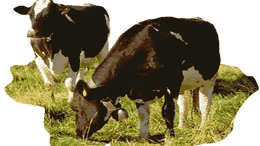
It's one of those hazy and muggy summer mornings, where the air's thick enough to soak up the smell of manure and dewy grass. Nearby, cows are swatting flies with their tails, eating grass and relaxing in lush, green pastures. These days it's a lifestyle most dairy cows never get to experience. Most are confined in big buildings with hundreds or thousands of other milk-making machines (cows).
Howard and Mary Jo Straub didn't like where dairy farming was going. So about ten years ago, they switched from a farm
 that warehoused dairy cattle indoors, to something called seasonal rotational grazing. Mary Jo explains how it works.
"The cows get a new paddock or area, and our areas are about five acres, and each day they would get a new five acres of grass to eat. We have 24 paddocks, so every 24 days, they would be back into the same five acres."
And in those 24 days, rainfall and the cows' own manure has helped the grass grow back in that first paddock, and then the second, and so on. This is very low-maintenance farming, and low-cost farming.
The Straubs don't have to buy tons of grain to feed their cows. And they're not applying pesticides or fertilizer to their pastures as they would on a corn field. They don't have tons of manure to dispose of, they don't have loans out on grain-harvesting machinery, and they don't have to pay lots of employees to feed and manage their animals.
Howard Straub says farming is a lot easier than it used to be, and a lot more lucrative.
"We used to get up and milk, we did a three-time-a-day milking before. We mixed up five loads of feed for different groups of cows. Now we just milk the cows twice a day and when we're done milking we open the gate and let them out to go eat."
BUT IS GRASS FED DAIRY PROFITABLE?
Since their costs are so low, the Straubs make between 800 and 1,000 dollars profit on each of their 84 cows. Before, they made around 150 dollars profit per cow.
|
STAY CURRENT WITH THE LATEST AUDIO DOWNLOADS |
|
CATEGORY: AGRICULTURE — 08.FEB.2015
 Agroinnovations Podcast
Food Hubs —
Erik Hoffner talks about the local food movement, focusing on the exciting development of "food hubs" that are springing up across the country. He describes the opportunities of scale and collaboration food hubs and related innovations are providing for local food entrepreneurs. Also discussed are energy cooperatives, fair trade, and the prospects for sustainable agriculture to replace the industrial model.
Go to page |
Download/listen
49:36
Original Show Pub Date: 19.Jan.2015
CATEGORY: AGRICULTURE, FOOD, GMOs — 09.DEC.2014
Food Sleuth Radio
The Seed Underground—A Growing Revolution to Save Food —
Janisse Ray discusses the threat to seed sovereignty posed by multinationals like Monsanto, which are endeavoring to lock up the food-related profit stream from field to fork by owning the means of production. She explains how activism and seed saving both play a role in the fight.
Go to page |
Download/listen
28:15
Original Show Pub Date: 13.Nov.2014
CATEGORY: AGRICULTURE, LABOR ISSUES — 03.DEC.2014
Democracy Now
Food Chains: New Film Tracks How Immokalee Farm Workers Won Fair Wages from Corporate Giants —
A new film, Food Chains, documents the groundbreaking partnership between farm workers, Florida tomato farmers, and some of the largest fast-food and grocery chains in the world. Twelve corporations have agreed to join the Fair Food Program, including McDonald’s, Taco Bell and WalMart. Participants agree to pay a premium for the tomatoes in order to support a "penny per pound" bonus that is then paid to the tomato pickers. Soon, the Fair Food label will appear on Florida tomatoes at participating stores. Gerardo Reyes-Chavez, a farm worker and organizer with the Coalition of Immokalee Workers, discusses the issue.
Watch |
Download/listen
9:32
Original Show Pub Date: 21.Nov.2014
 MORE
MORE
Get more audio clips on agriculture issues, gardening, and many more topics in Grinning Planet's biweekly
downloadable audio news feed.
|
Howard Straub says grazing has made cattle the chief asset on his farm, instead of a bunch of machines. His cows are healthier because they're eating grass, like they were meant to do. And because they get lots of exercise, the cattle live longer, produce more milk, and have more calves.
Even though the idea with grazing is that there are sprawling pastures for the cows, it doesn't require any more land than confined feeding farms. That's because you have to consider all the land that supports a herd of cattle, says Tom Kriegl, who studies dairy farming at the University of Wisconsin-Madison.
"You can have a diary operation where the only land that you own is the land that the building sits on that you house cows in, and you might buy all of your feed for those cows and you would not own the land that the feed is grown on. But you actually need that additional land that the feed is grown on even if you don't own it."
ROTATIONAL GRAZING AND DAIRY FARMING'S FUTURE
Howard and Mary Jo Straub say they encourage all the young farmers they meet to make the switch to rotational grazing. And it is catching on. The Great Lakes Grazing Network estimates that almost half of all new small and mid-size dairies in the region are using rotational grazing.
Kevin Ogles is a grazing specialist with the Natural Resources Conservation Service. He says grazing is probably the future for
all smaller dairy farms. But he says grazing is complicated, with benefits that don't come immediately.
"The concept is simple. Mastering it—that takes a while. So, once people make the transition after doing it for a few years, that's when you hear them talk about the economic gain. The quality of life has improved."
At this point, you could call the Straub family master grazers. Since they started ten years ago, Howard and Mary Jo have managed to pay off a 250,000 dollar mortgage. Today, they're almost debt-free, and they're able to stop farming for two months in the winter, when they head down to Florida, as Howard says, to take time for the fun things in life. He says that would never have been possible before.
© 2004 Great Lakes Radio Consortium
[Story originally aired on GLRC August 2, 2004]
| The Great Lakes Radio Consortium provides weekly environmental news stories in audio and print format. The stories usually focus on the Great Lakes region but are often of interest to a general audience. Visit them at www.glrc.org. |
|
~ ~ ~
Ah, that's a great story. :-)
So, while you contemplate that hot young star sporting the milk moustache, you might also consider buying milk that comes from a family farming operation. It takes a little time examining the labels—after all, they all try to SOUND like they're old-timey dairy operations. Look for "pasture fed" or "grass fed" on the label. Not even the "organic" label is a guarantee that the milk came from happy cows munching on green grass, though organic is still a good alternate choice if you can't find milk from grass-fed cows. Sometimes you can even find a brand of milk that is both organic AND grass-fed. Yumm! Moooooo. Yumm! Moooooo...
More articles and resources on....
Get Grinning Planet free via email
|