|
CATEGORY: ENVIRONMENT — 04.MAR.2015
 Sea Change Radio
Louisiana's Disappearing Coastline —
 With so much focus on the BP oil spill and the havoc it wrought on the Gulf Coast, it's easy to overlook the broader, more long-term environmental dilemma that serves as the backdrop for that catastrophe: Louisiana's coastline is shrinking at an alarming rate. Journalist Bob Marshall recounts the history of the region's struggle to keep dry, and delves into the reasons why human efforts to harness Mother Nature so often have gone awry. In the second part, Marshall focuses on the massive undertaking of reversing a century and a half of policies that have left the Mississippi River Delta region battered. Topics include the dominance of the petroleum industry in the region; the 50 year plan to fix the problem; and how Washington politics have proved to be a barrier to solutions.
Go to page A |
Download/listen A
30:00
Go to page B |
Download/listen B
30:00
Original Show Pub Date: 03.Feb.2015
CATEGORY: ENVIRONMENT (CLIMATE) — 28.FEB.2015
 Resistance Radio
The Guy McPherson Celebrity Roast —
More than ten years into a career in the academic ivory tower, Guy McPherson terminated his do-nothing, six-figure arrangement and turned his efforts toward awakening the public about impending catastrophic climate change. McPherson says current science is now showing that enough climate feedback loops have been triggered that we are in a runaway climate-change scenario, where nothing we may try to do can possibly reverse drastic temperature increases. The heating of the planet over the next few decades—unprecedented on a geological time scale—will result in the loss of many species, including humans. His assertions have, of course, come under heavy criticism from many mainstream thinkers as well as some climate scientists. In this clip, Derek Jensen allows McPherson to lay out his basic case, and then starts hurling the zingers that have been voiced by critics, and allows McPherson to respond to the criticisms.
Go to page |
Download/listen
56:08
Original Show Pub Date: 15.Feb.2015
CATEGORY: ENVIRONMENT (CHEMICALS), HEALTH — 25.FEB.2015
 Living on Earth
Plastics and Male Reproduction —
A new study in the Journal of Human Reproduction finds that a common chemical used to create
 flexibility in plastics can affect baby boys' development in the womb. Lead researcher Dr. Shanna Swan talks about the affect that phthalates have on the developing fetus and the threat they may pose to male reproductive health later in life.
Go to page |
Download/listen
6:14
Original Show Pub Date: 20.Feb.2015
CATEGORY: ENVIRONMENT, EMPIRE — 23.FEB.2015
Living on Earth
FBI Harassing Keystone XL Activists —
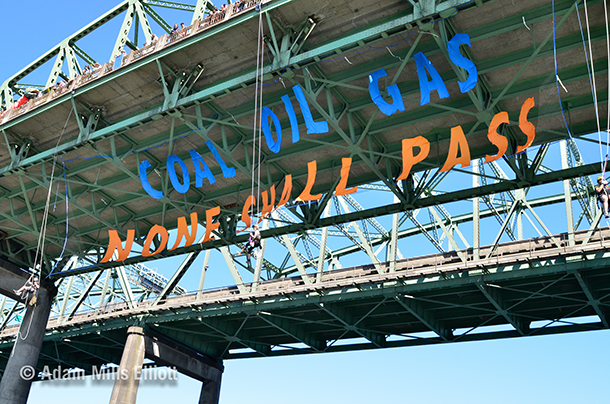 In October 2014, the FBI began contacting at least a dozen people who had been involved in protests against fracking and tar sands development, including the Keystone XL pipeline. In some instances, the agents visited—unannounced and uninvited—people at their place of employment, even though the people were not suspected of any crime or involvement in planned crimes. Reporter Becky Kramer and attorney Larry Hildes discuss the FBI's tactics and its history of surveillance against political activists.
Go to page |
Download/listen
10:21
Original Show Pub Date: 20.Feb.2015 ~~ Original story title: FBI Questions Keystone XL Activists
CATEGORY: ENVIRONMENT, COLLAPSE — 21.FEB.2015
C-Realm Podcast
Yay or Nay? — Intentional Collapse as a Response to Environmental Catastrophe —
 An extreme position in the environmental movement is that activists should be engaged in deliberately trying to hasten the collapse of the global economic system. Nothing short of complete collapse, they argue, can save the rest of life on earth from human rapaciousness and stupidity. In a debate recorded at the 16th annual Sustainable Living Festival in Melbourne, Australia, six thought leaders weighed in on whether there is any sensible reason to advocate the collapse of the global economy. No one said "yes," and one person answered with a clear "no," but the rest gave nuanced answers that cannot be contained within a simple "yay" or "nay."
Go to page |
Download/listen
58:16
Original Show Pub Date: 18.Feb.2015
CATEGORY: ENVIRONMENT, CORPORATIONS — 21.FEB.2015
Uprising
New Refinery Explosion ... and More Evidence of Oil Companies Not Investing in Safety —
 A recent explosion at an ExxonMobil refinery in Torrance, California injured four workers, shattered the windows of nearby buildings, and released massive amounts of smoke and ash into the air, prompting the mayor of Torrance to advise residents to "shelter in place, stay indoors, no outdoor activity, turn the air conditioners off, keep the windows closed." Investigative reporter Antonia Juhasz uses this event as a starting point for the broader discussion about oil companies scrimping on maintenance and safety at refineries and the dangers posed to nearby communities.
Go to page |
Download/listen
23:36
Original Show Pub Date: 19.Feb.2015 ~~ Original story title: Oil and Energy Expert Analyses Latest Exxon Refinery Explosion
CATEGORY: ENVIRONMENT, FINANCIAL — 20.FEB.2015
Radio EcoShock
Want to Fix the Broken System? Think Like a Commoner —
 One percent of humans control half the world's wealth. This is the result of what author David Bollier calls "the market state"—a tight marriage of billionaires, mega-corporations, and political institutions. A host of problems boil out of this paradigm of power, including unsustainable resource use, rampant pollution as "externalities," and a new economic serfdom. We've been told there is no alternative, but David Bollier says there is, and it's an idea we've been taught to hate: the commons. His most recent book is Think Like a Commoner: A Short Introduction to the Life of the Commons.
Go to page |
Download/listen
30:00
Original Show Pub Date: 11.Feb.2015
CATEGORY: ENVIRONMENT — 17.FEB.2015
Living on Earth
James Gustave Speth Calls for a New Environmentalism —
NRDC co-founder Gus Speth reflects on the environmental movement both as a previous 'insider' and now as a reformer. He says that half a century ago, he and other eco-activists were inspired by the direct-confrontation methods of the civil rights movement and applied similar energy and tactics in the fight to confront environmental issues. But somewhere along the way, as groups like NRDC worked to reform the system, they became part of the system. And now progress on environmental issues has stalled or reversed. In his memoir Angels by the River, Speth calls for deeper challenges to the economic status quo as an approach that can solve problems of the environment, of working people, and of a broken political system.
Go to page |
Download/listen
14:30
Original Show Pub Date: 13.Feb.2015
CATEGORY: ENVIRONMENT (COAL) — 11.FEB.2015
Radio EcoShock
Talking Dirty... About Coal —
Coal is a world-class environmental wrecking ball, with impacts affecting climate, mountains, streams, air pollution, food quality, and more. But hey don't worry about that; American jobs are at stake. That's the message coming from the National Center for Policy Analysis, or the NCPA. It's a tax-exempt organization that's been pumping out the big-business message for over 30 years. Here's an example of some recent NCPA coal propaganda: "Increasing US coal exports could be good for the US economy, workers, and the environment..." Really? Coal, good for the environment? Not so fast, mister...
Go to page |
Download/listen
12:01
Original Show Pub Date: 04.Feb.2015
CATEGORY: ENVIRONMENT (CLIMATE) — 05.FEB.2015
Biodiversity for a Livable Climate / Radio EcoShock
The Planetary Peril in the IPCC's Lowest-Common-Denominator Science —
Thomas Goreau's doctorate is in biogeochemistry. He's an expert in areas such as coral reef science and global climate change. Two of the main points Goreau makes are that the IPCC's window of focus is much too narrow—most of the worst climate effects will be beyond its 100-year window—and its conclusions are so "lowest common denominator" that they are greatly underestimating both the data trends and coming impacts. He also says that the "350" goal is far too high—if we accept even that currently politically unattainable goal, we are doomed to a temperature increase of 17-20 degrees C. Goreau says atmospheric CO2 levels need to be rolled back to 260 ppm. He says the essential solution—mostly ignored by global leaders—is to put carbon back in the soil using practices such as biochar.
Watch |
Download/listen
24:07
Original Show Pub Date: Nov.2014 ~~ Original title: Thomas Goreau - The Down-to-Earth Solution to Global Warming: How Soil Carbon Sequestration Works
CATEGORY: ENVIRONMENT — 23.JAN.2015
Sea Change Radio
Smarter Cities —
 Many planners agree that a more centralized population is a good thing for long-term environmental responsibility. But as people all over the world continue to flock to urban centers, the challenge of creating sustainable cities becomes more pressing. How can cities be improved to ensure that their billions of residents have energy-efficient transportation, housing, waste-stream management, as well as clean air and water? Ecological urban planner Melanie Nutter walks us through some of the emerging policies and practices to promote smart, sustainable, resilient cities.
Go to page |
Download/listen
29:00
Original Show Pub Date: 13.Jan.2015
CATEGORY: ENVIRONMENT — 18.JAN.2015
Living on Earth
Climate and the Collapse of Western Civilization —
Science historians Naomi Oreskes of Harvard and Erik Conway of CalTech have taken current climate science and extrapolated it into an apocalyptic new science fiction book, The Collapse of Western Civilization—A View From the Future. Oreskes discusses how democracy, the free market, and science are all failing to protect our future.
Go to page |
Download/listen
16:28
Original Show Pub Date: 16.Jan.2015
CATEGORY: NUCLEAR, ENVIRONMENT — 18.JAN.2015
Fairewinds Energy Education
Debate: Should Nuclear Energy Be Expanded to Help Create a More Sustainable Future? —
Given the seriousness of the climate challenge—of the need to get to a zero-carbon future—does nuclear need to play an expanded role in the world's energy matrix? This was the question that Hofstra University posed to a debate panel in late 2014. Arnie Gundersen of Fairewinds was among the debaters who discussed the environmental, fiscal, and policy issues pertaining to the expansion of nuclear energy.
Watch |
Download/listen
1:31:10
Original Show Pub Date: 20.Nov.2014
CATEGORY: ENERGY, ENVIRONMENT — 12.JAN.2015
Radio EcoShock
The Future of Energy—Green Tech or Green Illusions? —
Is the whole "green energy" game just an extension of the fossil fuel industry, dressed up in green clothing? In part 1, Ozzie Zehner makes the case that high-tech greening of our civilization is a pipedream. In particular, he targets solar PV as a technology that causes many more problems that it's worth, and is often use as a "green badge of honor" when other, less sexy approaches do far more to reduce energy use and pollution. ~~ In part 2, clean-tech venture capitalist Dan Miller gives his views on alternative energy and provides a counterweight to Ozzie Zehner's dim view of a green-tech future.
Go to page A |
Download/listen A
1:00:00
Go to page B |
Download/listen B
1:00:00
Original Show Pub Date: 31.Dec.2014 + 07.Jan.2015 ~~ Original story titles: (1) Green Illusions - Ozzie Zehner (2) Green Reality vs. Ozzie Zehner
CATEGORY: MEDIA, EMPIRE, ENVIRONMENT — 10.JAN.2015
Project Censored
The Most Underreported Stories of 2014 —
 Project Censored is out with a new addition of their annual "unreported stories" book. On the environmental front, their top underreported stories include "Ocean Acidification Increasing at Unprecedented Rate"; "Lawsuit Challenges Nuclear Power Industry Immunity from Liability in Nuclear Accidents"; "Agribusiness Attempts to Discredit Scientists Who Reveal Herbicide Health Threats." On the empire front, their most-underreported stories include "Top Ten US Aid Recipients All Practice Torture"; "WikiLeaks Revelations on Trans-Pacific Partnership Ignored by Corporate Media"; "Corporate Internet Providers Threaten Net Neutrality"; "Bankers Back on Wall Street Despite Major Crimes"; "The Deep State—Government Without the Consent of the Governed"; "US Media Hypocrisy in Covering Ukraine Crisis."
Download/listen
59:00
Original Show Pub Date: 06.Jan.2015
CATEGORY: HEALTH, ENVIRONMENT — 10.JAN.2015
Uprising
Cancer—Environmental Factors and Genetics vs. Plain Ol' Bad Luck —
 A new study has found that 22 types of cancer are the result of sheer bad luck, blaming the cancers largely on random mistakes in tissue-specific stem cells and stating that the cancers arise in a manner unrelated to genetic or environmental factors. Julia Brody of the Silent Spring Institute offers a countering opinion, noting that a different team looked at exactly the same data and concluded that only 10% of cancers were attributable to random bad luck.
Go to page |
Download/listen
12:28
Original Show Pub Date: 07.Jan.2015 ~~ Original story title: The Science of Health: Silent Spring Inst. Cautions Against New Cancer Study
CATEGORY: ENVIRONMENT — 08.JAN.2015
Unwelcome Guests
The Temptation of The Technofix —
 In this audio of speeches from the 2014 conference "Techno-Utopianism and the Fate of the Earth," we hear seven speakers who, despite contrasting styles and material, manage to jointly conclude that technological development has become unhinged from our true human values. The speakers, in order, are John Michael Greer, Gar Smith, Mary Reynolds-Thompson, David Ehrenfeld, Lisi Krall, and Stephanie Mills. Topics include technology's history of broken promises; how technology is devastating life; how technology has tamed us, as we use it to (unintentionally) destroy life on earth and ourselves; challenging the idea of "de-extinction" as a solution; the economic evolution of dominion.
Go to page A |
Download/listen A
1:00:00
Go to page B |
Download/listen B
1:00:00
Original Show Pub Date: 13.Dec.2014
CATEGORY: ENVIRONMENT — 18.DEC.2014
NPR
New York Moves to Ban Fracking —
Officials in New York have announced that the state will ban hydraulic fracturing within its borders. The move follows years of efforts by environmentalists, who cite dangers like earthquakes and potential contamination of New York's renowned pristine water supply.
Go to page |
Download/listen
3:14
Original Show Pub Date: 18.Dec.2014
CATEGORY: ENVIRONMENT — 17.DEC.2014
Living on Earth
AGs Driving Environmental Politics at State Level —
 US Attorneys General are not usually big players in national policy-making, but in recent years that's changed. Democrat AGs have previously teamed with environmental groups to move on issues that were stalled at the national level; now Republican AGs are allying with fossil fuel companies to challenge federal environmental regulations in court. Political scientist Paul Nolette discusses this development.
Go to page |
Download/listen
13:40
Original Show Pub Date: 12.Dec.2014 ~~ Original story title: Republican AGs Fight Environmental Regulations
CATEGORY: AGRICULTURE, CHEMICALS — 17.DEC.2014
Food Sleuth Radio
Pesticides—Beware the Drifter —
Attorney Amanda Heyman's job is providing legal counsel for independent farmers and food businesses. Here she discusses the legal aspects of pesticide drift, GMOs, organics, and "natural" labeling.
Go to page |
Download/listen
28:15
Original Show Pub Date: 20.Nov.2014
CATEGORY: ENVIRONMENT — 16.DEC.2014
Radio EcoShock
Catastrophic Failure of the Planet—Satire or SITREP? —
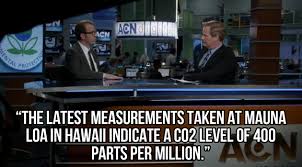 Joseph D'Lacey writes eco-apocalyptic/horror fiction as a way of exploring the way in which the human condition is broken. Here he discusses his fictional post-apocalypse books, which include the Black Dawn series, which extrapolates from our real-life era when corporations are literally sucking the earth dry of its high quality resources; and Meat, where a combination of powerful corporations and organized religion completely control the food supply, with living standards for animal welfare and human rights falling by the wayside. ~~ Then Stanford's Mary Kang explains the data on leaking methane from abandoned gas wells. ~~ A clip from the fictional show "The Newsroom" has an EPA scientist going non-linear, predicting absolute climate doom, with no possibility of escape. Real-life climate scientist Michael Mann gives his take on our climate prospects.
Go to page |
Download/listen
1:00:00
Original Show Pub Date: 10.Dec.2014 ~~ Original story title: Eco Horror ... Is "The Newsroom" Climate Doom for Real?
CATEGORY: ENVIRONMENT — 12.DEC.2014
NPR
Sloppy Fracking Practices Result In Large Methane Leaks —
Faulty equipment and maintenance procedures in natural gas operations can inadvertently release large quantities of methane, new research reveals. Scientists say most of the problem can be pinned on a relatively small number of "clunker" wells.
Go to page |
Download/listen
3:19
Original Show Pub Date: 09.Dec.2014
CATEGORY: ENVIRONMENT, CORPORATIONS — 10.DEC.2014
CounterSpin
30 Years Since Bhopal, Justice May Finally Be Getting Started —
 It was 30 years ago that a gas leak at the Union Carbide pesticide plant in Bhopal, India, killed thousands of people and injured tens of thousands more. But if you think of Bhopal as a tragedy from the '80s, you're missing the point: It was a crime and it's far from over. Amitabh Pal of the Progressive talks about the ongoing disaster of Bhopal and the potential progress finally being made to clean up the area and properly compensate victims.
Go to page |
Download/listen
10:14
Original Show Pub Date: 05.Dec.2014
CATEGORY: ENVIRONMENT, CORPORATIONS — 10.DEC.2014
Democracy Now
The US Role in Illegally Logging Peru's Forests —
More than half of Peru is still covered by tropical rainforest—an area the size of Texas—which plays a crucial ecosystem role and is a significant carbon sink. A new report documents how more than 20 US companies have imported millions of dollars in illegal wood from the Peruvian Amazon since 2008. Guest is Julia Urrunaga, Peru programs director for the Environmental Investigation Agency and author of the new report, "The Laundering Machine: How Fraud and Corruption in Peru's Concession System Are Destroying the Future of Its Forests."
Watch |
Download/listen
6:59
Original Show Pub Date: 08.Dec.2014
CATEGORY: ENVIRONMENT, CORPORATIONS — 09.DEC.2014
Living on Earth
Coal Baron Indicted in Mine Disaster —
In 2010, in one of the deadliest mine accidents in US history, an explosion at the Upper Big Branch
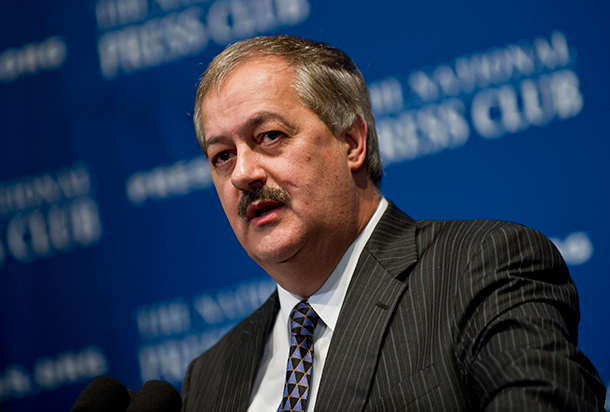 Coal mine in West Virginia killed 29 miners. Now Don Blankenship, the CEO of mining company Massey Energy, has been indicted on federal charges, which accuse him of directing company policies that were contrary to mining regulations and laws and that contributed to the disaster. Law professor Patrick McGinley talks about the case.
Go to page |
Download/listen
6:47
Original Show Pub Date: 05.Dec.2014
CATEGORY: AGRICULTURE, FOOD, GMOs — 09.DEC.2014
Food Sleuth Radio
The Seed Underground—A Growing Revolution to Save Food —
 Janisse Ray discusses the threat to seed sovereignty posed by multinationals like Monsanto, which are endeavoring to lock up the food-related profit stream from field to fork by owning the means of production. She explains how activism and seed saving both play a role in the fight.
Go to page |
Download/listen
28:15
Original Show Pub Date: 13.Nov.2014
CATEGORY: ENVIRONMENT, HEALTH — 05.DEC.2014
Sea Change Radio
Tis The Season For A Good Guide —
 It's that time of year, again: the season of giving ... or at least the season of buying. When you're perusing the shelves, be they virtual or actual, what matters to you? Beyond price, quality, and value, what about knowing how the company that made the product treats its workers, the extent to which production depletes natural resources, and what impact this product has on the environment? Many of us care about these things in the abstract, but it's difficult to put our tenets into practice. If only there were an app. But there is! Dara O'Rourke explains the Good Guide, a website and smart phone app that consumers can use to make informed "green" decisions on what they're buying.
Go to page |
Download/listen
30:00
Original Show Pub Date: 02.Dec.2014
CATEGORY: SPECIES, GENETIC ENGINEERING — 04.DEC.2014
 Quirks and Quarks
Genetically Modified Chestnuts —
A century ago, the American Chestnut was a tremendously important species in the forests of Eastern North America, representing more than a quarter of all forest trees in a swath from Georgia to Ontario. But a fungus introduced on imported Asian chestnut trees turned out to be catastrophic for the American Chestnut, killing billions of trees and essentially wiping out the species by the 1950s. Breeding a blight-resistant tree has proved laborious and difficult, so now a research team has developed a genetically modified American Chestnut that uses a gene from wheat to resist the effects of the fungus. Lead researcher William Powell explains.
Go to page |
Download/listen
10:08
Original Show Pub Date: 22.Nov.2014
CATEGORY: ENVIRONMENT — 03.DEC.2014
Radio EcoShock
The Anthropocene and Techno-Utopia —
 Environmental journalist Christian Schwagerl discusses some of the concepts of assigning human impact as the dominant force of the current era, now being called "The Anthropocene" by many in scientific circles. Can the planet survive the wave of human modification washing over it? Can WE? ~~ Then we hear excerpts from speeches given by American Green Party founder Charlene Spretnak and author Susan Griffinon on the topic "Techno-Utopianism and the Fate of the Earth."
Go to page |
Download/listen
1:00:00
Original Show Pub Date: 26.Nov.2014
CATEGORY: ENVIRONMENT (POLLUTION), SPECIES — 01.DEC.2014
Quirks and Quarks
Lakes Turning to Jelly —
 The problem of acid rain is often touted as one of the few success stories in controlling pollution, as the industrial emissions that cause it have been cut substantially. But the environmental damage and disruption caused by acid rain still echo in the wilderness. One example discovered is the "jellification" of temperate lakes, where acid rain has reduced calcium content, an essential element for most lake organisms. This has caused some crustaceans at the base of the aquatic food chain—the ones that make their exoskeletons from calcium—to be at a disadvantage, and they're now being displaced by species that have a jelly-like coating. These jelly organisms are inedible to many predators and thus are disruptive to the lakes' ecological balance.
Go to page |
Download/listen
10:43
Original Show Pub Date: 22.Nov.2014
CATEGORY: ENVIRONMENT — 26.NOV.2014
Radio EcoShock
Healing Green Despair —
Todd Wilkinson, author of a new biography of eco-billionaire Ted Turner, talks about Turner's attention to green issues. Is this proof that the wealthy can lead on environmental challenges? ~~ Kathleen Dean Moore comments on green despair, saying we should not wallow in self-loathing or use our own complicity in environmental issues as a reason to excuse the worst offenders—the fossil-fuel companies—when it comes to climate change and other issues. ~~ Writer and owl biologist Tim Fox sees humans as an unstoppable flood. Species that have been able to adapt have prospered; most have not.
Go to page |
Download/listen
1:00:00
Original Show Pub Date: 19.Nov.2014
CATEGORY: ENVIRONMENT — 22.NOV.2014
CounterSpin
US/China Climate Deal—Not Built to Last —
 The White House's climate emissions deal with China has been praised throughout the media as a big step in the right direction. One liberal columnist told readers not to listen to the "yes but" naysayers. But critics of the deal are worth listening to; for one, Daphne Wysham of the Center for Sustainable Economy, who says the goals are timid, the timing is suspect, and the enforcement mechanism is weak.
Go to page |
Download/listen
9:30
Original Show Pub Date: 21.Nov.2014
CATEGORY: ENVIRONMENT — 21.NOV.2014
Sea Change Radio
Digging Deep with Paul Hawken —
 Paul Hawken is an environmental thought-leader, author, and perhaps best known as the co-founder of the high-end gardening supply chain Smith & Hawken. Hawken talks about the challenge of taking society to the next quantum level in the face of political factionalism and environmental immaturity. Topics include corporate social responsibility; the evolution of the open-source-economy and sharing-economy movements; and how communication technology has transformed global human interaction, holding promise for future green activism.
Go to page A |
Download/listen A
30:00
Go to page B |
Download/listen B
30:00
Original Show Pub Date: 11.Nov.2014
CATEGORY: ENVIRONMENT — 20.NOV.2014
Radio EcoShock
Stolen Future, Broken Present —
 David Collings discusses the epochal environmental crisis that is unfolding. Climate change is a centerpiece, but this is a many-faceted problem with no easy solutions. Overcoming the psychology that fathered the problem may not be possible, but it's still worth trying. ~~ Then Martin Persson explains how tropical deforestation is still stripping the planet—to provide products for us, the consumers in rich countries. ~~ Finally, Olli Tammilehto asks whether we can we survive a system that rewards the rich with a license to commit ecocide?
Go to page |
Download/listen
1:00:00
Original Show Pub Date: 12.Nov.2014
CATEGORY: EMPIRE, ENVIRONMENT (CLIMATE) — 18.NOV.2014
Making Contact
This Changes Everything (Or Not) —
Naomi Klein argues that while it's too late to stop climate change, we can still take action to save our civilization. But it's going to take radical steps that will transform the way humans interact with the world. Klein offers her vision of how we can foster a global movement to counter climate change.
Go to page |
Download/listen
30:00
Original Show Pub Date: 29.Oct.2014
CATEGORY: EMPIRE, ENVIRONMENT — 14.NOV.2014
Nature Bats Last
Higher Learning, Higher Debt, and The System —
Guy McPherson talks to Karl Klein. Topics include....the inadequacies of IPCC climate reports; illegal asset forfeiture at the hands of local cops; the problem of limitations of rare-earth metals. Much of the conversation centers on how our higher-learning institutions are not training our students correctly at the same time they foster high levels of post-graduation indebtedness. McPherson contrasts his decision to leave academia with Klein's decision to stay within the system.
Download/listen
1:01:57
Original Show Pub Date: 04.Nov.2014
CATEGORY: ENERGY, ENVIRONMENT (COAL, CLIMATE) — 12.NOV.2014
Radio EcoShock
India's Mega-Coal Plants —
 Targeted for 4,000 megawatts, the Sasan Ultra Mega Power Project (UMPP) in India is ten times the size of the average coal power plant in the United States. Worse still, we find ourselves in an Orwellian world, where a mega coal plant in India is classified as "environmentally friendly technology"; where electricity customers in Europe can buy credits from a coal plant as a "clean development mechanism"; and where hundreds of millions of US taxpayer dollars help build a dirty coal project. Nicole Ghio of Sierra Club International explains.
Go to page |
Download/listen
21:55
Original Show Pub Date: 05.Nov.2014
CATEGORY: ENERGY, ENVIRONMENT — 11.NOV.2014
Radio Ecoshock
A Path to Sustainable Energy by 2030 —
 Super-scientist Mark Jacobson from Stanford explains the warming/cooling nuances of soot pollution in the atmosphere. Then he reviews the math on how available technologies can have the world well on the way to running on clean energy by 2030.
Go to page |
Download/listen
20:00
Original Show Pub Date: 05.Nov.2014
CATEGORY: ENVIRONMENT — 10.NOV.2014
Living on Earth
Green Issues in the 2014 Election —
 Steve Curwood and guests review how environmental candidates and issues fared in the recent US election. Other stories in this show are .... Arsenic Released in Frackwater Spills // Fingerprinting Frackwater // Hyundai and Kia Fined for Misreporting MPG and Greenhouse Gas Emissions // Restoring California's Giant Kelp Forests // Uprooting an Invasive Ribbon Grass on the Metolius River.
Go to page |
Download/listen
51:30
Original Show Pub Date: 07.Nov.2014
CATEGORY: EMPIRE, ENVIRONMENT — 10.NOV.2014
Radio EcoShock
Solving the Problem of Ecocidal Capitalism —
Frank Rotering is quite sure that capitalism is killing the planet. In the past, he has advocated a voluntary shrinkage of the industrial economy as a way to reduce pollution and resource pressures and let the planet come back into balance. But he now realizes that few are willing to join that quest, so he has a new strategy based on converting true conservatives of the capitalist class to a non-ecocidal posture.
Go to page |
Download/listen
27:39
Original Show Pub Date: 22.Oct.2014
CATEGORY: ENVIRONMENT (CLIMATE) — 07.NOV.2014
Living on Earth
How Can Harsher Winters Be Related to Arctic Sea Ice Loss? —
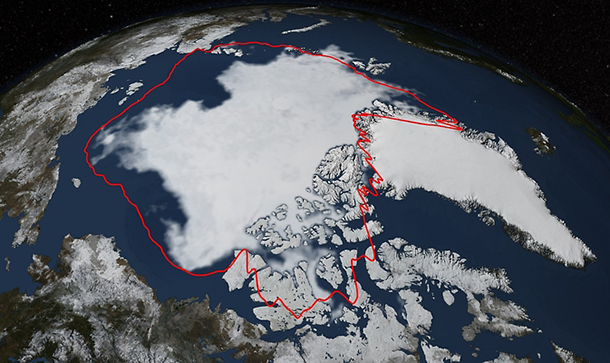 A new study published in Nature Geoscience found that the likelihood of unusually cold winters in parts of Eurasia doubles as the Arctic warms and sea ice declines. Rutgers University climate researcher Jennifer Francis explains how loss of Arctic sea ice can lead to harsher winters in some regions at the same time it causes warming-related phenomena such as drought or increased heavy rainfall events in other regions.
Go to page |
Download/listen
8:47
Original Show Pub Date: 31.Oct.2014
CATEGORY: ENVIRONMENT (CHEMICALS) — 04.NOV.2014
Living on Earth
Green Groups Sue EPA Over Agent Orange-Related Herbicide —
A coalition of environmental groups and farmers is suing the EPA over approval of Dow Chemical's new GMO crop herbicide, Enlist Duo, a combination of glyphosate and 2,4-D, one of two active ingredients in the notorious Vietnam-era defoliant Agent Orange. The lawsuit alleges inadequate environmental and health assessments by the agency. Bill Freese of the Center for Food Safety discusses the suit and the effects the herbicide is likely to have on weed resistance and pollinators.
Go to page |
Download/listen
8:35
Original Show Pub Date: 31.Oct.2014 ~~ Original story title: Agent Orange-Related Herbicide Approved for GMO Crops; EPA Sued
CATEGORY: ENVIRONMENT (CLIMATE) — 30.OCT.2014
Living on Earth
Carbon Recycling —
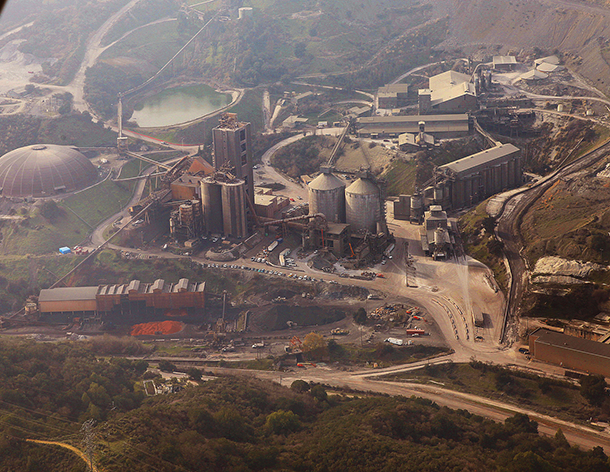 A Texas company has started capturing CO2 from a cement plant in San Antonio and is set to recycle 75,000 tons of CO2 per year by incorporating it into profitable products, including baking soda, hydrochloric acid, and bleach. The process can also be used for fossil fuel power plants.
Go to page |
Download/listen
5:56
Original Show Pub Date: 24.Oct.2014 ~~ Original title: Carbon Capture and Recycling
CATEGORY: ENVIRONMENT (POLLUTION) — 28.OCT.2014
Living on Earth
Fracking Waste Water Proves Highly Resistant to Clean-Up —
The oil and gas industry produces a high volume of dirty wastewater from fracking operations. That polluted water has to go somewhere, and the two typical solutions are down an injection well or, after some slight clean-up, into another fracking operation. But as public resistance to injection wells and fracking grows, some businesses trying to truly clean up fracking waste water so it can be put back into nature. Unfortunately, so far, it turns out that the matrix of pollutants in fracking wastewater is very difficult to deal with in volume.
Go to page |
Download/listen
7:32
Original Show Pub Date: 24.Oct.2014 ~~ Original title: It's Tough To Turn Frack Water into Profits
CATEGORY: ENVIRONMENT (POLLUTION, RECYCLING) — 27.OCT.2014
Living on Earth
Who is Recycling E-Waste? —
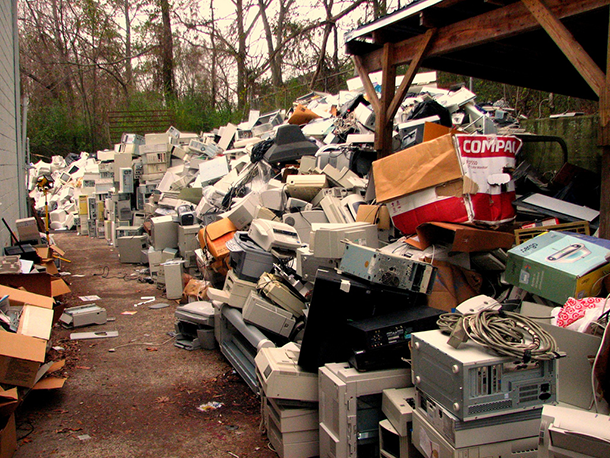 Electronic waste is one of the fastest growing waste streams in the world, and a new survey from Best Buy found that only about a third of people in the United State recycle their electronic waste, even though many more claim that they would like to. US stores, including Staples and Best Buy, are helping to close this gap with free e-waste recycling programs.
Go to page |
Download/listen
6:17
Original Show Pub Date: 24.Oct.2014
CATEGORY: ENVIRONMENT (CHEMICALS), SPECIES — 25.OCT.2014
Quirks and Quarks
The Pill is Harming Fish —
 We have known for years now that pharmaceuticals make their way into our waterways, through residues in urine or by disposal of unused drugs down our toilets. The consequences are often detrimental to aquatic wildlife. Dr. Karen Kidd of the University of New Brunswick has studied this phenomenon in the fathead minnow in an experimental lake in Northern Ontario. The introduction of birth-control chemicals into the water not only caused the fathead minnow population to crash, it upset the balance of the entire ecosystem. This included a sharp decline in the trout population, which prey on the minnow.
Go to page |
Download/listen
11:30
Original Show Pub Date: 18.Oct.2014
CATEGORY: ENVIRONMENT (MINING) — 25.OCT.2014
Living on Earth
Mountain Top Removal Coal Mining Increases Cancer Risk —
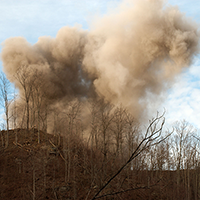 Overburden removal during mountain-top-removal coal mining in Appalachia blasts dust into the air that is then carried on the wind for miles and inhaled by nearby residents. Michael Hendryx is a Professor of Applied Health Science at Indiana University Bloomington and co-author of a study linking that dust to lung cancer. He's calling for a halt to this type of coal mining.
Go to page |
Download/listen
6:41
Original Show Pub Date: 24.Oct.2014
CATEGORY: ENVIRONMENT, SPECIES — 23.OCT.2014
Resistance Radio
Has Capitalism Captured the Environmental Movement? —
Tom Butler of the Northeast Wilderness Trust talks with Derrick Jensen about the problematic trend among mainstream environmental groups trying to steer capitalism in a better direction. The problem with that approach is that capitalists, when push comes to shove, will always prioritize corporate profits over natural preservation. Even more troubling is the shift in the framing of environmental issues, where the comfort, convenience, and continuation of modern life is a given, and any sacrifice along those lines to preserve species or protect the biosphere is not even up for discussion.
Download/listen
50:59
Original Show Pub Date: 19.Oct.2014
CATEGORY: ENVIRONMENT (CLIMATE, POLLUTION) — 21.OCT.2014
Sea Change Radio
Can Ozone Success Be Parlayed into GHG Success? —
 Durwood Zaelke was a key advocate decades ago in the fight to instate policies that would preserve the ozone layer. Those efforts were very successful and are often lauded as a sign that nations CAN come together to solve difficult environmental problems that are global in scope. Zaelke is still working on ozone protection, but his organization's mission has broadened to include combating climate change. Zaelke contrasts the ozone protection effort with the climate protection effort.
Go to page |
Download/listen
30:00
Original Show Pub Date: 16.Sep.2014 ~~ Original title: Durwood Zaelke and the Ozone Keepers
CATEGORY: ENERGY, ENVIRONMENT (POLLUTION) — 20.OCT.2014
Living on Earth
Companies Pulling Out of Canadian Tar Sands Oil —
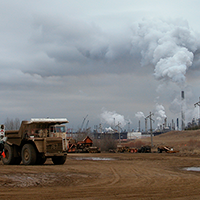 With crude prices sharply down and the future of the Keystone XL pipeline in doubt, energy companies have become dubious about investing in oil projects based in the Alberta Tar Sands. OnEarth writer Brian Palmer discusses the problems facing the industry.
Go to page |
Download/listen
8:35
Original Show Pub Date: 17.Oct.2014
CATEGORY: COLLAPSE, ENVIRONMENT (CLIMATE) — 20.OCT.2014
C-Realm Podcast
No Matter What —
KMO talks to Global Catastrophic Risk Institute researcher David Denkenberger about the technical feasibility of feeding everyone on earth in the aftermath of a calamity the wipes out conventional agriculture. The potential collapse scenarios include nuclear winter based on nuclear war or a massive volcanic eruption; a plague (natural or manmade); a catastrophic mistake in a high-impact technology; or even artificial intelligence taking over. Denkenberger is careful to distinguish technical feasibility from political or economic feasibility. Then KMO shares some thoughts on the incompatibility of capitalism and environmental stewardship from the Socialist Equality Party and with a brief clip from a conversation between Laura Flanders and Gar Alperovitz. He closes with some unconventional thoughts on technology from sci-fi author Karl Shroeder.
Go to page |
Download/listen
59:55
Original Show Pub Date: 08.Oct 2014
CATEGORY: ENVIRONMENT (COAL, WETLANDS) — 16.OCT.2014
Living on Earth
Coal Dust Poses Wetland Threat —
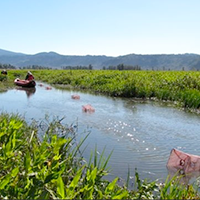 With recent proposals to bring coal by rail through the Pacific Northwest for export to Asia, some scientists worry that coal dust containing mercury might contaminate Washington's wetlands, threatening wildlife. Reporter Ashley Ahearn treks through marshes and muck near railways with USGS scientists as they look for coal's potential impacts on wetland ecosystems.
Go to page |
Download/listen
4:55
Original Show Pub Date: 10.Oct.2014
CATEGORY: AGRICULTURE, ENVIRONMENT (GMOs) — 16.OCT.2014
Food Sleuth Radio
Failed Promises and Real Risks of GMO Crops —
Raymon Seidler is a former senior scientist at the Environmental Protection Agency. Decades ago, he led the first team to study the environmental and health impacts of newly introduced GMO crops. He explains how we have ignored risks in favor of broad market penetration; in particular, plans for containing the unintended contamination of organic and non-GMO crops with GMO genetic material have been utterly inadequate. Pesticide use has also risen, not fallen as the industry promised.
Go to page |
Download/listen
28:15
Original Show Pub Date: 02.Oct.2014
CATEGORY: ENERGY, ENVIRONMENT (POLLUTION, CLIMATE) — 14.OCT.2014
Living on Earth
 China Still Burning Plenty of Coal as Fracking Ramps Up —
Among China's energy efficiency initiatives is a program that replaces outdated coal-fired power plants with more modern—but larger—coal-fired plants. This has led to an overall increase in CO2 emissions as more coal is burned. ~~ Partly in response to the unprecedented air pollution crisis caused largely by burning coal, China is looking to its massive natural gas reserves for energy. But Mother Jones reporter James West says that fracking is bringing its own environmental problems to China.
China Still Burning Plenty of Coal as Fracking Ramps Up —
Among China's energy efficiency initiatives is a program that replaces outdated coal-fired power plants with more modern—but larger—coal-fired plants. This has led to an overall increase in CO2 emissions as more coal is burned. ~~ Partly in response to the unprecedented air pollution crisis caused largely by burning coal, China is looking to its massive natural gas reserves for energy. But Mother Jones reporter James West says that fracking is bringing its own environmental problems to China.
Go to page A |
Download/listen A
5:00
Go to page B |
Download/listen B
10:30
Original Show Pub Date: 10.Oct.2014 ~~ Original story titles: China's Energy Efficiency Program Still Promotes Global Warming ~~ China's Great Frack Forward
CATEGORY: ENVIRONMENT (CLIMATE) — 14.OCT.2014
Living on Earth
In Hotter (Sea) Water —
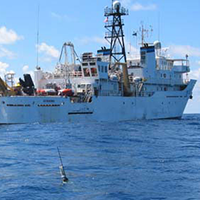 As the climate warms, atmospheric temperatures don't tell the full story—much of the heat increase is being absorbed by the oceans. Scientists are increasingly concerned about the impact on ocean health. Paul Durack of the Lawrence Livermore National Laboratory discusses new measurements that say mainstream estimates of ocean warming are off by more than 25 percent.
Go to page |
Download/listen
6:14
Original Show Pub Date: 10.Oct.2014
CATEGORY: ENVIRONMENT, SPECIES — 10.OCT.2014
Living on Earth
Obama Creates the World's Largest Ocean Reserve —
President Obama expanded the Pacific Remote Islands National Marine Monument, protecting nearly half a million square miles of Pacific Ocean from commercial exploitation. Elliott Norse of the Marine Conservation Institute talks about the impact of the reserve on the ecosystem and the precedent it sets for global conservation.
Go to page |
Download/listen
6:40
Original Show Pub Date: 03.Oct.2014
CATEGORY: ENVIRONMENT (POLLUTION) — 08.OCT.2014
Quirks and Quarks
"Microbead" Plastic Pollution Plagues the St. Lawrence River —
 Microplastic beads, often found in industrial and household products like cosmetics and cleaners, are known to pollute ocean water. Now the beads have been found in the sediments of the St. Lawrence for the first time. Anthony Ricciardi, a biologist at McGill University, explains why it was surprising to find this type of pollution in a river, especially in the sediment, and what the impact on river life is.
Go to page |
Download/listen
8:50
Original Show Pub Date: 04.Oct.2014
CATEGORY: ENVIRONMENT (CLIMATE) — 07.OCT.2014
Radio EcoShock
 Why Lie to Ourselves About Methane? —
While the world's focus is on carbon dioxide, a group of powerful scientists have written an urgent letter to the directors of five US government agencies. The scientists worry that the American government, like other governments around the world, is not paying attention to the big climate risk posed by methane, especially from the thawing Arctic. Mickey Moritz of the Center for Biological Diversity explains.
Why Lie to Ourselves About Methane? —
While the world's focus is on carbon dioxide, a group of powerful scientists have written an urgent letter to the directors of five US government agencies. The scientists worry that the American government, like other governments around the world, is not paying attention to the big climate risk posed by methane, especially from the thawing Arctic. Mickey Moritz of the Center for Biological Diversity explains.
Go to page |
Download/listen
17:18
Original Show Pub Date: 01.Oct.2014
CATEGORY: ENVIRONMENT — 06.OCT.2014
Living on Earth
The State of the Planet —
The World Wildlife Fund recently released its 2014 Living Planet Report, which studied 10,000 wildlife populations across the globe to assess the overall state of the planet. The WWF's Keya Chatterjee discusses the report. A key finding was that the total number of vertebrate animals—excluding humans—is down by 50%. Other topics include climate, cities getting sustainable, and population.
Go to page |
Download/listen
8:42
Original Show Pub Date: 03.Oct.2014
CATEGORY: ENVIRONMENT (POLLUTION) — 01.OCT.2014
Living on Earth
Communities at Odds with States on Fracking Wastewater Zoning —
Fracking wastewater is trucked from Pennsylvania into Ohio, where it is processed and injected into deep wells. Many locals worry about earthquakes and water contamination, but local councils are finding that state rules override citizens' concerns about waste-water well siting.
Go to page |
Download/listen
7:09
Original Show Pub Date: 19.Sep.2014
CATEGORY: ENVIRONMENT (FORESTS, CLIMATE) — 29.SEP.2014
Radio EcoShock
Fires in Northern Canada a Major Event in the Life of the Earth System —
Northern Canada just experienced the worst fire season ever recorded. A Canadian scientist calls them "a major event in the life of the earth system." Soot from these fires may be a primary cause of the snow surface in Greenland turning from white to dark and dirty—i.e. a major change in albido. Marc-Andre Parisien, a research scientist for the Canadian Fire Service, talks about the characteristics of the great Boreal forest and why the fires there are such a major issue.
Go to page |
Download/listen
20:00
Original Show Pub Date: 24.Sep.2014
CATEGORY: SPECIES, ENVIRONMENT — 25.SEP.2014
Living on Earth
The Wilderness Act at 50 —
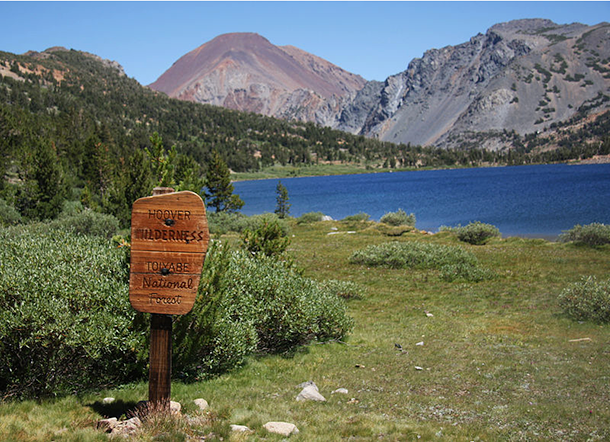 In 2014, the Wilderness Act turned 50. American environmental writer Jordan Fisher Smith discuss the relevance of the Wilderness Act today, as well as changing perceptions of wild lands, their uses, and how to protect them.
Go to page |
Download/listen
9:23
Original Show Pub Date: 12.Sep.2014
CATEGORY: CLIMATE, COLLAPSE — 24.SEP.2014
Radio Ecoshock
Near-Term Climate-Driven Human Extinction—Or Not —
In the first clip, conservation biologist Guy McPherson lays out his case that runaway feedback mechanisms have already been tripped and will alter the climate so significantly that humans will be unable to survive—and we'll be toast within just a few decades. Psychologist Carolyn Baker agrees and offers tips on how to live a happy life in the meantime. ~~ In part two, environmental writer Scott K. Johnson says it ain't so, that McPherson cherry picks data and extrapolates in inappropriate ways. Podcaster KMO, an excellent deep-thinker on collapse issues, says McPherson seems to be trying to make the data fit his foregone conclusions. Just as "collapse from peak oil" has not happened as precipitously as many predicted, so neither is "collapse from climate chaos" likely to drive human extinction in our lifetimes.
Go to page A |
Download/listen A
1:00:00
Go to page B |
Download/listen B
1:00:00
Original Show Pub Date: 17.Sep.2014
CATEGORY: ENVIRONMENT (TOXICS, CLIMATE) — 23.SEP.2014
TUC Radio
Poisoning the Sky—A Community Investigates Chemtrails and Fights Back —
Residents of Shasta County, California have documented that the lingering white trails in the sky above—chemtrails—are correlated with an increase in toxic contaminants in rain, snow, and surface water, including aluminum, barium and strontium. In this clip, we hear experts and citizens present their evidence before the Shasta County Supervisors as a matter of public health and an issue of citizens' right to know. They point out that the chemicals in the contaminated water are also found in patents for weather modification chemicals used by the military and private contractors.
Go to page |
Download/listen
30:00
Original Show Pub Date: 10.Sep.2014
CATEGORY: ENVIRONMENT (CLIMATE) — 11.SEP.2014
Radio EcoShock
 The High Arctic and High Anxiety —
Alex Smith provides a review of some of the disturbing climate news in the high Arctic—trends that predict a hotter and less stable climate for all of us. Climate scientist Paul Beckwith, who is just back from the glaciers of Alaska, explains. ~~ Psychologist Susie Burke talks about mental preparation for disasters and ways to cope with eco-anxiety.
The High Arctic and High Anxiety —
Alex Smith provides a review of some of the disturbing climate news in the high Arctic—trends that predict a hotter and less stable climate for all of us. Climate scientist Paul Beckwith, who is just back from the glaciers of Alaska, explains. ~~ Psychologist Susie Burke talks about mental preparation for disasters and ways to cope with eco-anxiety.
Go to page |
Download/listen
1:00:00
Original Show Pub Date: 02.Sep.2014, Original story title: The High Arctic and Eco-Anxiety
CATEGORY: ENVIRONMENT (PESTICIDES), HEALTH — 06.SEP.2014
Making Contact
Pesticides—Homes, Farms, and Kids —
The pesticide chlorpyrifos was deemed toxic enough that it has been banned for household use. But the pesticide is still allowed for farm use, so what about the continued effects on the health of farmworkers and their children? What about pesticide drift into unintended areas? What about other pesticides—are we protecting children in general from their development-disruption effects?
Go to page |
Download/listen
28:58
Original Show Pub Date: 27.Aug.2014
CATEGORY: ENERGY, ENVIRONMENT (POLLUTION) — 03.SEP.2014
Sea Change Radio
Keeping An Eye On The Natural Gas Boom —
 Even the most casual followers of energy policy have become aware of the controversy surrounding the massive expansion of fracking in this country over the past decade. Successful attempts to lift the curtain on fracking, like Josh Fox's 2010 documentary film Gasland, have spurred a grassroots movement to push back against an industry that would have us believe that fracking is clean and safe as well as the solution to US energy woes. Journalist Neela Banerjee discusses the battle for America's health and well-being that is being fought on the parallel fronts of policy and PR.
Go to page |
Download/listen
30:00
Original Show Pub Date: 18.Aug.2014
CATEGORY: ENVIRONMENT (WATER), SPECIES — 28.AUG.2014
Resistance Radio
The Colorado River—Past, Present, and Future —
Gary Wockner coordinates the Save the Colorado River Campaign, whose mission is to protect and restore the Colorado River and its tributaries from the source to the sea. Topics include the history of the river; water rights and farms vs. cities; impact of dams and water rights on species; and opportunities for improving the river's future.
Download/listen
39:45
Original Show Pub Date: 24.Aug.2014
CATEGORY: GARDENING, POLLUTION — 25.AUG.2014
You Bet Your Garden
Is Your Lawn Causing Water Pollution? —
Mike McGrath's topics include .... adequate soil calcium combats tomato blossom end rot; weather and care factors in cherry production; crepe myrtle conundrums; outdoor potted plants approach the doom of winter; tips for new trees. In the question of the week, McGrath talks about runoff from lawn fertilizer, a problem that recently made Toledo's water undrinkable. Find out how to not be part of the problem when you feed your lawn.
Go to page |
Download/listen
52:58
Original Show Pub Date: 23.Aug.2014
CATEGORY: ENERGY, ENVIRONMENT, FINANCIAL — 20.AUG.2014
Post Carbon Institute
Humans—Are We the Borg? ... Or Merely Delusional? —
 In an hour and a half, ecological economist Nate Hagens offers up a grand tour of how the human-dominated planet works, or more accurately, mis-works. It all comes down to bad programming—science shows that we humans are predisposed to making bad choices; or at least making choices that bolster short-term, selfish desires at the expense of long-term, altruistic interests. Energy, or an increasing lack thereof relative to our needs, is the hammer that will force us to recognize reality and make increasingly hard choices.
Watch |
Download/listen
1:30:00
Original Show Pub Date: 29.Jul.2014
CATEGORY: ENVIRONMENT (POLLUTION) — 28.JUL.2014
Living on Earth
Pennsylvania's Complicated Groundwater Contamination —
In many locations in Pennsylvania, well water is unfit to drink, polluted with iron and manganese. But the source of the contamination is complex. Reid Frazier of the Allegheny Front reports that fracking, coal mining, and natural methane formations in the ground combine to make single-source blame difficult to prove.
Go to page |
Download/listen
7:18
Original Show Pub Date: 25.Jul.2014
CATEGORY: ENVIRONMENT — 25.JUL.2014
Making Contact
Fighting Goliath—The Tar Sands Monster —
 The Canadian Tar Sands is the largest industrial project on earth. Its potential environmental consequences have brought together citizens from across borders, to fight its rippling effects. In Idaho and Montana, hundreds of gargantuan trucks were routed to haul mining equipment to the Tar Sands oil fields of Alberta, Canada, endangering sensitive wildlife areas and risking damage to roads and municipal utilities. But an alliance of citizens and community groups was able to block the transport project. Meanwhile, back in the Tar Sands extraction area, regulations lag and the enormity of the environmental damage grows.
Go to page A |
Download/listen A
30:00
Go to page B |
Download/listen B
30:00
Original Show Pub Date: 22.Jul.2014
CATEGORY: ENVIRONMENT (CLIMATE, FORESTS) — 24.JUL.2014
Unwelcome Guests
REDD and the Perversity of Financial Incentives —
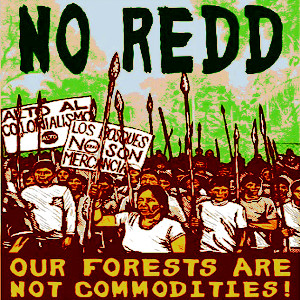 Jeff Conant explains REDD, a scheme to financialize carbon and forests, where pristine, formerly priceless natural zones are turned into commodities for sale. Most market advocates argue that such a process should lead to efficient outcomes, but Conant explains why the devil lurking in the details of REDD means that the program is much more about making money than about reducing carbon or preserving forests. ~~ The Conant piece is preceded by a short reading of John Taylor Gatto's sorry tale of trying to use cash payments to incentivize and enhance the learning of his students, providing us with an example of the perverse way in which financial incentives—whether for learning or for forest preservation—can cause the opposite outcome from that which is desired.
Go to page |
Download/listen
59:36
Original Show Pub Date: 28.Jun.2014
CATEGORY: ENERGY, ENVIRONMENT — 21.JUL.2014
The Keiser Report
Fracking—Economic Insolvency, Environmental Insanity —
Tina Rothery discusses the government's propagandistic stance on the 'inevitability' of fracking, the environmental damage the process causes, the poor economics for almost all fracking undertakings, how the moneychangers are propelling the technology forward despite the bad economics for most participants, and how fracking companies are now using paid squatters on fracking sites to prevent anti-fracking activists from doing the same and disrupting operations.
Watch |
Download/listen
13:23
Original Show Pub Date: 12.Jul.2014
CATEGORY: ENVIRONMENT, COOL AND COSMIC — 21.JUL.2014
The Lifeboat Hour
Planetary Hospice —
In an ecosystem, each dying thing ultimately becomes part of the nutrient stream for new growth. Zhiwa Woodbury explains why humans' irrational fear of dying is a root cause of our lack of environmental understanding and why we do not properly value natural systems and interaction with nature. Just as we feel fear at the though of dying, we feel fear at the thought that the planet might die (from catastrophic environmental degradation). Indeed, the rich web of life is broken and ending; but there can also be liberation and rebirth in disintegration.
Download/listen
55:20
Original Show Pub Date: 20.Jul.2014
CATEGORY: ENVIRONMENT, SPECIES — 16.JUL.2014
resistance Radio
The Impact of Recreational Off-Road Vehicles —
Bethanie Walder, WildEarth Guardians Public Lands Director, discusses the impact of recreational off-road vehicles on non-motorized outdoor enthusiasts (hikers, campers, fishers, etc.) and on the environment and animals. Topics include history off off-road vehicles in parks, how NEPA applies, off-roaders as a vocal minority, the false "jobs vs. owls" argument in forestry decisions, rights vs. responsibilities.
Download/listen
48:21
Original Show Pub Date: 13.Jul.2014
CATEGORY: ENVIRONMENT, FOOD — 14.JUL.2014
Food Sleuth Radio
Nanomaterials In Soil—Our Future Food Chain? —
Steve Suppan of the Institute for Agriculture and Trade Policy discusses a new report on the presence of nanomaterials in soil and water, as well as their effects on soil health and, ultimately, the safety of food and drinking water.
Go to page |
Download/listen
28:15
Original Show Pub Date: 26.Jun.2014
CATEGORY: ENVIRONMENT (COAL) — 12.JUL.2014
One Radio Network
Coal Problems Continue as the Noose Tightens —
 After trash, coal ash is the second largest source of solid waste in the US. The recent massive coal ash spill into the Dan River in North Carolina has brought renewed attention to the problem of toxic pollution from coal operations. Mary Anne Hitt of the Sierra Club's Beyond Coal Campaign discusses a variety of coal-related topics, including new political will to tighten regulations on coal ash; mercury pollution from power plants to be cut by 90%; and coal as the number one source of water pollution.
Go to page |
Download/listen
51:00
Original Show Pub Date: 30.Jun.2014
CATEGORY: SPECIES, CLIMATE — 24.JUN.2014
Uprising
As Ocean Acidity Rises, Will Phytoplankton Health Fall? —
 Microscopic ocean creatures called phytoplankton produce an astonishing 60 percent of the Earth's oxygen and they occupy the crucial bottom rung of our world's ocean food chain. The survival of most life on this planet depends on healthy phytoplankton. Researcher William Cochlan discusses a new study that is attempting to predict the likely impact to phytoplankton from rising CO2 and ocean acidity levels. Though results are still unfolding, it appears that some phytoplankton turn more toxic in a higher acidity environment and, in turn, harm the shellfish and other marine animals that feed on them.
Go to page |
Download/listen
21:06
Original Show Pub Date: 18.Jun.2014
CATEGORY: ENVIRONMENT (CLIMATE) — 17.JUN.2014
Living on Earth
EPA Greenhouse Gas Rules Ignore Methane —
Climate protection advocates have applauded the EPA's recent power plant regulations, but environmental lawyer Bill Snape says the new rules don't deal with methane, and that's a serious problem for the climate. More broadly, it's a continuation of Obama's policy of underregulating the natural gas extraction industry.
Go to page |
Download/listen
10:43
Original Show Pub Date: 13.Jun.2014
CATEGORY: ENVIRONMENT (POLLUTION) — 14.JUN.2014
Quirks and Quarks
Microplastics on Ice —
Researchers have discovered that Arctic sea ice is contaminated with tiny fragments of plastic that originated from run-off, dumped garbage, and fishing gear. As multi-year sea-ice disappears, this reservoir of frozen plastic is likely to be released back into the Arctic Ocean. Dr. Rachel Obbard explains why the ice naturally takes up the particles of plastic that enter the Arctic Ocean from the Atlantic and Pacific, and expresses concern that as global warming causes more ice to melt, sea life will be more and more impacted.
Go to page |
Download/listen
10:24
Original Show Pub Date: 31.May.2014
CATEGORY: ENVIRONMENT (CLIMATE) — 10.JUN.2014
Alternative Visions
Obama's New CO2 Rules—The Bogus Brain Behind the Happy Face —
 Energy analyst Steve Breyman discusses the new Obama/EPA proposal to reduce CO2 emissions from existing industrial plants in the US by 30% by 2030. Are the proposals too little, too late, and cleverly crafted to defer the pain until after Obama leaves office? Topics include the slippery climate math of fracked natural gas; the XL pipeline loophole; a backdoor approach to cap and trade; increased taxation vs. consumer rebates; the future for coal-fired power plants.
Download/listen
1:00:27
Original Show Pub Date: 07.Jun.2014
CATEGORY: FOOD, AGRICULTURE, CHEMICALS — 09.JUN.2014
Food Chain Radio
Waste, Want Not —
Caroline Snyder talks about the toxic chemicals that are found in sewage sludge and the conspiracy of corporations and municipal treatment operations that hides the truth from the public and attacks anyone who dares question their practices. Snyder is professor emeritus at the Rochester Institute of Technology and founder of Citizens for Sludge-Free Land. Joining the conversation is Patty Martin, a former town mayor in California and co-founder of Safe Food and Fertilizer.
Go to page |
Download/listen
42:22
Original Show Pub Date: 24.May.2014
CATEGORY: ENVIRONMENT, SPECIES — 09.JUN.2014
Sea Change Radio
A Wilderness Too Tame —
When was the last time you were really in the wilderness? Or, maybe you're like the millions of Americans who've never even been in the wild before. Jason Mark, editor of Earth Island Journal, shares his misgivings about what he views to be a technological threat to some of nature's most mysterious spots. He says much of what we currently consider wild is actually pretty tame. Also discussed are conservation policy and the surprising number of bipartisan conservation bills that (unsurprisingly) have not yet been passed by Congress.
Go to page |
Download/listen
30:00
Original Show Pub Date: 20.May.2014
CATEGORY: ENVIRONMENT (CHEMICALS) — 04.JUN.2014
Living on Earth
Common Pollutants and Chemicals Increase Breast Cancer Risk —
A recent study from the Silent Spring Institute catalogued common pollutants and chemicals that increase breast cancer risk. Dr. Julia Brody explains how we can minimize exposure to these carcinogens and reduce the health risk.
Go to page |
Download/listen
7:02
Original Show Pub Date: 16.May.2014
CATEGORY: ENVIRONMENT (CLIMATE) — 29.MAY.2014
Quirks and Quarks
Why Are Scientists Sure That the West Antarctic Ice Will Slip Away? —
 The West Antarctic ice sheet appears to have passed a critical tipping point and will inevitably collapse. According to new research by two separate climate-study groups, warm deep-sea water, driven by shifting climate patterns around Antarctica, has undermined two critical glaciers that are part of the ice sheet, making it likely that the whole ice sheet will melt into the sea. If this happens, global sea levels will rise by more than three meters.
Go to page |
Download/listen
10:52
Original Show Pub Date: 17.May.2014
CATEGORY: FOOD, GMOs, CHEMICALS, HEALTH — 28.MAY.2014
One Radio Network
Glyphosate—Either It Goes Away or We Go Away —
Stephanie Seneff is a Senior Research Scientist at MIT. She's been studying the effects of GMOs
 and glyphosate, the primary herbicide used with GMOs, and what she has discovered is devastating: Glyphosate is ubiquitous and exposure is toxic, leading her to conclude that we either ban glyphosate's use or we prepare to die off. Topics include ... glyphosate and gut bacteria; glyphosate as a cause of fungal infections; glyphosate vs. bees, bats and other animals; Europe, Russia, China, and others pushing back against GMOs.
Go to page |
Download/listen
1:03:24
Original Show Pub Date: 20.May.2014
CATEGORY: FOOD, ENVIRONMENT, LABOR — 26.MAY.2014
Sierra Club Radio
Green Coffee —
Helen Russell of Equator Coffee discusses the reasons we should care about sustainably grown, fair-trade coffee. Russell also talks about how she went from two coffee shops to a $9M green coffee company.
Go to page |
Download/listen
14:02
Original Show Pub Date: 17.May.2014
CATEGORY: SUSTAINABILITY, ENVIRONMENT — 22.MAY.2014
ExtraEnvironmentalist
William Rees: Why Degrowth? —
 Ecological economist William Rees, author of the "ecological footprint" concept, talks about the numerous limits humans are smacking up against and that may prove to be our undoing. He explains the concept of "degrowth"—the idea that we would intentionally choose a to shrink economic activity to reverse unsustainable trends. From the 2014 De-Growth Vancouver Event, Part 1.
Watch |
Download/listen
35:43
Original Show Pub Date: 17.Apr.2014
CATEGORY: SUSTAINABILITY, CLIMATE — 22.MAY.2014
ExtraEnvironmentalist
Jennie Moore: How Degrowth Applies to Vancouver, Canada, and the World —
 Jennie Moore is the Director of Sustainable Development and Environmental Stewardship at the British Columbia Institute of Technology. She discusses opportunities for we caring humans to do better at reducing our ecological footprint, especially carbon, but also explains why such steps will never be enough in the context of an infinite growth economy. From the 2014 De-Growth Vancouver Event, Part 2.
Watch |
Download/listen
17:33
Original Show Pub Date: 17.Apr.2014
CATEGORY: ENVIRONMENT (MINING) — 21.MAY.2014
Living on Earth
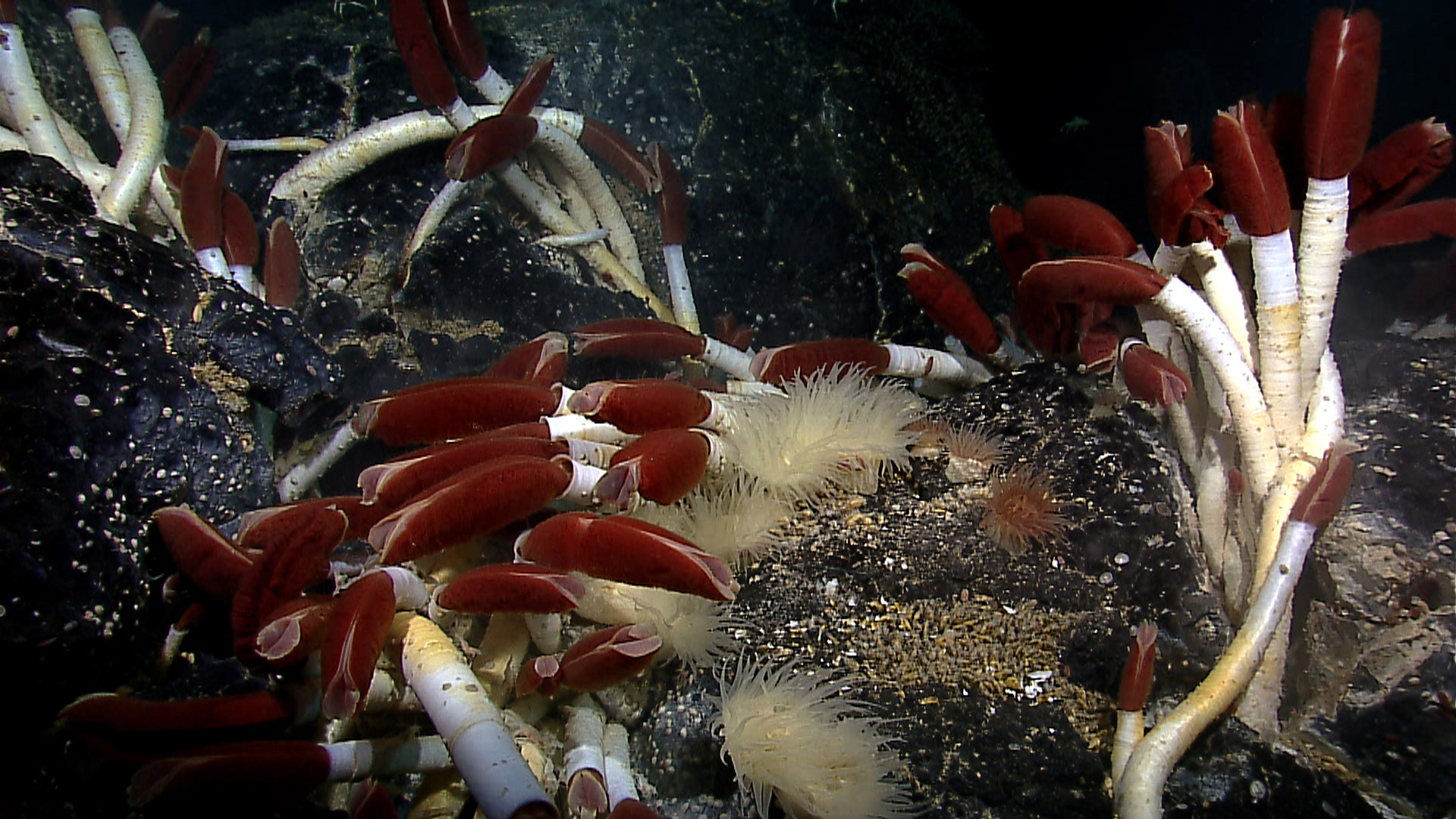 Deep Seabed Mining —
Deep-ocean mining may sound futuristic, but a Canadian company recently struck a deal with Papua New Guinea to mine gold and other metals from deep beneath their coastal sea. Greenpeace campaigner Richard Page explains what types of minerals and mining are being targeted and talks about why the project raises concerns about the impact on life in the deep ocean.
Deep Seabed Mining —
Deep-ocean mining may sound futuristic, but a Canadian company recently struck a deal with Papua New Guinea to mine gold and other metals from deep beneath their coastal sea. Greenpeace campaigner Richard Page explains what types of minerals and mining are being targeted and talks about why the project raises concerns about the impact on life in the deep ocean.
Go to page |
Download/listen
6:30
Original Show Pub Date: 16.May.2014
CATEGORY: CLIMATE — 21.MAY.2014
Living on Earth
The (So Far) Elusive Dream of Carbon Capture And Storage —
Future regulations on carbon dioxide emissions will mean that coal plants must capture and sequester their CO2—or go out of business. Reid Frazier reports that despite years of experiments there is still no cost-effective way to employ carbon capture technology at coal-fired power plants.
Go to page |
Download/listen
7:55
Original Show Pub Date: 16.May.2014
CATEGORY: ENVIRONMENT, CLIMATE — 20.MAY.2014
Moyers and Company
David Suzuki on Corp-Gov Anti-Environmentalism —
We live in an upside-down world where the people who would protect the natural systems that sustain us (environmentalists) are openly declared enemies of the state, where corporations fund a big-media propaganda machine dedicated to false statements about global warming and other environmental issues. David Suzuki says the "kill the messenger" strategy is ripped straight from big tobacco's old playbook. While he is concerned that humans are setting themselves up for a fall, he is more optimistic about the chances for "the planet"—it's highly resilient (though we are not).
Watch |
Download/listen
24:27
Original Show Pub Date: 16.May.2014
CATEGORY: ENVIRONMENT, GLOBALIZATION — 19.MAY.2014
CounterSpin
White House Trade Policies Undermining Clean Energy Goals —
 Ben Lilliston of the Institute for Agriculture and Trade Policy explains why White House policies promoting energy efficiency and renewables may be good rhetoric, but the broader goals for sustainable energy and a clean environment are undermined by White House trade policies.
Go to page |
Download/listen
9:30
Original Show Pub Date: 16.May.2014
CATEGORY: ENVIRONMENT, CORPORATIONS — 19.MAY.2014
Political Analysis
Green Slime—The Corporate Attack on Rooftop Solar —
Solar industry insider Chuck McCune discusses energy democracy, solar power, and paradigm shifts. Topics include how energy corporations are trying to undermine consumer-installed solar; the true (and shocking) kilowatt-hour cost of nuclear energy; strategies for boosting solar energy.
Download/listen
1:00:00
Original Show Pub Date: 08.May.2014
CATEGORY: ENVIRONMENT, MEDIA — 16.MAY.2014
Between the Lines
Environmental Group Targets NPR for Ditching Coverage of Fracking Issues in Deference to Corporate Sponsors —
 It's no secret that the interests of corporate sponsors influence what stories get covered, which get ignored, and what point of view the coverage conveys. So it was not surprising that when NPR started accepting corporate sponsorship from the American Natural Gas Alliance, the network's national coverage of the downsides of fracking all but ceased. Drew Hudson of Environmental Action explains why his group targeted NPR.
Go to page |
Download/listen
6:58
Original Show Pub Date: 02.Apr.2014
CATEGORY: GARDENING, CLIMATE — 15.MAY.2014
Living On Earth
Gardening in a Climate-Changed World —
 From vicious drought to terrible storms, climate change is affecting people throughout the world. But writer Jim Barilla sees that climate change is also being felt in his own urban garden in South Carolina. He explains how climate disruption has changed his gardening practice and offers suggestions on how gardeners can adapt.
Go to page |
Download/listen
6:10
Original Show Pub Date: 09.May.2014
CATEGORY: AGRICULTURE, CLIMATE — 15.MAY.2014
NPR
Less Nutritious Grains May Be In Our Future —
In the future, Earth's atmosphere is likely to include much more carbon dioxide. Scientists say that some of the world's most important crops will likely contain fewer crucial nutrients when they grow in such an environment.
Go to page |
Download/listen
2:59
Original Show Pub Date: 08.May.2014
CATEGORY: CHEMICALS, FOOD — 14.MAY.2014
Living on Earth
 Guide to Pesticide Residues on Produce —
The Environmental Working Group has released its annual "dirty dozen" list of the twelve fruits and vegetables most contaminated with pesticide residues. This clip lists many of the top 12 and reminds us that extra washing of non-organic produce is not a solution.
Guide to Pesticide Residues on Produce —
The Environmental Working Group has released its annual "dirty dozen" list of the twelve fruits and vegetables most contaminated with pesticide residues. This clip lists many of the top 12 and reminds us that extra washing of non-organic produce is not a solution.
Go to page |
Download/listen
5:40
Original Show Pub Date: 09.May.2014
CATEGORY: ENVIRONMENT — 09.MAY.2014
Radio EcoShock
Kevin Danaher on the Green Future —
 Kevin Danaher says people often react to the proposal of good grand projects with the attitude, "sure, that will be great for the future." But "the future is now" in terms of implementing projects that will correct current problems and pay dividends for the era of our grandchildren. He talks about this year's green festival and green goals in general.
Go to page |
Download/listen
21:00
Original Show Pub Date: 07.May.2014
CATEGORY: ENVIRONMENT (POLLUTION) — 07.MAY.2014
Living on Earth
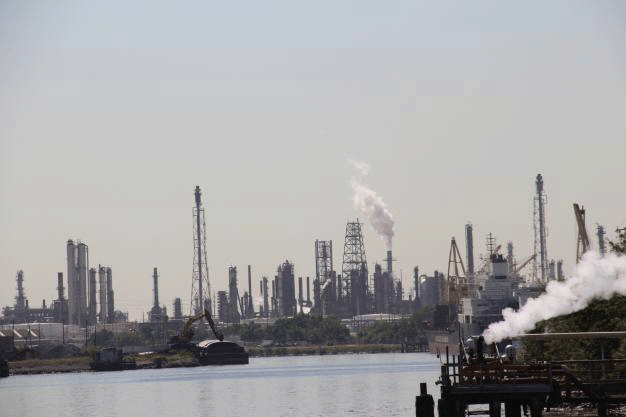 State of the Air 2014 —
This year's State of the Air report from the American Lung Association shows a growing ground-level ozone problem. But the recent Supreme Court decision on interstate air pollution has clean-air advocates smiling. ~~ In a related story, Houston, Texas is home to the largest chemical hub in the Americas and is one of the smoggiest cities in the US. The city is working to clean up its air, but it still has a long way to go.
State of the Air 2014 —
This year's State of the Air report from the American Lung Association shows a growing ground-level ozone problem. But the recent Supreme Court decision on interstate air pollution has clean-air advocates smiling. ~~ In a related story, Houston, Texas is home to the largest chemical hub in the Americas and is one of the smoggiest cities in the US. The city is working to clean up its air, but it still has a long way to go.
Go to page A |
Download/listen A
6:07
Go to page B |
Download/listen B
5:00
Original Show Pub Date: 02.May.2014
CATEGORY: ENVIRONMENT (POLLUTION) — 05.MAY.2014
NPR
Farmers And Frackers Wrangle For Water In Shadow Of California Drought —
California's drought has developed an interesting relationship between farmers and oilers: California oil wells produce more water than oil, and Chevron filters that water and sells it to a local water district. Interest in the technology is growing in the Central Valley, but high costs and uneasy relations between oil and agriculture might get in the way.
Go to page |
Download/listen
4:58
Original Show Pub Date: 29.Apr.2014
CATEGORY: ENVIRONMENT (POLLUTION) — 05.MAY.2014
NPR
Supreme Court Ruling Affirms Law Regulating Out-Of-State Pollution —
The Supreme Court has upheld an EPA air pollution rule that reins in pollution from power plant smoke stacks when that pollution fouls the air in downwind states. Clean-air advocates say the rule finally addresses a disconnect between the science of air pollution and the laws intended to clean it up.
Go to page |
Download/listen
2:41
Original Show Pub Date: 29.Apr.2014
CATEGORY: ENVIRONMENT, CLIMATE — 04.MAY.2014
Sea Change Radio
Richard Heinberg on the Anthropocene —
Richard Heinberg discusses the era of the anthropocene, the geological epoch during which the enduring central feature will be human-driven changes to the environment. Climate change is not the only characteristic within this concept, but it is likely to be the dominant one. Heinberg distinguishes between "lean, green" solutions (typified by permaculture) and "techno" solutions (typified by genetic engineering, geoengineering, etc.). The first group is hampered by the fact that human desire is at odds with the goals; the second group is likely to prove unsustainable. In the end, Heinberg thinks the interdependence of species—the web of life—will prove to be something that we break at our peril.
Go to page |
Download/listen
30:00
Original Show Pub Date: 22.Apr.2014
CATEGORY: HEALTH, ENVIRONMENT (CHEMICALS) — 02.MAY.2014
Living on Earth
Flea Collar Chemical Banned To Protect Toddlers —
 The EPA has banned certain flea and tick collars for cats and dogs because young children touching their pets can get exposures to unhealthful amounts of pesticides. The move came in response to lawsuits filed by the Natural Resources Defense Council. NRDC Senior Scientist Miriam Rotkin-Ellman explains which collars are the problem and says there are safer alternatives.
Go to page |
Download/listen
5:54
Original Show Pub Date: 25.Apr.2014
CATEGORY: ENVIRONMENT (CLIMATE) — 30.APR.2014
Radio EcoShock
Cli-Fi — Climate Beyond Imagination —
 Envisioning a future where the climate has changed significantly enough to affect people's everyday lives is the theme of a growing body of fiction and non-fiction dubbed "Cli-Fi." Alex Smith talks to authors Perry Kelly and Mary Woodbury about the genre. ~~ Richard Rosen of the Tellus Institute explains why current models of the economics of mitigating climate change are so flawed as to be useless.
Go to page |
Download/listen
59:59
Original Show Pub Date: 23.Apr.2014
CATEGORY: ENVIRONMENT (CLIMATE) — 30.APR.2014
Living On Earth
Finance and Economics vs. Climate and Fossil Fuels —
Some may think that the price of addressing climate change today is high, but the IPCC's 2104 mitigation report says it's cheap compared to what it would cost in the future. Joseph Romm discusses the report's cost-benefit analysis. ~~ A growing movement across the country is demanding that institutions pull their investments out of fossil fuel companies. In Massachusetts, pensioners, professors, and students recently demonstrated to urge divestment from the corporations most responsible for climate change.
Go to page A |
Download/listen A
11:23
Go to page B |
Download/listen B
6:46
Original Show Pub Date: 18.Apr.2014
CATEGORY: ENVIRONMENT (CHEMICALS) — 24.APR.2014
Democracy Now
Toms River—How a Small Town Fought Back Against a Corporate Giant and Its Toxic Dumping —
Environmental reporter Dan Fagin discuss the topic of his book, Toms River: A Story of Science and Salvation, which tells the story of how a small New Jersey town fought back against industrial pollution and astronomical rates of childhood cancer and ultimately won one of the largest legal settlements in US history. Regarding chemical pollution in general, Fagin says that we collect massive amounts of data but we don't look for patterns that point to contamination and health problems: "People are dying because we do not do effective public health surveillance in this country."
Watch |
Download/listen
24:41
Original Show Pub Date: 23.Apr.2014
CATEGORY: ENVIRONMENT (CLIMATE) — 22.APR.2014
Radio EcoShock
The Green Scare—Religion and Anti-Environmentalism —
Are big fundamentalist churches selling out to the big bucks of Big Oil and Big Coal and helping the fossil fools derail
 climate action? Rev. Michael Dowd explains why junk-science-thumping preachers are at odds with the core tenets of Christianity and are actually doing evil. ~~ Also discussed: A new report from UNEP shows alternative energy growth strong but slightly down in 2013.
Go to page |
Download/listen
1:00:00
Original Show Pub Date: 16.Apr.2014
CATEGORY: HEALTH, CHEMICALS — 22.APR.2014
Against the Grain
Flame Retardants and Other Synthetic Chemicals Are Ubiquitous —
  We may not realize it, but most of us consume small amounts of toxic flame retardants and other chemicals on a daily basis. California has just overturned the mandate that flame retardants be used on foam, but the chemicals remain in much of our existing furniture. Chemist Arlene Blum, who is partially responsible for the change, discusses the use of flame retardants in everything from sofas and mattresses to baby products. ~~ Then environmental historian Nancy Langston talks about how synthetic chemicals can trigger cancer and other illnesses in humans.
Go to page |
Download/listen
54:59
Original Show Pub Date: 07.Apr.2014
CATEGORY: ENVIRONMENT (POLLUTION) — 22.APR.2014
Democracy Now
Four Years After BP Disaster, Ousted Regulator Warns US at Risk of Another Spill —
 Four years ago, BP's Deepwater Horizon drilling platform exploded and killed 11 workers, causing more than 200 million gallons of oil to spew into the Gulf of Mexico. Now, the Environmental Protection Agency has lifted a ban that excluded BP from new federal oil contracts. Elizabeth Birnbaum, who was forced out as director of the Minerals Management Service shortly after the Deepwater Horizon blowout, explains that little has changed in the way drilling is practiced and warns that there is a real risk of another offshore oil blowout. ~~ Then Jaclyn Lopez of the Center for Biological Diversity comments on the impact to Gulf wildlife.
Watch |
Download/listen
16:17
Original Show Pub Date: 21.Apr.2014
CATEGORY: ENVIRONMENT (POLLUTION) — 22.APR.2014
NPR
Telltale Rainbow Sheens Show Thousands Of Oil Spills Across The Gulf —
Under the Clean Water Act, when a company spills any amount of oil in the water, it must file a report with the National Response Center run by the Coast Guard. But when Jonathan Henderson checked, he found many small spills in the Gulf region were not making that list. So environmental groups formed the Gulf Monitoring Consortium to get a better count on spills.
Go to page |
Download/listen
3:57
Original Show Pub Date: 19.Apr.2014
CATEGORY: ENVIRONMENT (CLIMATE) — 17.APR.2014
Living on Earth
The Growing Threat From Methane —
Methane is many times more powerful as a greenhouse gas than carbon dioxide. Evidence from prehistory suggests methane was a major factor in Earth's largest extinction, and current global warming projections warn of ballooning methane emissions in the future. The White House has launched plans to reduce methane emissions from US sources.
Go to page |
Download/listen
6:23
Original Show Pub Date: 11.Apr.2014
CATEGORY: HEALTH, PESTICIDES — 15.APR.2014
Living on Earth
Study Links Pesticides and Lowered Intelligence —
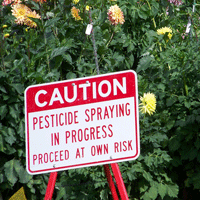 Studies conducted in the Salinas Valley and New York City have found that the effects of pesticides on development in children can be similar to those of lead, including lower IQs and slower mobility. Journalist Susan Freinkel discusses the findings.
Go to page |
Download/listen
6:27
Original Show Pub Date: 11.Apr.2014
CATEGORY: CLIMATE, HISTORY — 15.APR.2014
Against the Grain
In the 17th Century, a Different Climate Crisis but the Same Old Elites —
In the 1600s, the world faced a global climate crisis—an extended period of cooling known as the Little Ice Age—which severely depressed agricultural output. Most rulers of the time took the opportunity not to help their populations adapt to the problem but as an opportunity to purge internal enemies and harvest the wealth of other lands. Historian Geoffrey Parker discusses the lessons of the 17th century, where elites—with the exception of Tokugawa Japan—responded to the crisis with wars and scapegoating.
Go to page |
Download/listen
54:41
Original Show Pub Date: 01.Apr.2014
CATEGORY: ENVIRONMENT — 14.APR.2014
Sea Change Radio
Hurricane Sandy's Lessons in Coastal Resilience —
 As major weather-related calamities like Hurricane Sandy are teaching us, decisions around where buildings are built and vegetation is planted are important, especially as they relate to the encroaching coastline and other impacts of climate change. Meera Subramanian discusses post-Sandy restoration efforts that draw upon engineering insights from a hundred years ago.
Go to page |
Download/listen
30:00
Original Show Pub Date: 01.Apr.2014
CATEGORY: ENVIRONMENT (POLLUTION) — 12.APR.2014
Making Contact
Sounding the Alarm—Noise Pollution —
 Noise pollution is a growing problem. On this edition, we hear three stories about noise pollution: how it affects marine mammals; how it affects people near airports; how it feels to be in a remote area with only natural sounds.
Go to page |
Download/listen
30:00
Original Show Pub Date: 02.Apr.2014
CATEGORY: ENVIRONMENT (CLIMATE) — 09.APR.2014
Quirks & Quarks
IPCC Climate Change Report Advocates Adaptation —
The Intergovernmental Panel on Climate Change has issued its latest report, which focuses on "Impacts, Adaptation and Vulnerability," or how humans and the natural systems are likely to be affected by climate change, and how we can try to adapt to it. We are definitely already seeing the impacts of climate change, and while we've started to prepare for the more serious issues to come—including extreme weather, drought, floods, potential crop failures, and wildfires—there is still much to do.
Go to page |
Download/listen
16:28
Original Show Pub Date: 05.Apr.2014
CATEGORY: ENVIRONMENT (POLLUTION) — 01.APR.2014
Living On Earth
Oil Spills Increasing —
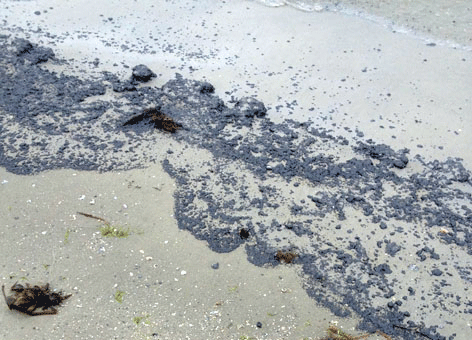 The 25th anniversary of the Exxon Valdez spill was marked by a tanker spill in the Gulf of Mexico, an oil pipeline rupture in an Ohio nature reserve, and a BP refinery leaking oil into Lake Michigan. Lorne Stockman of Oil Change International says that oil producers are increasingly going after difficult-to-extract oil reserves. The more difficult production environments and changing oil substrates are stressing the infrastructure, so we're seeing an increase in spills.
Go to page |
Download/listen
7:20
Original Show Pub Date: 28.Mar.2014
CATEGORY: ENVIRONMENT (CHEMICALS) — 29.MAR.2014
NPR
Toxic Chemical Dioxane Detected In More Water Supplies —
West Virginia's drinking water crisis earlier this year highlighted an unsettling truth about tap water: Treatment plants test for only a fraction of the chemicals in use. The chemical 1,4-dioxane, which is used by industry to dissolve oily or greasy substances—and likely causes cancer—is one chemical that is being detected now that it's being tested for.
Go to page |
Download/listen
3:49
Original Show Pub Date: 26.Mar.2014
CATEGORY: CLIMATE, EMPIRE — 26.MAR.2014
Red Ice Radio
Climate Change, Geoengineering, and the Collapse of Civilization —
 Dane Wigington is a former employee of Bechtel Power Corp, with an extensive background in solar energy. When he began to lose significant amounts of solar uptake due to ever-increasing "solar obscuration," Wigington undertook an investigation that has turned into a 10-year quest to understand and document government geoengineering programs, their impact on the weather and climate; their use for political pressure, military conquests, and land grabs; and their impact on environmental and human health. He explains why he thinks all this tinkering with earth's natural systems has gotten out of control, setting us up for catastrophic collapse.
Go to page |
Download/listen
53:19
Original Show Pub Date: 14.Mar.2014
CATEGORY: ENVIRONMENT (POLLUTION) — 25.MAR.2014
NPR
25 Years After Valdez Spill, Alaska Town Still Struggling With Aftermath —
On March 24, 1989, the tanker Exxon Valdez struck a reef in Prince William Sound, Alaska, spilling 11 million gallons of crude oil into the pristine water. At the time, it was the single biggest spill in US history. Today, its legacy is a lasting social and economic disaster.
Go to page |
Download/listen
7:19
Original Show Pub Date: 24.,Mar.2014
CATEGORY: ENVIRONMENT (TRANSPORTATION) — 24.MAR.2014
Living On Earth
Boosting Public Transit —
Congestion and smog in Paris are bad enough that authorities are taking aggressive measures to deal with the problem. Can bold steps taken in an iconic city abroad make Americans more accepting of the actions necessary to solve transportation woes in US cities? Former Massachusetts Transportation Secretary Fred Salvucci explains why public transit is a key to limiting congestion and reducing emissions from cars. in spite of this, many cities with public transit, including Boston, aren't keeping up with growing demand and infrastructure requirements.
Go to page |
Download/listen
9:50
Original Show Pub Date: 21.Mar.2014
CATEGORY: ENVIRONMENT — 23.MAR.2014
Sea Change Radio
Little By Little—Nanoparticle Technology —
In a relatively short period, ultra-small nanoparticles have become ubiquitous in modern products. And probably in the environment, too. We don't really know about the latter because no one has bothered to test what happens to nano products when they are disposed of. Though most people don't pay much attention to nano, the technology is found in everyday applications, from making toothpaste whiter and sunscreens more transparent to making hair dryers hotter and clothing more stain-resistant to making food more visually appealing. Journalist Heather Millar talks about the pros and cons of nano.
Go to page |
Download/listen
30:00
Original Show Pub Date: 11.Mar.2014
CATEGORY: POLLUTION — 20.MAR.2014
NPR
 Oil Industry Gets An Earful As It Eyes Florida's Everglades —
Drilling companies have new interest in southern Florida's Big Cypress preserve. The prospect of large-scale operations, with or without fracking, worries environmentalists and residents.
Oil Industry Gets An Earful As It Eyes Florida's Everglades —
Drilling companies have new interest in southern Florida's Big Cypress preserve. The prospect of large-scale operations, with or without fracking, worries environmentalists and residents.
Go to page |
Download/listen
3:57
Original Show Pub Date: 13.Mar.2014
CATEGORY: CHEMICALS, HEALTH — 18.MAR.2014
Living On Earth
BPA-Free Does Not Mean Safe —
 Though those numbers on the bottom of plastics tell you what can be recycled, plastic waste now litters the earth and seas, and what once seemed an inert material can sometimes affect human health by mimicking estrogen. The ingredient bisphenol A (BPA) is now widely banned in baby bottles and children's sippy cups, but BPA-free alternatives may not be much safer. Recent research suggests Tritan, a BPA replacement, is also estrogenic. Mariah Blake, a reporter with Mother Jones, discusses the findings and the corporate dirty tricks designed to discredit anyone who finds fault with their products.
Go to page |
Download/listen
10:37
Original Show Pub Date: 14.Mar.2014
CATEGORY: ENVIRONMENT — 12.MAR.2014
Living on Earth
New Rules Will Reduce Fuel Sulfur and Air Pollution —
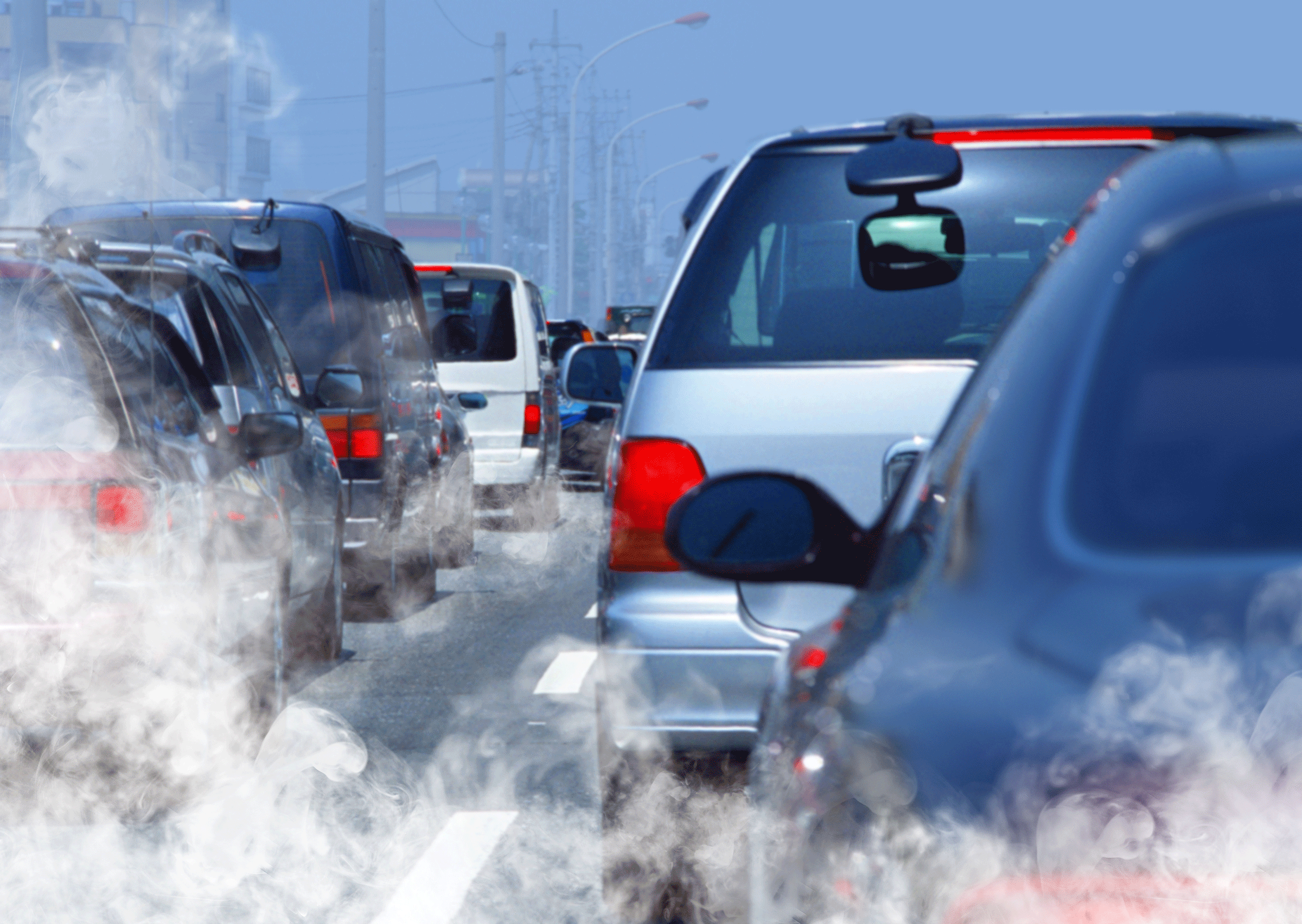 Sulfur in gasoline makes automobile engines less efficient and creates more pollutants. The US EPA has released new regulations to cut the amount of sulfur in gasoline. Dan Greenbaum from the Health Effects Institute explains how the new rules are expected to save money and prevent more than 2,000 premature deaths.
Go to page |
Download/listen
5:18
Original Show Pub Date: 07.Mar.2014
CATEGORY: CLIMATE — 10.MAR.2014
Against the Grain
Ocean Acidification—A Basic Problem —
Carbon dioxide generated by the burning of fossil fuels is being absorbed into the oceans with already serious (and potentially catastrophic) consequences for marine life and, eventually, human life. Meg Chadsey describes the phenomenon of ocean acidification and the myriad physical and civilizational threats it poses.
Go to page |
Download/listen
53:00
Original Show Pub Date: 24.Feb.2014
CATEGORY: ENVIRONMENT — 08.MAR.2014
Exploration
Our Oceans—Pollution and Plunder —
Dr. Robert Callum discusses the devastating effect human activities—some intentional, some not—are having on the health of the oceans and the sea life in them.
Go to page |
Download/listen
59:50
Original Show Pub Date: 04.Mar.2014
CATEGORY: CLIMATE, POLLUTION — 06.MAR.2014
Radio EcoShock
New Data on Methane Leaks from City Gas Systems —
Last year a team of scientists drove a truck loaded with measuring equipment around Boston and found thousands of places where natural gas (including its prime component, methane) was escaping from decaying distribution pipes. A new study shows a similar situation in Washington, D.C. Overall, methane is 25-30 times more powerful a greenhouse gas than carbon dioxide, though short-term effects are even worse. Nathan Phillips reviews the study results and discusses the risks to trees and human health, as well as the climate change risks.
Go to page |
Download/listen
20:00
Original Show Pub Date: 26.Feb.2014
CATEGORY: CLIMATE — 05.MAR.2014
Radio EcoShock
The Climate Impact of Arctic Ice Loss —
 Arctic ice expert Paul Beckwith discusses a newly released NASA study that has calculated the changing reflection of the sun's rays as sea ice increasingly diminishes during the Arctic summer. It's about 4% more heat absorbed now, compared to 1979, which doesn't sound like much, but NASA says it's huge, accounting for 25% as much global warming as all human-made fossil fuel burning.
Go to page |
Download/listen
18:00
Original Show Pub Date: 26.Feb.2014
CATEGORY: ENVIRONMENT — 03.MAR.2014
Living On Earth
Plastic Microbeads Contaminating US Waterways —
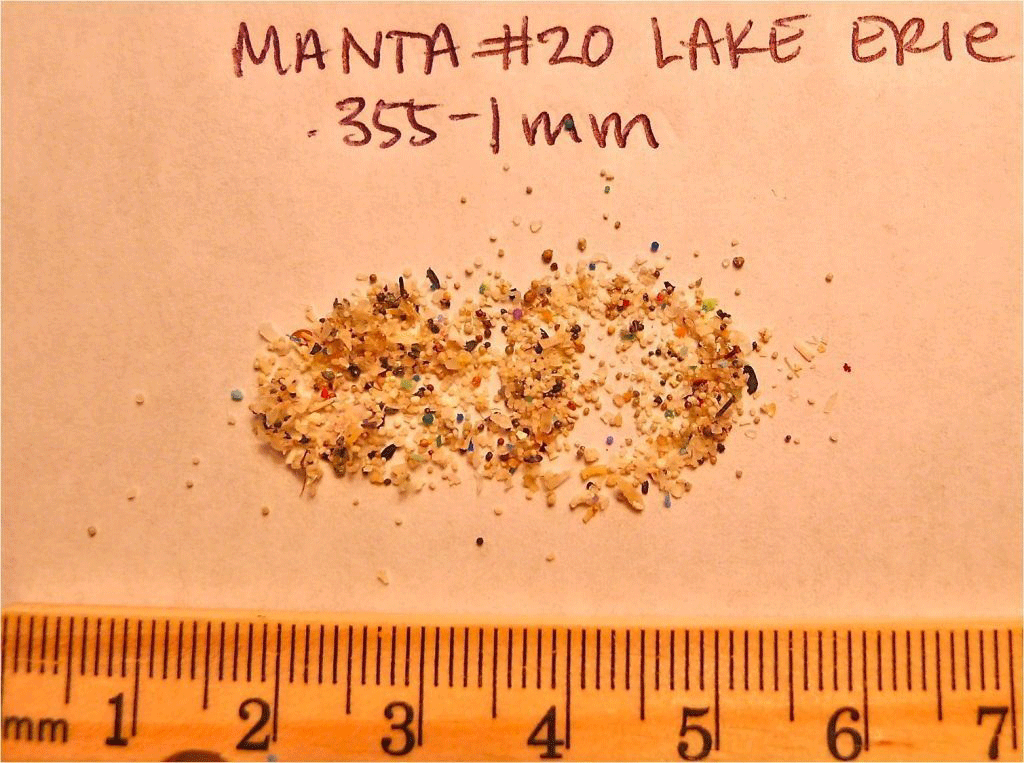 Microbeads are tiny plastic spheres found in facial scrubs and other cosmetics. Sewage treatment doesn't remove them from wastewater, so they end up in lakes and streams. As Kara Holsopple of the Allegheny Front reports, they are a hazard to fish and to anyone who might eat the fish.
Go to page |
Download/listen
5:11
Original Show Pub Date: 21.Feb.2014
CATEGORY: ENVIRONMENT (POLLUTION) — 01.MAR.2014
Democracy Now
Report Exposes Link Between Fracking and Toxic Air Emissions —
Residents who live near areas of oil and natural gas fracking have long complained that the industry's activities contaminate groundwater. A new investigation is shedding light on another concern: air quality. David Hasemyer and Lisa Song, two of the reporters who worked on the investigation, explain the findings.
Watch |
Download/listen
6:36
Original Show Pub Date: 27.Feb.2014
CATEGORY: HEALTH, CHEMICALS — 28.FEB.2014
Natural News
Mercury Toxicity and You —
Mercury toxicity expert Chris Shade explains how humans are exposed to mercury, what it does to us, and how we can avoid it. Topics include organic mercury vs. inorganic mercury vs. elemental mercury; why testing must combine urinalysis and hair analysis; synergistic toxicity between mercury, cadmium, and lead; how the dental lobby stands in the way of sensible mercury regulations; how to get rid of mercury if you have it.
Go to page |
Download/listen
45:46
Original Show Pub Date: 22.Feb.2014
CATEGORY: ENVIRONMENT, FINANCIAL, PEAK OIL — 26.FEB.2014
C-Realm Podcast
 Peak Oil, Environment, Finance, and Psycho-Social Debt —
David Holmgren has been tracking the onset of climate change and peak oil for many years, but he says that in recent years, largely due to the work of Steve Keen and Nicole Foss, he has come to see financial systems as the fastest moving and most volatile element in the emerging global crisis. Here, Holmgren offers a nuanced and apt review of the intersection between energy, finance, climate, and culture, adding to the basis for his assertion that we must collapse the financial system to preserve a livable biosphere. He also explains why he thinks that multiple generations of mass affluence has left us saddled with a "psycho-social debt" that will be very difficult for us to discharge.
Peak Oil, Environment, Finance, and Psycho-Social Debt —
David Holmgren has been tracking the onset of climate change and peak oil for many years, but he says that in recent years, largely due to the work of Steve Keen and Nicole Foss, he has come to see financial systems as the fastest moving and most volatile element in the emerging global crisis. Here, Holmgren offers a nuanced and apt review of the intersection between energy, finance, climate, and culture, adding to the basis for his assertion that we must collapse the financial system to preserve a livable biosphere. He also explains why he thinks that multiple generations of mass affluence has left us saddled with a "psycho-social debt" that will be very difficult for us to discharge.
Go to page |
Download/listen
1:00:00
Original Show Pub Date: 12.Feb.2014
CATEGORY: CORPORATIONS, CHEMICALS — 25.FEB.2014
Democracy Now
Silencing the Scientist—Tyrone Hayes on Being Targeted by Herbicide Firm Syngenta —
 Scientist Tyrone Hayes discovered that a widely used herbicide called Atrazine may have harmful effects on the endocrine system. But when he tried to publish the results, the chemical's manufacturer launched a campaign to discredit his work and threaten him with physical harm. Newly available court documents from a class action lawsuit against Syngenta show how it sought to smear Hayes' reputation and prevent the US EPA from banning the profitable chemical, which has already been banned by the European Union.
Watch |
Download/listen
17:41
Original Show Pub Date: 21.Feb.2014
CATEGORY: CHEMICALS, HEALTH — 24.FEB.2014
Living On Earth
Flouride and Other Chemical Risks —
New research finds exposure in early life to several common chemicals, including fluoride in drinking water, diminishes brain function in children. Study lead author Philippe Grandjean says fluoride, flame retardants, pesticides, and and fuel additives may be affecting children's intelligence.
Go to page |
Download/listen
6:41
Original Show Pub Date: 21.Feb.2014
CATEGORY: ENVIRONMENT — 21.FEB.2014
Living On Earth
 Using Bacteria to Heal the Desert —
Erosion is a huge problem in the dry American West. But there's hope. Soil scientist Matthew Bowker explains how bacteria can be used to help bring a living crust back to the surface of the desert.
Using Bacteria to Heal the Desert —
Erosion is a huge problem in the dry American West. But there's hope. Soil scientist Matthew Bowker explains how bacteria can be used to help bring a living crust back to the surface of the desert.
Go to page |
Download/listen
6:25
Original Show Pub Date: 14.Feb.2014
CATEGORY: COAL, POLLUTION — 18.FEB.2014
Living On Earth
Coal Ash Impoundments Threaten Water Quality —
Huge Coal ash waste ponds are commonplace at power plants in Appalachian coal country, but environmental watchdogs
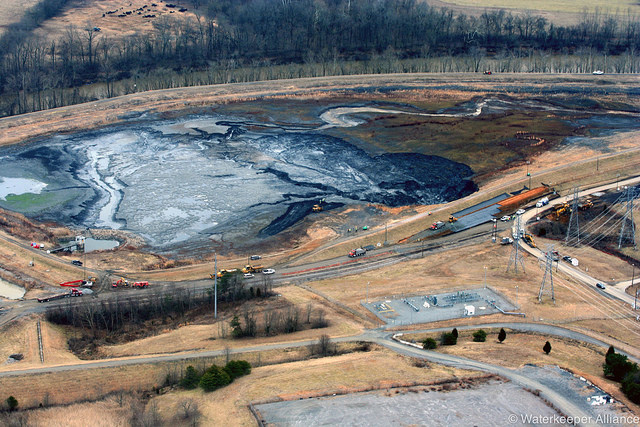 say state and federal oversight is lax. A recent spill on the Dan River in North Carolina dumped thousands of tons of toxic coal ash into the water. Amy Adams of Appalachian Voices discusses the threat of coal ash impoundments and offers some ideas for reform.
Go to page |
Download/listen
7:21
Original Show Pub Date: 14.Feb.2014
CATEGORY: ENVIRONMENT — 15.FEB.2014
Resistance Radio
Environment and "Collapse Consciousness" —
As it becomes more and more obvious that the corp-gov state has no intention of addressing increasingly urgent environmental issues, including ecosystem collapse, species extinction, ubiquitous pollution, and climate chaos, people of conscience are increasingly feeling the deep wounding that comes with awareness of how dire the predicament has become. Derrick Jensen and Carolyn Baker discuss five facets of "collapse consciousness"—fear, anger, grief, depression, and even joy—and offer ideas on how we can best navigate what's coming (and what's already here).
Download/listen
44:03
Original Show Pub Date: 09.Feb.2014
CATEGORY: ENVIRONMENT (CLIMATE) — 14.FEB.2014
NPR
Risky Tech Fixes For Climate Becoming Likelier, Critic Warns —
As the window of opportunity to address climate change through severe reduction of human-emitted greenhouse gases closes—if it's not already closed—Clive Hamilton sees a grim, potentially dangerous world ahead, where nations become desperate to confronting worsening climate-driven problems and pull the last best hope off the shelf: risky geoengineering solutions. In fact, he says, the logic of why they WILL do that is inescapable.
Go to page |
Download/listen
4:23
Original Show Pub Date: 12.Feb.2014
CATEGORY: ENVIRONMENT (CHEMICALS) — 12.FEB.2014
NPR
US Chemical Safety Board Understaffed and Largely Ignored —
The lead federal agency investigating the West Virginia chemical leak is one most Americans have probably never heard of: The US Chemical Safety Board. It's is an independent body, but critics say it is understaffed, underfunded, and takes too long to finish its investigations. An even larger problem is that its non-binding recommendations are often ignored anyway.
Go to page |
Download/listen
4:13
Original Show Pub Date: 03.Feb.2014
CATEGORY: CLIMATE, PEAK OIL, RESILIENCE — 10.FEB.2014
Radio EcoShock
Crash on Demand —
 Do we need to break the insane, rapacious financial system to save the climate? Permaculture co-founder David Holmgren says "yes." Nicole Foss counters that the system is going to crash anyway, so why set yourself up as the fall-guy or get stuck in the quagmire of climate-denier politics? We should focus on the peak-oil/resilience message. If people get onboard with that, action on climate issue will happen as a natural side-effect.
Go to page |
Download/listen
1:00:00
Original Show Pub Date: 05.Feb.2014
CATEGORY: CLIMATE — 08.FEB.2014
Radio EcoShock
Do We Have the Wisdom to Survive? —
 Anne Macksoud discusses her film, The Wisdom to Survive—-Climate Change, Capitalism & Community. She sees climate chaos as an existential threat, but recognizes that the relentless gears of capitalism must be replaced with a less destructive system if we are to get anywhere on solutions.
Go to page |
Download/listen
25:00
Original Show Pub Date: 29.Jan.2014
CATEGORY: ENVIRONMENT (POLLUTION), ACTIVISM — 07.FEB.2014
Democracy Now
Michigan Activists Face Up to Two Years in Prison for Protesting Oil Pipeline Behind 2010 Spill —
Three environmentalists have been convicted for their role in nonviolently protesting the construction of tar sands pipelines in Michigan. Last summer, they tied themselves to excavators at an Enbridge construction site to stall work on a pipeline that ruptured in 2010, dumping about 800,000 gallons of crude oil into a tributary of the Kalamazoo River. In this clip, we hear a brief statement by the protesters, then Christopher Wahmhoff of the Michigan Coalition Against Tar Sands discusses the local activism that's been bringing awareness to the problematic pipeline.
Watch |
Download/listen
6:14
Original Show Pub Date: 03.Feb.2014
CATEGORY: CLIMATE — 06.FEB.2014
Fresh Air
Entrepreneurs Looking for Windfalls as Climate Changes —
In Windfall—The Booming Business of Global Warming, journalist McKenzie Funk looks into how some entrepreneurs and even some nations stand to benefit from a changing climate. They include investors buying water rights and farmland around the world; firms offering wildfire protection services for affluent homeowners; investment houses running mutual funds designed to take advantage of financial opportunities forced by climate change; and the nation of Greenland, which will be able to exploit new mineral deposits as its ice melts.
Go to page |
Download/listen
26:13
Original Show Pub Date: 28.Jan.2014
CATEGORY: CLIMATE — 05.FEB.2014
Between the Lines
United Church of Christ Takes Leading Role in Fossil Fuel Divestment Movement —
 In the summer of 2012, environmentalist Bill McKibben challenged colleges, municipalities and religious organizations to divest their endowment or pension fund holdings from fossil fuel stocks. The first national organization to move forward with divestment was the United Church of Christ, which in June 2013 voted to divest its fossil fuel holdings. Rev. Jim Antal, who introduced the resolution, discusses his organization's decision and its practical implications for the bigger picture on climate change.
Go to page |
Download/listen
7:46
Original Show Pub Date: 29.Jan.2014
CATEGORY: ENVIRONMENT (CHEMICALS) — 03.FEB.2014
Fresh Air
How Industrial Chemical Regulation Failed West Virginia —
On January 9, 2014, people in and around Charleston, WV, began showing up at hospitals with nausea and eye infections, and some were vomiting. It was later discovered that around 10,000 gallons of a toxic chemical had leaked into the Elk River, just upstream from a water treatment plant that serves 300,000 people. After initially staying silent, the company and the WV government finally told citizens not to drink or bathe in the water. Today, some people are back to using water from their taps, but many still don't trust it or the information coming from public officials. Charleston Gazette reporter Ken Ward recaps the event, the response, the politics, and the aftermath.
Go to page |
Download/listen
36:03
Original Show Pub Date: 29.Jan.2014
CATEGORY: CLIMATE — 03.FEB.2014
Radio EcoShock
Are We Headed for the Climate Cliff? —
Does the global future look like Australia today, where the heat causes bats to fall dead out of the sky and tennis players to drop like flies? Cam Walker of Friends of the Earth Australia talks about what's going on in Australia, where the heat is affecting the economy, with some outdoor work being cancelled and some downtown streets looking like a ghost-town, as people stay home, hunkered down against the heat. Will such problems accelerate and push us over the climate cliff?
Go to page |
Download/listen
1:00:00
Original Show Pub Date: 22.Jan.2014
CATEGORY: ENVIRONMENT, RESILIENCE, FINANCIAL — 31.JAN.2014
ExtraEnvironmentalist
Green Wizards, Get Off Your Butt! —
 Americans are finding it increasingly difficult to achieve and maintain their expectations for jobs, housing, and other basic aspects of life. With the limits to growth putting basic lifestyle assumptions under assault, can people use intermediate technologies to reduce their ecological footprint, be more resilient, and find satisfaction? John Michael Greer talks about the concept of Green Wizardry, which advises development of hands-on skills as a way for a person to change their life and their culture. Then Jessica Kellner explains how people are building their own homes out of salvaged materials using lots of sweat but very little money.
Go to page |
Download/listen
1:45:36
Original Show Pub Date: 27.Jan.2014
CATEGORY: ENERGY, ENVIRONMENT — 29.JAN.2014
Living On Earth
Explosive Oil Trains —
The past year has seen a marked increase in oil train derailments and explosions, including the deadly accident in Lac-Megantic in Quebec that killed 47 people. These events have raised questions about oil transport in North America. Canadian journalist Jacquie McNish discusses.
Go to page |
Download/listen
15:06
Original Show Pub Date: 24.Jan.2014
CATEGORY: ENVIRONMENT (POLLUTION) — 28.JAN.2014
 Living On Earth
New Research Probes BP Oil Disaster —
Five million barrels of oil spewed into the Gulf of Mexico when BP's Macondo well exploded in 2010, and some oil remained suspended in the water. New research is examining why the oil behaved in such an unexpected way.
Go to page |
Download/listen
8:09
Original Show Pub Date: 24.Jan.2014
CATEGORY: ENVIRONMENT (POLLUTION, CHEMICALS) — 26.JAN.2014
NPR
Water Companies Can't Monitor All Chemicals; There Are Too Many —
The fact that a second contaminant in West Virginia's drinking water eluded detection for nearly two weeks—despite intense testing of the water—reveals an important truth about how companies test drinking water: In most cases, they only find the contaminants they're looking for.
Go to page |
Download/listen
3:26
Original Show Pub Date: 24.Jan.2014
CATEGORY: HEALTH, CHEMICALS — 23.JAN.2014
Radio EcoShock
Getting Toxics Out of Our Bodies —
Are you accumulating harmful chemicals and metals in your body? If so, what about all those magic pills and therapies to detox? Do they work? Bruce Lourie talks about how we are exposed to chemicals in food, products, and our everyday environment; what they can do to us; and how we can get rid of them. His book on the topic is Toxin, Toxout, Getting Harmful Chemicals Out of Our Bodies and Our World.
Go to page |
Download/listen
18:15
Original Show Pub Date: 15.Jan.2014
CATEGORY: ENVIRONMENT, WATER, HABITAT —
22.JAN.2014
NPR
Night of the Living Streams —
It once made sense to urban planners to put streams in pipes underground. Now, pipe decay and chronic flooding problems are causing some cities to revive above-ground portions of some waterways.
Go to page |
Download/Listen
3:17
Original Show Pub Date: 21.Jan.2014
CATEGORY: POLLUTION, MINING —
21.JAN.2014
Living On Earth
Fracking With Recycled Mine Water —
Thousands of abandoned mines in Pennsylvania are full of polluted water. Some think the fracking boom is a way to pay for cleaning up that water—by reusing it.
Go to page |
Download/Listen
5:35
Original Show Pub Date: 10.Jan.2014
CATEGORY: CLIMATE CHANGE —
20.JAN.2014
Radio EcoShock
Clouds and Climate —
A key unknown has been the behavior of clouds in a hotter world. If the future is cloudier, more sun will be blocked, helping cool the earth. But fewer clouds mean more solar energy will be soaked up by land and sea. Dr. Steve Sherwood explains new research that clears up some of the cloud-cover uncertainty. He is concerned that we are going to blow past 2 degrees of warming to a level of warming that may make life very uncomfortable.
Go to page |
Download/Listen
11:25
Original Show Pub Date: 15.Jan.2014
CATEGORY: POLLUTION, HEALTH —
18.JAN.2014
Living On Earth
Air Pollution and Diabetes —
We've long known that air pollution is bad for our lungs and can even cause cardiovascular disease, but as Doctor Sanjay Rajagopalan tells us here, recent research suggests that breathing dirty air in combination with a fatty diet can promote diabetes.
Go to page |
Download/Listen
7:10
Original Show Pub Date: 10.Jan.2014
CATEGORY: POLLUTION —
17.JAN.2014
Colbert Report
Stephen Colbert on WV
 Water Contamination —
Roughly 300,000 people in West Virginia were advised not to drink or touch their tap water because its source, the Elk River, had been contaminated by a chemical spill from a Freedom Industries' coal-cleaning operation. Stephen Colbert mines this unfortunate situation for laughs.
Water Contamination —
Roughly 300,000 people in West Virginia were advised not to drink or touch their tap water because its source, the Elk River, had been contaminated by a chemical spill from a Freedom Industries' coal-cleaning operation. Stephen Colbert mines this unfortunate situation for laughs.
Watch |
Download/Listen
4:01
Original Show Pub Date: 13.Jan.2014
CATEGORIES: ENVIRONMENT, POLLUTION, ENERGY —
15.JAN.2014
Radio EcoShock
The Awful Truth About Fracking —
As peak energy hits, fracking is the salvation plan for countries like the US, UK, Canada, and many more. Politicians take huge campaign donations from industry, slash regulations, squash local protests, and foster a new wave of water pollution and climate-killing emissions. This show examines the real cost of fracking for gas. Professor and journalist Walter Brasch reports from Pennsylvania, a hotbed of dirty fracking. Then UK energy activist Helen Rimmer explains the government's rabid push for fracking. Finally, scientist Sandra Steingraber offers a damning assessment of the true nature of fracking and its impacts.
Go to page |
Download/Listen
1:00:00
Original Show Pub Date: 08.Jan.2013
CATEGORY: CLIMATE, ENVIRONMENT —
14.JAN.2014
Lifeboat Hour
Is It Too Late for Climate Action? Is Geoengineering is All We Have Left? —
Paul Beckwith discusses some of the feedback mechanisms that are accelerating the impact of global warming, including Arctic thawing. He discusses the recent "polar vortex" in the context of overall global warming. More broadly, he says the sum of all the feedback loops is now too strong—there is no plausible way for humanity to reduce its greenhouse gases sufficiently to restore climate balance. He reluctantly sees geoengineering as the last best hope.
Download/Listen
59:03
Original Show Pub Date: 12.Jan.2014
CATEGORY: POLLUTION, HEALTH —
08.JAN.2014
NPR
California County Pushes Drugmakers To Pay For Pill Waste —
The leftover prescription drugs you have around your house are at the center of a battle between small government and big pharmaceutical companies.
Go to page |
Download/Listen
4:15
Original Show Pub Date: 03.Jan.2014
CATEGORY: POLLUTION, TRASH, SPECIES —
07.JAN.2014
Food Chain Radio
Can the Oceans Survive Our Plastic Waste? —
Charles Moore talks about plastic waste in the ocean and the health problems it's causing for marine life. There are so many microscopic bits of plastic in the ocean now it's estimated that they outnumber plankton by more than 100 to 1. Topics include the sources of plastic trash in the ocean, how plastic molecules are finding their way into our food chain, and what, if anything, can be done to reduce the damage.
Go to page |
Download/Listen
42:39
Original Show Pub Date: 21.Dec.2013
CATEGORIES: ENVIRONMENT, MUSIC —
06.JAN.2014
Radio EcoShock
Best Environmental Songs of 2013 —
Talk, talk, talk ... about environmental stuff. Here, instead of more jabbering, Alex Smith turns to DJ'ing for an hour, with his picks for the best environmental songs of the last year. Top tracks are the hilarious "Denial Tango" by the group Men With Day Jobs and Kris Kitco's excellent "Frack That Oil."
Page for full song list |
Download/Listen
1:00:00
Original Show Pub Date: 24.Dec.2013
CATEGORIES: ENVIRONMENT, MINING, RECYCLING —
04.JAN.2014
Radio EcoShock
Ugly Times for Ugly Mines —
Giant mines are operating or being developed all over the world to provide the metals that make the products that feed our consumer desires. But even in areas with environmental regulations, mines spew pollution, carve into wilderness, and leave behind heavy metals that leach into rivers and lakes for hundreds of years. Environmental lawyer Paula Maccabee discusses the fight against a proposed copper mine in Minnesota.
Go to page |
Download/Listen
1:00:00
Original Show Pub Date: 11.Dec.2013
CATEGORY: ENVIRONMENT — 29.DEC.2013
NPR
Gulf Spill Cleanup Grinds On —
Though the mainstream press has long-since forgotten about the 2010 Gulf oil disaster, the environment and people of the Gulf have not. Though oil on the beach is less of an obvious problem, the black gunk still lurks below the surface, and the aftermath is still affecting ecosystems, seafood, and livelihoods in the Gulf region.
Go to page |
Download/Listen
5:00
Original Show Pub Date: 21.Dec.2013
|